
The Best Michigan Native Plants for Fall Color
Fall Color Is More Than Flowers
There is a moment in a Michigan garden when summer begins to loosen its hold.
The days are still warm enough to spend outside, bees may still be moving among the last flowers, and a few late bloomers are doing their best to keep the season going. But around them, something else has started to happen.
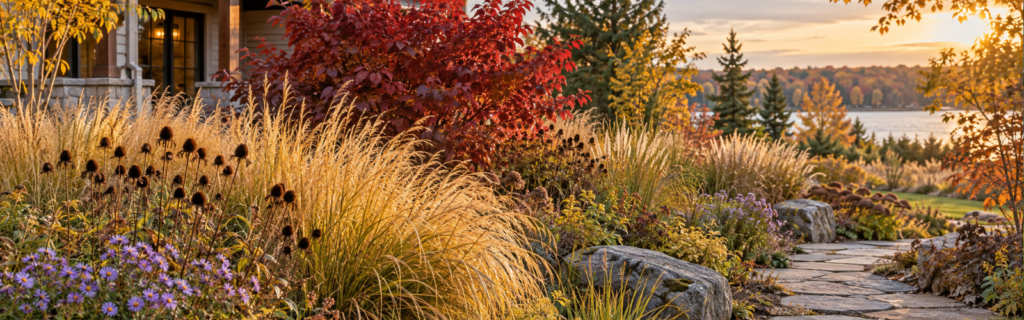
Leaves deepen. Grasses turn gold. Seed heads darken. Shrubs begin to glow red, bronze, burgundy, or yellow.
The garden is changing its palette.
When we think about fall color, it is easy to picture the spectacular autumn canopy of Michigan’s maples, oaks, and other woodland trees. But you do not need an entire forest, or even a large property, to bring that same sense of seasonal change into a native garden.
Some of the most beautiful fall color can happen much closer to the ground.
A Native Garden Should Not Peak Only Once
Many gardens are planned primarily around bloom.
We ask what flowers in May, what flowers in July, and what can keep blooming into September. Those are worthwhile questions, especially when we are trying to provide a long season of flowers for pollinators.
But flowers are only one layer of seasonal interest.
A native plant can finish blooming and still have months of visual work ahead of it. Its foliage may change color. Its stems may become more noticeable. Seed heads may catch the low autumn light. A shrub that blended quietly into the summer garden may suddenly become one of the most striking plants in the landscape.
This is one of the reasons a native garden often becomes more interesting as it matures. As we explored in Why Your Native Garden Gets Better Every Year, the garden gradually becomes more than a collection of individual plants. Layers begin to interact, and seasonal changes become easier to notice.
Fall is one of the seasons when that transformation is especially visible.
Think in Layers, Not Just Individual Plants
The most memorable fall gardens rarely rely on one spectacular plant.
Instead, color appears at several heights.
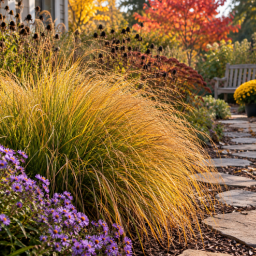
A low-growing perennial may turn warm red or bronze near the front of a planting. Taller perennials and grasses bring gold, copper, and texture through the middle. Shrubs add larger sweeps of changing foliage, while existing native trees may create the canopy above everything else.
Together, those layers make the garden feel connected to the larger Michigan landscape.
That does not mean every plant needs dramatic autumn foliage. In fact, some of the most beautiful combinations come from contrast: a deep red shrub beside tawny grasses, dark seed heads against yellowing foliage, or fading flowers standing among plants whose leaves have just begun to change.
The goal is not to make every corner bright.
It is to give the garden enough seasonal diversity that something interesting continues to happen as summer fades.
Fall Color Can Help You Plan Ahead
Autumn is also an unusually helpful time to study your own landscape.
Areas that seemed full in midsummer may suddenly reveal missing structure. A planting dominated by summer flowers may look surprisingly quiet once those flowers fade. Another area may become more beautiful than expected because foliage, grasses, and seed heads begin working together.
Before adding anything, take a few photographs.
Look at the garden from the street, from a favorite chair, and from the windows you see most often. Notice where color is concentrated, and where the garden seems to disappear once flowering slows.
That observation can guide future planting far better than choosing a plant simply because its fall photograph looks beautiful.
It follows the same principle we discussed in How to Plan for Your Fall Native Plantings: begin with what your garden is telling you before deciding what it needs.
And fall may be telling you that the next layer your garden needs is not another flower.
It may be foliage.
It may be a grass.
It may be the larger presence of a native shrub, which is something we will explore even more in the next Michigan Garden article, How to Add Native Shrubs to an Existing Landscape.
For now, we can begin with the plants capable of bringing some of that changing autumn beauty into the garden you already have.
Native Plants That Bring the Garden Into Autumn
When choosing plants for fall color, it helps to think beyond finding the brightest red or deepest gold.
A plant earns its place in the garden by doing more than performing for a few weeks in October. The strongest choices contribute something earlier in the season—flowers, foliage, texture, habitat, or structure—and then offer another reason to notice them when autumn arrives.
Here are several Michigan natives that can do exactly that.
Wild Geranium — Color for the Lower Layer
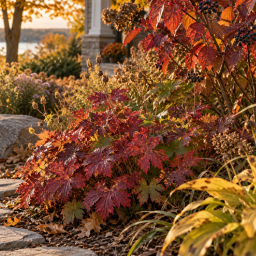
Wild geranium (Geranium maculatum) is often appreciated for its lavender-pink spring flowers, but its foliage deserves attention later in the year, too. As temperatures cool, the leaves can develop warm red and burgundy tones.
Its relatively low growth makes it especially useful beneath shrubs, along woodland edges, or toward the front of a partly shaded planting. Matthaei Botanical Gardens specifically notes wild geranium for its outstanding fall color, making it a wonderful example of a plant whose usefulness extends far beyond bloom.
This is the kind of autumn detail that may not dominate a landscape but can make the lower layer of a garden feel finished.
Prairie Drop-seed — A Fountain of Gold
For sunny, well-drained areas, prairie dropseed (Sporobolus heterolepis) brings a very different effect.
Its fine-textured foliage grows in graceful, arching clumps, typically around two to three feet tall. In fall, that green foliage shifts toward gold, often with warm orange tones. Left standing, the plant continues adding movement and structure well beyond the growing season.
Prairie dropseed works especially well where you want softness rather than bulk: along a path, repeated through a sunny border, or woven among flowering perennials.
Black Chokeberry — Bold Color in the Shrub Layer
Some of the strongest fall color in a native garden can come from the shrub layer.
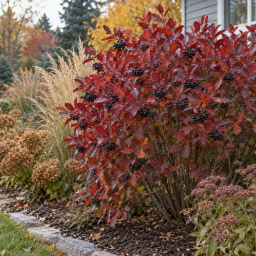
Black chokeberry (Aronia melanocarpa) is a beautiful example. Its green summer foliage can shift into brilliant shades of red in autumn, while clusters of dark purple-black fruit add another layer of seasonal interest.
Because it grows as a multi-stemmed deciduous shrub, black chokeberry can bring more visual weight to a planting than a perennial or grass alone. It can work especially well where a garden needs something substantial between the lower perennial layer and taller trees.
Rather than using it simply as a splash of fall color, think of black chokeberry as part of the garden’s structure. Placed behind lower-growing perennials or paired with golden grasses, its darker foliage and fruit can create the kind of contrast that becomes especially noticeable as summer flowers begin to fade.
It is a good reminder that sometimes the best way to extend autumn interest is not to add another flowering plant at all.
Sometimes the missing piece is a shrub.
Arrowwood Viburnum — A Shrub With Several Seasons
For gardeners wanting a more conventional shrub form, arrowwood viburnum (Viburnum dentatum) can provide interest across much of the growing season.
Its dark green foliage accompanies creamy white spring flowers and dark blue fruit later in the year, followed by fall foliage that can move through shades of yellow, red, and burgundy. Michigan State University Extension lists it among native shrubs useful in Michigan landscapes.
At roughly eight to ten feet at maturity, it is not a small foundation shrub. Give it room to become the substantial landscape plant it naturally wants to be.
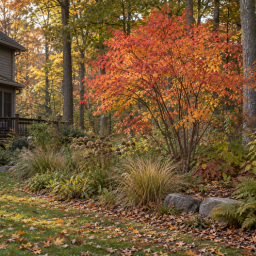
Serviceberry — Fall Color at a Taller Scale
If the garden needs something between a shrub and a full-sized shade tree, serviceberry (Amelanchier spp.) deserves consideration.
Depending on the species and form, serviceberries can function as large shrubs or small trees. They bring white spring flowers, summer fruit, and another strong season of interest when their leaves turn shades of red and gold in fall. Michigan’s Department of Natural Resources highlights serviceberry for exactly this combination of landscape beauty and wildlife value.
This makes serviceberry particularly useful where the garden needs height without the scale of a large canopy tree.
The Best Choice Depends on the Layer You Are Missing
Notice how different these plants are.
Wild geranium can brighten the ground layer.
Prairie dropseed adds fine texture and golden movement.
Smooth sumac can create a bold sweep of fiery color.
Arrowwood viburnum brings the substantial presence of a shrub.
Serviceberry carries autumn color higher into the landscape.
Rather than asking, “Which plant has the best fall color?”, look at your garden and ask:
“Where is fall color missing?”
That question will usually lead to a much better plant choice.
Designing With Fall Color
Choosing plants with beautiful autumn foliage is only part of the story.
The more important question is how those plants work together.
A garden with strong fall interest usually has a sense of rhythm. One patch of color leads your eye to another. A golden grass repeats farther down the border. A red-leaved shrub becomes more noticeable because something softer or darker grows beside it. Seed heads and fading stems add contrast instead of disappearing immediately after bloom.
That is where fall color becomes part of the design rather than simply a seasonal bonus.
Repeat Color Where It Matters
If one plant develops beautiful autumn color, consider repeating that plant, or a plant with a similar effect, in another part of the landscape.
Repetition helps the garden feel intentional.
This does not mean creating identical masses everywhere. Even two or three repeated touches of gold, burgundy, or red can visually connect different areas of the garden.
This is especially effective when those colors can be seen from places you use often: a front walkway, patio, kitchen window, or favorite chair.
Let Contrast Do Some of the Work
Fall color becomes more noticeable when it has something to contrast with.
Golden foliage can stand out beautifully against dark seed heads. Red or burgundy leaves become stronger beside soft tan grasses. A shrub with changing foliage may become the focal point of an area that seemed relatively quiet in summer.
This is another reason not to clear the garden too quickly.
As flowering slows, stems, grasses, seed heads, and changing leaves begin interacting in ways that were not visible earlier in the season. The garden may look less colorful in the traditional sense, but often more layered.
That shift is worth allowing.
Design for the View, Not Just the Plant
One of the simplest ways to improve fall interest is to step away from the planting bed.
Look at it from across the yard.
Then look from inside the house.
A plant that seems impressive when you are standing beside it may barely register from twenty feet away. On the other hand, a shrub or grass with strong autumn form may become surprisingly important when viewed from a distance.
Fall is a good season for discovering which parts of the landscape need more structure.
It is also a reminder that adding seasonal interest does not always mean adding more flowers.
Sometimes the garden needs a stronger middle layer.
Sometimes it needs repetition.
And sometimes it needs a shrub.
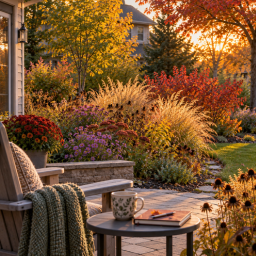
Barbara’s Observation
One of the things I appreciate most about autumn is how clearly it reveals the structure of a garden.
Summer flowers can be generous. They fill space, draw attention, and sometimes hide what is happening underneath.
Fall is different.
As the blooms begin to fade, I notice the shapes of plants more. I notice which shrubs anchor an area, which grasses catch the light, and which corners suddenly seem empty.
It feels less like the garden is ending and more like it is showing me its framework.
And that can be one of the most useful things the garden teaches us all year.
Complimentary Garden Journal
Fall color is especially interesting when you watch the same garden over several weeks.
You might notice one plant beginning to change while another stays green much longer. You may discover that a view from the house becomes more beautiful in October than it was in July.
The Michigan Native Garden Journal can help you record those changes—what colors appear, where they appear, and which combinations you would like to remember for future planting.
COMPLIMENTARY FIRST MONTH
The Michigan Native Garden Journal
↓ GET YOUR COPY ↓
Observe • Discover • Wonder • Grow
Even a few notes and photographs this fall can become useful information when you begin planning next year.
Keep Exploring
If you would like to continue building a garden with stronger seasonal interest, you may also enjoy:
- Why Your Native Garden Gets Better Every Year
- How to Let Your Native Garden Fill in Naturally
- How to Plan for Your Fall Native Plantings
- Why Fall Is One of the Best Times to Plant Michigan Native Plants
- Learning How to Trust Your Native Garden
Each of these looks at a different part of the same larger idea: learning to work with the garden as it changes rather than expecting it to look the same throughout the year.
What’s Next
Choose one place you see often—a front window, patio, walkway, or favorite chair—and look at that view specifically for fall interest.
What is carrying the scene now?
A shrub?
A grass?
Seed heads?
Changing foliage?
And where does the view seem to lose structure?
That one observation may tell you more about what to plant next than any plant list can.
Coming Next:
Fall does more than reveal color.
It can also show us which perennials have outgrown their space, where a planting has become crowded, and which plants might be better positioned somewhere else in the garden.
In the next Michigan Garden article, How to Divide and Move Native Perennials in Fall, we’ll look at when dividing makes sense, how to move plants with less stress, and what to consider before giving an established perennial a new place to grow.