
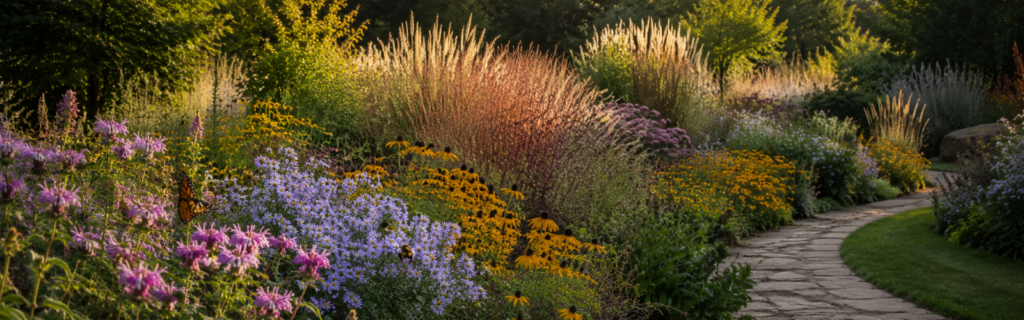
Learning How to Trust Your Native Garden
When the Garden Stops Looking Like a Plan
There comes a point in almost every native garden when the gardener begins to wonder whether something has gone wrong.
A plant appears where you do not remember putting it. Another grows wider than expected. A once-visible patch of soil begins disappearing beneath stems and leaves. One species seems especially enthusiastic while another quietly settles into the background.
The garden you carefully planned begins making decisions of its own.
For gardeners who are accustomed to traditional landscapes, where plants are expected to remain neatly separated and the gardener continually restores everything to its intended place, this can feel uncomfortable.
But in a native garden, change is not necessarily a sign that the design is failing.
Very often, it is evidence that the garden is beginning to function.
A Native Garden Is Not a Static Picture
When we first plant a garden, we naturally see individual plants.
One coneflower here.
A clump of little bluestem there.
Perhaps a few asters, woodland plants, or sedges filling another area.
We arrange them according to the space available and the conditions we understand at the time.
But plants do not experience the garden as a drawing on paper.
They respond to light, moisture, soil, competition, weather, and the plants growing around them.
Some slowly enlarge.
Some form colonies.
Some release seeds that germinate nearby.
Others may shift slightly from where we originally imagined they would remain.
That gradual change is one of the reasons native gardens can become more interesting with age.
In Why Your Native Garden Gets Better Every Year, we explored how native gardens develop through time rather than reaching some perfect finished moment immediately after planting. Learning to trust the garden is another part of that same process.
The gardener begins moving from constantly directing the garden toward occasionally allowing the garden to reveal what works.
The Difference Between Change and a Problem
Trusting your garden does not mean ignoring it.
It does not mean allowing every plant to spread indefinitely or assuming that every change is automatically beneficial.
It means becoming more observant before becoming corrective.
When something changes, the first question does not always have to be:
How do I fix this?
Sometimes the better question is:
What is the garden showing me?
Perhaps one plant is spreading because that particular location provides exactly the moisture and light it prefers.
Perhaps another plant remains smaller because nearby plants are creating more shade than they did two years ago.
Perhaps an area that once looked empty is gradually filling as plants mature and seedlings establish.
That process connects closely with How to Let Your Native Garden Fill in Naturally. Space between young plants can look unfinished at first, but some of that space exists because the garden has not yet reached its mature rhythm.
If we respond too quickly, we can interrupt a process that was beginning to solve the problem for us.
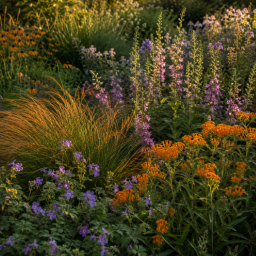
You Do Not Have to Control Every Inch
One of the most freeing lessons in native gardening is realizing that a successful garden does not require constant intervention.
Traditional gardening sometimes teaches us to notice anything unexpected and immediately correct it.
Native gardening asks for something slightly different:
Notice first.
Watch a little longer.
Then decide.
A volunteer seedling may be welcome.
A spreading plant may be creating exactly the ground coverage you hoped for.
A slightly irregular edge may soften the planting in a beautiful way.
And plants weaving together may be creating the layered structure we discussed in How to Create Garden Rooms with Native Plants.
The garden may be becoming less like a collection of separate specimens and more like a community.
That shift can feel unfamiliar because the gardener is no longer making every decision alone.
Trust Comes From Paying Attention
The easiest way to trust a garden is not to become less involved with it.
It is to become more observant.
Over time, you begin recognizing patterns.
You notice which plants remain where you put them and which tend to wander.
You learn where soil stays moist longest after rain.
You see which plants lean toward openings in the sunlight.
You begin recognizing which combinations look increasingly natural together.
And perhaps most importantly, you start noticing that many changes you once might have considered problems eventually become part of what makes the garden feel established.
A native garden can teach patience in a very practical way.
Not every open space needs to be filled today.
Not every seedling needs to be moved.
Not every plant that grows beyond its original boundary needs to be cut back immediately.
Sometimes the most useful thing a gardener can do is watch one more season.
When to Leave It, Guide It, or Step In
Trust becomes easier when you have a way to evaluate what you are seeing.
A native garden does not need to be left entirely on its own, but it also does not need constant correction. Most garden changes fall somewhere between those two extremes.
A useful way to think about it is this:
Leave it. Guide it. Intervene.
The goal is not to remove yourself from the garden. It is to respond in proportion to what is actually happening.
Leave It When the Garden Is Simply Maturing
Many changes are normal signs of establishment.
A plant broadens.
A few seedlings appear nearby.
Stems begin leaning into neighboring plants.
Bare soil becomes less visible.
Plant combinations become fuller than they looked in the first year.
These are often reasons to watch rather than act.
If the plants are healthy, the area is still functioning well, and no species is overwhelming everything around it, the garden may simply be settling into itself.
This is especially important in younger native gardens. Plants frequently need several growing seasons before their mature size and behavior become clear.
What looked like too much open space in the first year may feel entirely different by the third.
Before adding, moving, or removing something, ask:
Is this actually a problem, or is the garden just becoming more established?
Sometimes the correct answer is to leave it alone.
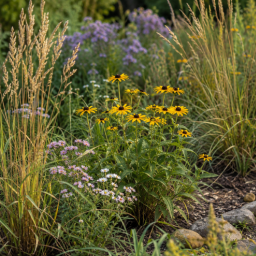
Guide It When a Small Adjustment Is Enough
Trust does not require passivity.
There are times when the garden is moving in a good direction but could benefit from a little help.
Perhaps one plant is beginning to crowd a smaller neighbor.
Maybe a self-seeded plant appeared in a place where it would work better a few feet away.
A clump may be leaning heavily into a path.
Or a garden edge may be losing enough definition that the planting begins to feel less intentional.
These situations do not always require major changes.
You might:
- relocate a volunteer seedling
- divide a spreading clump
- trim back growth encroaching on a walkway
- strengthen an edge
- create a little breathing room around a slower-growing plant
- remove only part of an expanding colony
This is garden guidance rather than garden control.
You are responding to what the plants are doing without trying to force them back into the exact positions they occupied when first planted.
Structure can remain visible even as plants become fuller and more natural within it.
Intervene When One Plant Begins Taking Over
Some native plants are naturally vigorous.
That is not a flaw.
In the right place, a spreading or colony-forming plant can be extremely useful. It may cover soil, compete with unwanted plants, fill a larger area, or create habitat.
But vigorous growth still needs to match the space available.
If one species begins reducing diversity by pushing out several others, moving repeatedly into paths, or expanding far beyond the area you are willing to give it, intervention may be appropriate.
This is where knowing a plant’s growth habit matters.
Some species spread primarily through seed.
Others expand through underground stems or rhizomes.
Some slowly enlarge into wider clumps.
Understanding how the plant is moving helps you decide what kind of response makes sense.
The goal is not to punish a plant for doing what comes naturally.
It is to decide whether its natural behavior fits that particular location.
If it does not, you may need to divide it, relocate part of it, reduce seedlings, or eventually choose a plant better suited to the scale of the space.
Pay Attention to What Is Disappearing
Sometimes the easiest thing to notice is the plant that is thriving.
The more important clue may be the plant that is quietly declining.
If a smaller native begins receiving less light because neighboring plants have grown taller, that relationship may need attention.
If a plant that once flowered well begins weakening over several seasons, conditions around it may have changed.
Perhaps the garden has become shadier.
Perhaps another plant is competing strongly for the same space.
Perhaps moisture patterns have shifted.
This is why trusting the garden is not the same as ignoring it.
The garden is always providing information.
The gardener’s job is to notice the relationships.
Let Volunteer Seedlings Prove Themselves
Self-seeding often makes gardeners nervous because the new plant was not part of the original plan.
But a volunteer seedling can also be useful information.
It tells you that the plant was able to reproduce under the conditions present in that particular area.
That does not automatically mean every seedling should remain.
Instead, pause long enough to ask:
Would I have planted this here if I had chosen the location myself?
If the answer is yes, consider leaving it.
If the answer is almost, move it while it is still young.
If the answer is no, remove it.
That simple approach allows natural regeneration without surrendering the overall design.
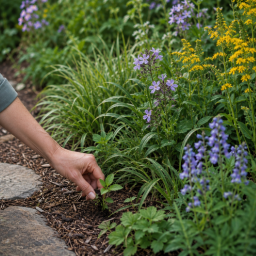
Watch for Patterns Across More Than One Season
One unusual year can be misleading.
A wet summer may cause certain plants to grow more vigorously.
A dry season may temporarily reduce flowering.
An unusually mild winter or late spring may affect timing.
Michigan gardens experience year-to-year variation, so not every change requires an immediate redesign.
Whenever possible, compare what you are seeing with what happened the year before.
Photographs can be surprisingly helpful.
So can a few notes about:
- bloom timing
- plant height
- spreading
- open spaces
- sunlight
- moisture
- which plants appear stronger or weaker
Over time, those small observations help you separate a temporary change from a repeating pattern.
And repeating patterns are much easier to trust.
Let the Garden Become More Than the Plan
There is a subtle shift that happens when you have lived with a native garden for several seasons.
At first, you notice individual plants.
Eventually, you begin noticing relationships.
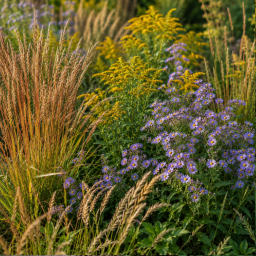
You see how one plant supports another. You recognize where grasses soften the edge of a planting, where taller stems create shelter behind shorter flowers, where seedlings naturally find openings, and where plants have begun forming combinations you never deliberately designed.
The garden stops feeling like a collection of things you planted.
It begins feeling like a place.
Keep the Structure, Loosen the Grip
Trusting a native garden does not mean abandoning design.
Structure still matters.
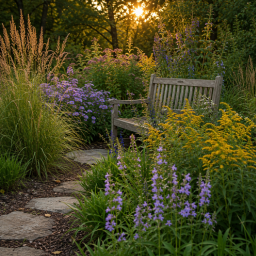
A defined path, a strong edge, an intentionally placed shrub, a garden room, a bench, or another recognizable feature can provide the visual framework that allows the planting within it to become more relaxed.
That balance is especially useful in residential landscapes.
The structure tells us the garden is cared for.
The plants are allowed to tell the rest of the story.
This is one reason the principles from How to Create Garden Rooms with Native Plants work so beautifully with a more natural planting style. When the larger spaces feel intentional, every individual plant does not have to remain perfectly controlled.
Leave Room for Surprise
Some of the most interesting moments in a garden are the ones we never planned.
A flower appears beside a grass where the two happen to look beautiful together.
A plant fills an awkward gap.
A seedling establishes in a place that turns out to suit it better than the original location.
A once-small planting begins connecting with another and suddenly the garden feels fuller.
Not every surprise should stay.
But every surprise does not need to disappear either.
Before changing something simply because it was unexpected, give yourself permission to look at it.
Does it work?
Does it improve the planting?
Does it create a problem?
Or does it simply look different from what you originally imagined?
That pause is where trust begins.
Your Garden Does Not Need to Stand Still to Be Successful
We sometimes judge gardens as though there should be a moment when they are finally finished.
Native gardens remind us that there really is no such moment.
Plants grow.
Light changes.
Weather varies.
Seeds move.
Wildlife visits.
Some plants become more prominent while others quietly occupy smaller roles.
The garden you see this year will not be exactly the garden you see three years from now.
That is not something we need to prevent.
It is something we can learn to work with.
The goal is not to create a garden that never changes.
It is to create one that can change well.
Barbara’s Observation
I think one of the greatest lessons a garden can teach us is that attention and control are not the same thing.
The more closely I observe a garden, the less interested I become in making every plant behave exactly as I expected.
Sometimes the garden makes a better choice.
A plant finds the light.
A seed settles into an open space.
Two plants grow together in a way I would not have thought to arrange them.
And sometimes I still step in.
But I want that decision to come after I have noticed what is happening—not simply because something changed.
Perhaps trusting a native garden is really learning when to garden with it instead of always asking it to follow the plan.
Continue the Observation in Your Garden Journal
This is a wonderful topic to follow over more than one season.
Choose one area of your native garden and photograph it now. Make a few notes about what is spreading, where open spaces remain, which plants are growing together, and anything that surprises you.
Then return to the same place later.
You may discover that something you were tempted to change simply needed more time.
COMPLIMENTARY FIRST MONTH
The Michigan Native Garden Journal
↓ GET YOUR COPY ↓
Observe • Discover • Wonder • Grow
Keep Exploring
If you would like to continue exploring how a native garden develops over time:
- How to Let Your Native Garden Fill in Naturally
- Why Your Native Garden Gets Better Every Year
- How to Create Garden Rooms with Native Plants
Each explores a different part of the same larger idea: creating a garden with enough intention to feel designed and enough flexibility to become something richer over time.
What’s Next
Choose one thing in your garden that you have been thinking about changing.
Before you move it, divide it, cut it back, or fill the space around it, simply observe it for a little while longer.
Ask yourself:
Is there actually a problem here, or is this simply different from what I expected?
You may still decide to make the change.
But you will be making it because you understand the garden better, not simply because the garden surprised you.
Coming Next
How to Create Spaces Where Wildlife Feels Safe
Once we begin trusting the way a native garden grows and changes, the next step is to look at the garden from another perspective: the wildlife using it.
In our next Michigan Garden article, we’ll explore how plant layers, shelter, quiet corners, cover, and thoughtful garden structure can help create spaces where birds, pollinators, and other garden visitors are more likely to feel protected enough to stay.