
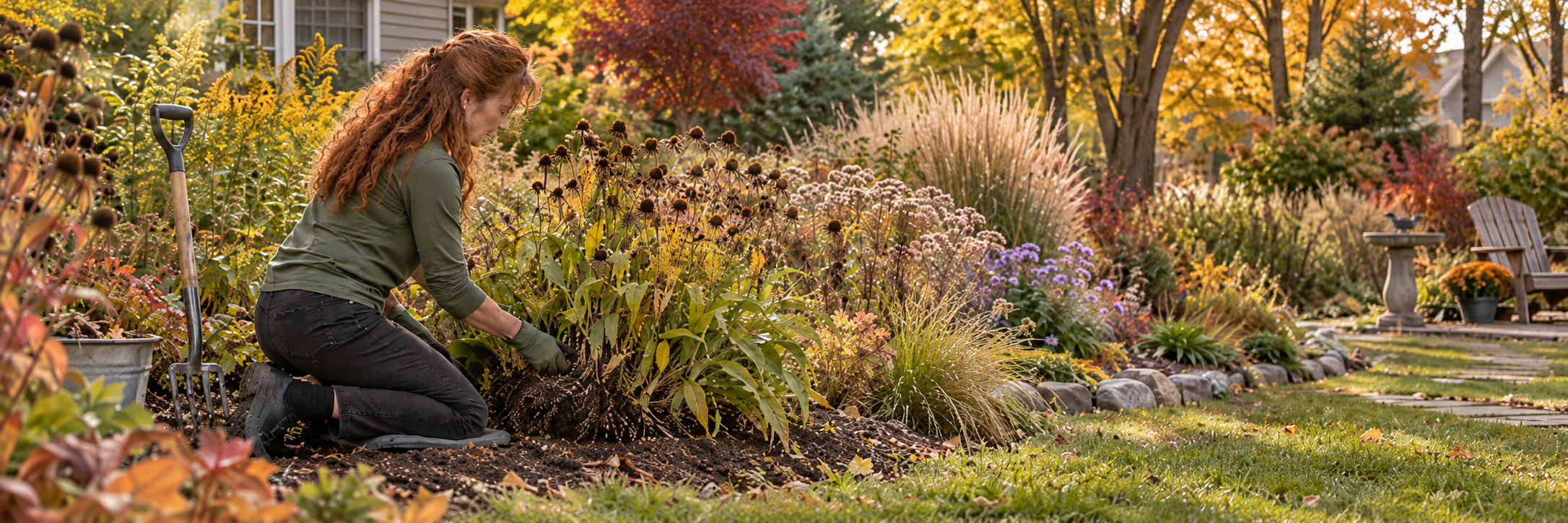
How to Divide and Move Native Perennials in Fall
There comes a point in almost every established native garden when something begins to feel a little crowded.
A clump that once fit comfortably beside the path has slowly widened. A plant you loved in one corner would solve a problem beautifully somewhere else. Perhaps one part of the garden has filled in so well that you realize you already have many of the plants you need, you simply need to move some of them.
Fall can be a wonderful time to make those adjustments.
But dividing native perennials is not something every plant needs simply because it has been in the ground for a few years. In a garden where plants are encouraged to settle in, spread naturally, and develop into communities, sometimes the best decision is to leave an established plant exactly where it is.
The real question is not, “Is it time to divide my perennials?”
It is, “What is this particular plant, and this particular garden, telling me?”
Division Is a Garden Tool, Not a Routine Chore
Traditional perennial gardening sometimes treats division almost like a maintenance schedule: every few years, dig up the clump, split it apart, and start again.
A native garden can ask us to think a little differently.
Some native perennials gradually form larger clumps. Others spread through underground stems, seedlings, or nearby offsets. That natural expansion may be exactly what you hoped for, especially if your goal is a fuller planting that shades soil, reduces open gaps, and creates the layered look we explored in How to Let Your Native Garden Fill in Naturally.
So size alone is not necessarily a reason to divide.
Instead, look at what the plant is doing within the space around it.
Has it grown beyond the area you want it to occupy?
Is it crowding a smaller neighboring plant you would like to preserve?
Has the center of an older clump begun to lose vigor?
Or do you simply have an established plant in one location that could help you repeat a color, texture, or form somewhere else?
Those are useful reasons to consider division.
And sometimes the answer will still be: not yet.
Moving Plants Can Be Part of the Design Process
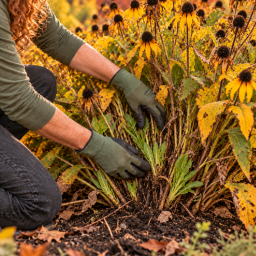
One of the nicest things about an established native garden is that it gradually begins providing some of its own plant material.
Instead of seeing every expanding clump as a problem, you can begin seeing it as an opportunity.
A division from one planting might fill a bare space farther down the border. Repeating the same plant in several places can create rhythm and help separate parts of the landscape feel connected. A perennial that has become hidden behind taller neighbors may perform better where its mature size makes more sense.
This is one reason learning to trust your native garden becomes so valuable. As we discussed in Learning How to Trust Your Native Garden, not every change requires immediately buying another plant. Sometimes the garden is already providing the solution.
Division simply allows you to redistribute what is working.
Why Fall Can Work So Well
For many spring and summer-blooming perennials, fall offers a useful window for dividing and moving plants.
The hottest part of summer has passed, cooler temperatures reduce stress, and the plant no longer needs to put most of its energy into flowering. The goal after transplanting is not to produce new blooms. It is to begin rebuilding and establishing roots before winter.
Timing matters, however.
A newly divided perennial should have a reasonable period to begin settling into its new location before the ground freezes. Because Michigan weather varies considerably from one part of the state to another, and even from one fall to the next, it is better to watch conditions than rely on one calendar date.
And fall division is not right for every species.
Plants that are blooming late in the season are often better left until spring, and some native perennials dislike disturbance once established. Before dividing an unfamiliar plant, it is worth checking the needs of that particular species rather than assuming all perennials respond the same way.
That small bit of restraint can make the difference between simply rearranging plants and actually helping the garden.
A Chance to Look at the Whole Garden
Before you pick up the shovel, take a walk.
Look for the plants that have become generous enough to share.
Look for places where repetition would strengthen the design.
Notice where one plant has outgrown its space, and where another part of the garden feels thin.
Fall division works best when it is not simply about making a plant smaller.
It is an opportunity to make the whole garden work better.
Start With the Plant, Not the Shovel
Once you have identified a perennial that might benefit from dividing or moving, the first step is still observation.
Look at the entire clump before disturbing it.
Where is the strongest growth? Is the center still healthy, or is most of the new growth occurring around the edges? Can you see natural smaller sections or offsets that could be separated from the parent plant?
And just as importantly: what plant are you working with?
Not every native perennial responds to division in the same way. Plants with fibrous or naturally clumping root systems may separate fairly easily. Others develop deeper or more specialized root systems and resent being disturbed once established.
If you are uncertain about a particular species, identify it first and check how it responds to division before digging.
Fall is generally most appropriate for spring and summer-blooming perennials that have finished flowering. Native plants that are actively blooming late into fall are usually better candidates for spring division.
Prepare the New Home First
One of the easiest ways to reduce stress on a divided plant is to minimize the amount of time its roots spend out of the ground.
Before lifting the original plant, prepare the location where the division will go.
Make sure the new site suits the plant’s existing needs for sunlight and moisture. A plant that has thrived in morning sun and moderately moist soil should not automatically be moved to a hot, dry corner simply because there is an opening there.
This is where garden observation pays off.
Rather than asking, Where do I have an empty spot? ask, Where would this plant naturally be comfortable?
Dig the new planting hole before beginning the division. If the soil is dry, watering the original plant area ahead of time can also make lifting the root system easier and reduce unnecessary stress.
Lift More Root Than You Think You Need
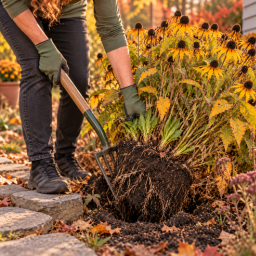
When you are ready to dig, begin several inches away from the visible stems rather than cutting immediately beside them.
Work around the plant with a garden spade or fork, gradually loosening the soil beneath the root mass. Your goal is not to remove every root intact, that is rarely possible, but to preserve as much healthy root structure as reasonably practical.
Lift the clump from beneath rather than pulling it upward by its stems.
Once it is out of the ground, gently remove enough loose soil to see what you are working with.
You may discover that the plant almost shows you where it wants to separate.
Divide According to the Root System
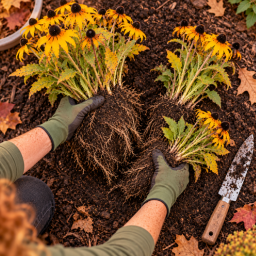
Some clumps can be gently pulled apart by hand.
Others may require two garden forks worked apart from the center, or a clean, sharp garden knife or spade.
There is no advantage to creating the greatest possible number of tiny plants.
A strong division with several healthy shoots or growing points and a good supply of roots generally has a better beginning than a very small fragment created simply to maximize the number of new plants.
If part of an older clump has become weak, woody, damaged, or hollow in the center, that section may not be the portion worth saving. Often the younger, vigorous growth around the outside of an established clump makes the more useful division.
Keep exposed roots shaded and moist while you work, and replant them promptly.
Replant at the Same General Depth
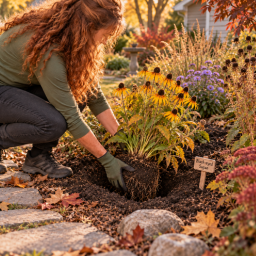
Place the division into its prepared hole so the crown, the point where stems and roots meet, sits at approximately the same soil level it occupied before.
Avoid burying the crown deeply simply because winter is approaching.
Backfill gently with the existing soil, settling it around the roots without packing it excessively. Then water thoroughly.
That first watering is important even if the air feels cool. Newly moved plants still need moisture around their roots as they begin making contact with the surrounding soil.
Continue watching soil moisture through fall, particularly if rainfall becomes scarce. Cool weather reduces water loss, but it does not eliminate a newly transplanted perennial’s need for moisture.
You Do Not Have to Move Every Division
Dividing a large clump sometimes produces more plant material than the garden actually needs.
That does not mean every piece needs to be squeezed into another opening.
Choose the strongest divisions for the places where they improve the planting. Extra healthy divisions can be shared with another gardener or used elsewhere if you have an appropriate site.
The goal is not to fill every inch.
It is to use the plants your garden is already producing with intention.
Give Newly Moved Plants Time to Settle
Once a division is back in the ground, the most important work is surprisingly simple: help it settle in and resist the urge to fuss with it.
Keep an eye on soil moisture during the weeks that follow. Fall temperatures may be cooler, but newly disturbed roots are still adjusting to their new surroundings. If rainfall is scarce, water deeply enough to moisten the root zone rather than giving the surface a quick sprinkle.
A light layer of mulch around the plant can help conserve moisture and moderate soil temperature, but keep mulch away from the crown rather than piling it directly against the stems.
The goal at this stage is not new top growth.
It is establishment below the surface.
That can make fall division feel a little anticlimactic. You may move a healthy plant, water it carefully, and then watch the foliage fade with the rest of the garden.
That is perfectly normal.
Fall is not asking the plant to impress you. It is simply giving it an opportunity to begin settling into its new home.
Let Spring Give You the Answer
One of the most useful things you can do after moving native perennials is remember where you put them.
That sounds obvious in September or October.
It becomes considerably less obvious several months later when the garden is brown, snow-covered, or just beginning to wake up.
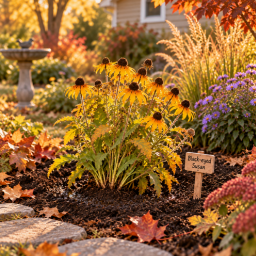
A simple plant marker, photograph, sketch, or garden-journal note can help you find each division again in spring.
Then give the plant time.
Native perennials do not all emerge at the same moment. Some appear early. Others remain quiet long after neighboring plants are growing.
Avoid deciding too quickly that a division did not survive.
Instead, watch.
Look for new shoots emerging from the crown. Notice whether the plant begins filling out as spring progresses. Compare its growth with the original plant if you left part of the clump behind.
You are gathering information that will make the next garden decision easier.
Division Can Change More Than One Plant
Perhaps the most satisfying part of dividing established perennials is seeing what happens beyond the individual plant.
One mature clump may eventually become a repeating thread through the garden.
A plant that once appeared in only one corner might begin connecting two planting areas visually. Another division may fill a troublesome opening without introducing an entirely different species. Over time, those repeated plants can make a garden feel more intentional even as it remains natural.
That is the larger opportunity hidden inside this simple fall task.
You are not merely making one plant smaller.
You are learning how to work with what your garden is already giving you.
And that can be one of the most economical, and satisfying, ways to let a native landscape evolve.
Barbara’s Observation
There is something different about moving plants that have already proven themselves in your own garden.
You know where they came from. You have watched them grow. You already understand something about how they behave.
When a small division reappears somewhere new the following spring, it does not feel quite like adding another plant.
It feels as though one part of the garden has begun a conversation with another.
Sometimes good garden design is not about continually adding more.
Sometimes it is about noticing what has grown well enough to share.
Continue the Observation in Your Garden Journal
When you divide or move a native perennial this fall, make a simple record of it.
Note the plant, where it originally grew, where you moved the division, and the date. You might also photograph the new location.
Then return to that entry in spring.
What emerged?
Which divisions established most strongly?
Did the new location suit the plant as well as you expected?
Those observations gradually become your own record of how plants behave in your garden.
COMPLIMENTARY FIRST MONTH
The Michigan Native Garden Journal
↓ GET YOUR COPY ↓
Observe • Discover • Wonder • Grow
Keep Exploring
If you are making changes to your native garden this fall, these Michigan Garden Design articles can help you look at the larger picture:
How to Let Your Native Garden Fill in Naturally — before dividing a spreading plant, consider whether its expansion is actually helping create the fuller garden you want.
Learning How to Trust Your Native Garden — a reminder that not every opening, change, or unexpected bit of growth requires immediate correction.
How to Plan for Your Fall Native Plantings — step back from individual plants and consider where the garden truly needs something added or changed.
Why Fall Is One of the Best Times to Plant Michigan Native Plants — explore what makes fall such a useful season for establishing plants before another growing year begins.
What’s Next
Before you begin dividing anything, walk through your garden and identify just one established perennial that may be ready to share.
Then ask three questions:
Is this plant truly crowded, or simply filling in naturally?
Would dividing it improve another part of the garden?
Do I already know where the new division belongs?
If the answers point toward moving it, prepare the new location first.
One thoughtful division is enough to begin.
Coming Next
Perennials are only one way to add another layer to an established garden.
Sometimes what a landscape really needs is more structure, a plant that can anchor a bed, soften a foundation, create a transition, offer seasonal interest, or help connect existing garden areas.
In our next Michigan Garden article, How to Add Native Shrubs to an Existing Landscape, we’ll look at how to introduce shrubs without feeling as though you need to redesign everything that is already working.