
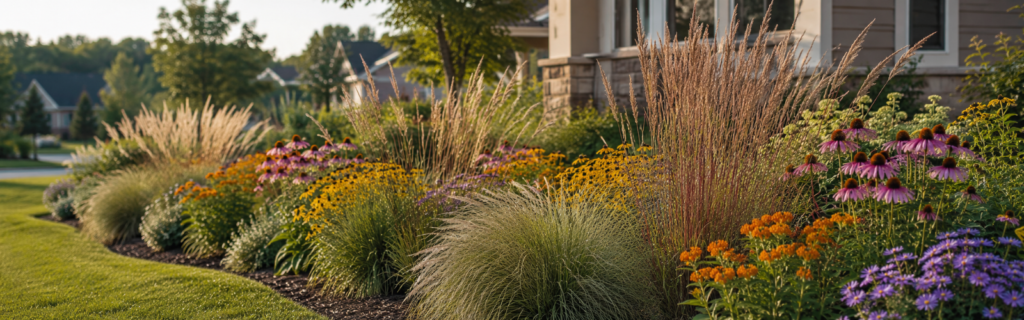
How to Use Native Grasses in Your Michigan Garden
There is something especially beautiful about a garden that moves.
A breeze passes through, flower stems nod gently, seed heads sway, and suddenly the garden feels alive in a completely different way. Native grasses bring that kind of movement to a landscape, and yet they are often one of the most overlooked elements in a Michigan garden.
When we first begin choosing native plants, it is easy to be drawn to the flowers. Purple Coneflower, Black-eyed Susan, Butterfly Weed, asters, and blazing stars naturally capture our attention.
But flowers are only part of the picture.
Native grasses help hold a garden together. They create structure between blooms, soften the edges of planting beds, provide texture throughout the growing season, and continue adding interest long after many flowers have finished blooming.
They also support the wildlife that shares our gardens.
If you have ever wondered how to use native grasses without making your landscape look like an open prairie, the good news is that you do not need a large property, or even a particularly wild-looking garden, to include them beautifully.
You simply need to understand what they can do.
Why Native Grasses Belong in a Michigan Garden
Think of a garden as a composition.
Flowers often provide the color. Shrubs and trees create the larger framework. Native grasses help connect everything in between.
Their narrow leaves and graceful forms create a visual contrast to the broader leaves and rounded flowers found throughout many perennial gardens. That difference in texture can make neighboring plants stand out even more.
A clump of Little Bluestem beside Purple Coneflower, for example, creates an entirely different effect than another flowering perennial planted in the same spot.
One provides bloom.
The other provides movement, texture, shape, and eventually beautiful fall color.
Together, they create a more complete garden.
Native grasses can also help a garden feel intentional rather than crowded. Repeating the same grass in several places throughout a bed creates a visual rhythm that gently carries your eye from one area to another.
That repetition can be especially helpful in native gardens, where many different flowers, heights, and bloom times are naturally occurring at once.
The grasses become a quiet thread tying everything together.
Native Grasses Bring Beauty Beyond the Bloom
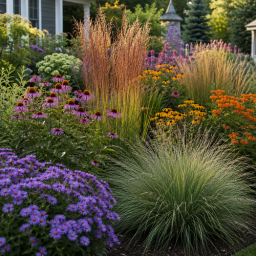
One of the greatest advantages of native grasses is that their beauty is not dependent upon flowers.
They change throughout the seasons.
In spring, fresh green blades emerge from the soil.
By summer, the grasses begin adding height, texture, and movement among blooming perennials.
As fall approaches, many native grasses develop shades of bronze, copper, red, gold, or burgundy.
And then something wonderful happens.
While much of the garden begins settling down for winter, the grasses often remain standing.
Their stems and seed heads catch frost, hold bits of snow, and glow when low winter sunlight passes through them.
A garden that might otherwise feel empty can still have shape and presence.
This is one of the reasons I encourage gardeners to think beyond bloom time when designing a landscape. A Michigan garden has four seasons, and the plants we choose can help us enjoy every one of them.
They Are More Than Decorative
Native grasses are beautiful, but their role in the garden goes much deeper.
Their foliage, stems, seeds, and root systems all become part of the small ecosystem developing just outside our doors.
Birds may use grass seeds as a food source.
Insects find shelter among the leaves and stems.
Standing grasses can provide winter cover.
And beneath the soil, extensive root systems help stabilize the ground and allow water to move into the soil rather than simply running across its surface.
Those roots are one of the hidden strengths of native grasses.
While we notice what is happening aboveground, an equally important garden is developing beneath our feet.
Many native prairie grasses evolved with remarkably deep root systems that allowed them to survive periods of drought and thrive in challenging conditions. Those same characteristics can make them valuable additions to today’s home landscapes.
Once established in the right location, many require very little attention.
That makes them especially well suited to the kind of garden I love most, one that becomes more resilient and more alive with each passing year.
Native Grass Does Not Have to Mean “Prairie”
For some homeowners, the words native grass immediately create a picture of a tall prairie stretching across an open field.
That is one way grasses can be used.
But it is certainly not the only way.
Native grasses can feel surprisingly refined when they are placed thoughtfully within a more traditional landscape.
A single clump can soften the corner of a walkway.
Three grasses repeated along the edge of a planting bed can create rhythm.
A low-growing grass can weave gently between flowering perennials.
A taller grass can provide a soft backdrop behind plants that would otherwise disappear against a fence or wall.
The difference is not whether you use native grasses.
It is how you use them.
You can design a garden that feels loose and naturalistic, neat and structured, or somewhere beautifully in between.
Choosing the Right Native Grass for the Right Place
Once you begin seeing native grasses as part of the structure of a garden rather than simply something growing between flowers, the next question becomes much easier:
Which grass belongs where?
Native grasses are not interchangeable.
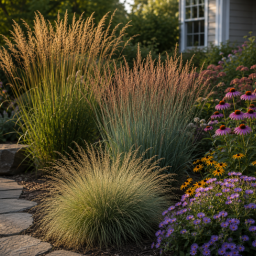
Some stay low and graceful. Others become tall enough to create a backdrop or screen. Some prefer dry, sandy soil. Others tolerate heavier or wetter conditions. Some remain tidy and compact, while others are better suited to a larger, more naturalistic planting.
The key is not finding the “best” native grass.
It is finding the right grass for the role you want it to play.
That same idea applies throughout a native landscape. Matching plants to their growing conditions is one of the simplest ways to create a garden that becomes easier to maintain over time. If you are still learning how to evaluate your site, How to Design a Simple Native Garden in Michigan is a helpful place to begin.
Here are several Michigan native grasses worth getting to know.
Little Bluestem
Schizachyrium scoparium
Little Bluestem is one of my favorite grasses for residential gardens because it offers so much without taking over the landscape.
It typically grows in upright clumps and stays narrow enough to fit comfortably among flowering perennials. During summer, the foliage has a blue-green cast. By fall, it can shift into shades of copper, bronze, orange, or reddish purple.
Even after the growing season ends, the stems often remain attractive well into winter.
Little Bluestem works beautifully when you want:
- vertical structure without a bulky plant
- warm fall color
- movement through the garden
- contrast beside broad-leaved perennials
- a grass that looks natural without looking unruly
Try it beside Purple Coneflower, Black-eyed Susan, Butterfly Weed, asters, or blazing stars.
Several of these plants are also excellent choices when your goal is to Create a Pollinator Habitat in Michigan, making Little Bluestem an easy way to add structure without sacrificing habitat value.
Repeated in small groups, Little Bluestem can also create a strong visual rhythm through a larger planting bed.
Prairie Dropseed
Sporobolus heterolepis
Prairie Dropseed has a completely different personality.
Rather than growing upright like Little Bluestem, Prairie Dropseed forms a soft, rounded fountain of fine-textured foliage.
It is one of the most graceful grasses you can add to a garden.
Its narrow leaves arch outward from the center of the plant, creating a tidy mound that works particularly well near paths, garden edges, patios, and places where you will see the plant up close.
Later in summer, delicate flowering stems rise above the foliage.
Prairie Dropseed is especially useful when you want:
- a softer edge along a walkway
- fine texture among larger-leaved plants
- an orderly, architectural shape
- a lower grass for the front or middle of a planting
- movement without a lot of height
It is also a wonderful choice for gardeners who are nervous that native grasses might look too wild.
Prairie Dropseed proves otherwise.
A few well-placed plants can look remarkably polished.
For homeowners interested in creating a native landscape that still feels tidy and intentional, the same principles I share in The Best Native Michigan Plants for Low-Maintenance Gardens apply here: choose plants with a growth habit that fits the space rather than trying to control an oversized plant later.
Switchgrass
Panicum virgatum
If Little Bluestem and Prairie Dropseed are supporting players, Switchgrass can become part of the framework of the garden.
Depending on the variety and growing conditions, Switchgrass can reach several feet tall and develop a strong upright presence.
Its airy flower and seed heads soften the height of the plant, giving it movement without making it feel heavy.
Switchgrass works especially well toward the back of a planting bed or anywhere you need more vertical structure.
Consider it when you want:
- a soft backdrop behind shorter perennials
- seasonal privacy
- height beside a fence or property edge
- a larger grass to anchor a planting
- strong winter structure
Because of its size, placement matters.
A single Switchgrass in the front of a small foundation bed may feel overwhelming.
Several placed intentionally toward the rear of a deeper planting can feel completely different.
This is one of those grasses where giving the plant enough room makes all the difference.
If your garden includes heavier soil, it is also worth looking at plants that tolerate those conditions rather than assuming your soil needs to be completely changed. The Best Native Plants That Thrive in Clay Soil offers several additional possibilities for difficult Michigan sites.
Think in Layers, Not Isolated Plants
One of the easiest mistakes to make when adding grasses is to treat each one as an individual specimen.
Instead, think about the whole garden in layers.
Taller grasses can help form the background.
Medium grasses can weave among flowering perennials.
Lower grasses can soften the front edge.
Then repeat some of those same grasses elsewhere in the planting.
That repetition creates unity.
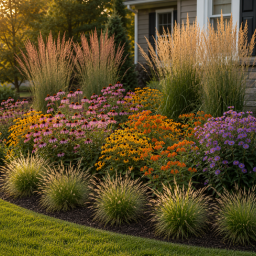
For example, imagine a sunny bed with taller Switchgrass toward the back, flowering perennials through the middle, and several Prairie Dropseed plants repeated near the edge.
Or picture Little Bluestem appearing in three different areas among Purple Coneflower, Butterfly Weed, and New England Aster.
The grasses do not need to dominate the garden.
They simply help connect it.
This layered approach is also one of the easiest ways to create a stronger pollinator habitat because it gives insects and birds more than flowers alone. Different heights, stems, seed heads, and plant forms provide additional places to feed, rest, shelter, and overwinter.
Let the Site Help You Decide
Before choosing a grass because you love how it looks in a photograph, pay attention to the conditions where you plan to plant it.
Ask:
- How many hours of sun does this area receive?
- Is the soil usually dry, average, or moist?
- How much room will the grass have at maturity?
- Do I want a tidy clump or a more naturalized effect?
- Will I see this area mostly in summer, or do I want winter interest too?
The right plant in the right place is always easier to live with.
That is especially true with native grasses.
A grass that feels too large or aggressive in one part of the garden may be exactly what another area needs.
And if your property has an especially dry or wet area, choosing plants adapted to those conditions can save you considerable frustration. The articles The Best Native Plants That Thrive in Sandy Soil and The Best Native Michigan Plants for Wet Areas can help you expand the planting around the grasses you choose.
A Simple Place to Begin
If you are new to native grasses and want to experiment without completely redesigning your garden, begin with just one or two species.
For many Michigan home gardens, Little Bluestem and Prairie Dropseed are excellent starting points.
They have very different forms, which makes them useful for different situations, yet both can fit comfortably into a residential landscape.
Place Prairie Dropseed near an edge where you can enjoy its fountain-like form.
Use Little Bluestem a little farther back, where its vertical shape can rise between flowering plants.
Then watch.
Notice how the grasses move.
Notice what they look like when nearby flowers begin fading.
Notice how the garden changes in fall.
That observation may teach you more about designing with grasses than any plant list ever could.
Once you have chosen the grasses that fit your site, the final step is deciding how to use them.
You do not need many different species to create a beautiful effect. In fact, repeating just one or two grasses throughout a planting often creates a stronger design than scattering many different varieties.
Let the Garden Evolve
Native grasses change the feeling of a garden gradually.
The first season may be subtle.
By the second or third year, their shape, movement, fall color, and winter structure become much more noticeable.
Resist the urge to judge the planting too quickly.
Watch how the grasses interact with the plants around them.
Notice where the garden feels balanced and where it may need another repeated clump.
A native garden does not have to be designed perfectly all at once.
It can evolve.
And sometimes, one well-placed grass is enough to make an entire section of the garden feel complete.
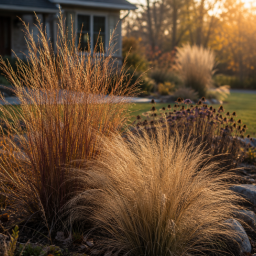
🌿 Barbara’s Observation
Native grasses have changed the way I look at a garden.
Flowers naturally draw our attention first, but grasses often provide what we do not immediately realize is missing—the movement, texture, repetition, and structure that allow everything around them to feel more complete.
And they ask us to notice the garden differently.
Watch Little Bluestem as its summer foliage begins changing color. Notice the way Prairie Dropseed moves in even the slightest breeze. Leave seed heads standing and see how different they look covered with frost or holding the first light snow.
And there are so many more Michigan native grasses to introduce to your garden.
Simple may be best in the beginning.
Native grasses remind us that a garden is not a still picture.
It is always becoming something else.
Take Your Observations Into the Garden
One of the best ways to understand your garden is to spend time observing it before deciding what needs to change.
That idea is at the heart of The Michigan Native Garden Journal.
My complimentary First Month edition gives you a place to slow down, notice what is happening in your landscape, and begin recording the small changes that are easy to miss from one week to the next.
⬇Download Your Complimentary Copy of The Michigan Native Garden Journal – First Month⬇
Use it to record what is blooming, what is visiting, what is changing, and even where a native grass might someday belong.
Coming Next:
How to Create Small Water Features for Wildlife
A garden does not need a pond to offer wildlife a dependable source of water.
In the next Michigan Garden article, we’ll look at simple ways to add water to your landscape, even in a small garden.
From shallow basins and bird-friendly containers to thoughtful placement and maintenance, we’ll explore how a small water feature can support birds, pollinators, and other garden visitors while adding another layer of life and movement to your outdoor space.
Keep Exploring
If native grasses have you thinking differently about the structure of your garden, continue exploring with these Michigan Garden articles:
- How to Design a Simple Native Garden in Michigan
- The Best Native Michigan Plants for Low-Maintenance Gardens
- Best Native Plants that Thrive in Michigan Shade
- The Best Plants for Dry Soil in Your Michigan Garden
- How to Create a Pollinator Habitat in Michigan: It’s More Than Just Flowers
For additional information about native grasses and Michigan ecosystems, explore resources from trusted organizations such as: