
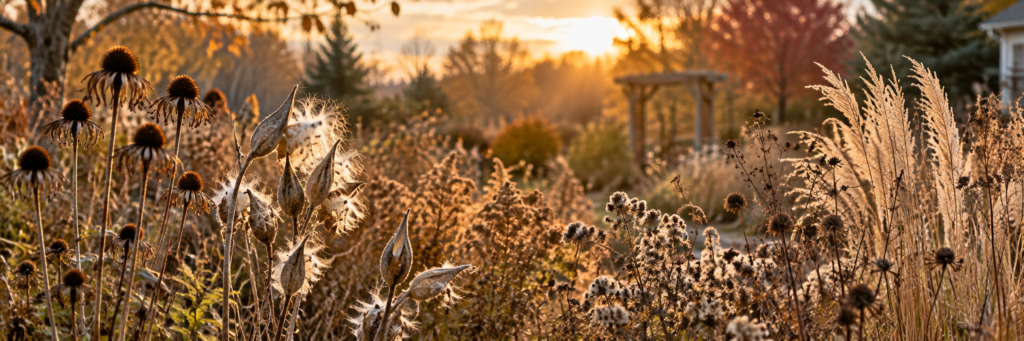
How to Unravel the Secret Life of a Seed Head
What Happens After the Flowers Fade
There is a moment in the fall garden when something subtle changes.
The flowers that held our attention through summer begin to fade. Petals loosen. Colors soften. Stems turn from green to gold and brown. And where a flower once stood, something quieter takes its place.
A seed head.
It is easy to see this as the ending of the flower. In a garden accustomed to being tidied, it may even look like something that has finished its work and is ready to be removed.
But a seed head is not simply the remains of a flower.
It is one of the most fascinating stages in the life of a plant.
Nature Notes is meant to invite us to slow down long enough to notice details like these, to look beyond what is immediately beautiful and discover what the garden is doing when we are no longer watching for blooms.
The Flower Has Changed Its Purpose
Throughout the growing season, a flower may be busy attracting pollinators. Once pollination has taken place, its job begins to change.
Petals are no longer necessary.
Instead, the plant turns its energy toward developing and protecting seeds.
That transformation can produce remarkably different structures. Some seed heads become firm cones. Others form papery clusters, slender pods, bristly spheres, fluffy tufts, or tiny capsules that seem almost designed to be overlooked.
Look closely at several plants growing beside one another and you may realize that the garden has developed an entirely new collection of shapes.
What appeared uniform when everything was green and flowering can become surprisingly individual after bloom.
And those differences are not merely decorative. They often reflect different ways plants protect, hold, and eventually release their seeds.
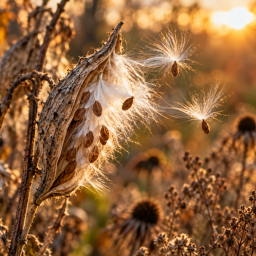
A milkweed pod can split open and reveal seeds equipped with silky fibers that catch the wind. Other plants hold their seeds more tightly, releasing them gradually as weather, movement, or hungry birds disturb the aging flower head.
Rather than thinking of the seed head as a flower that has died, it may be more useful to see it as the flower entering its next form.
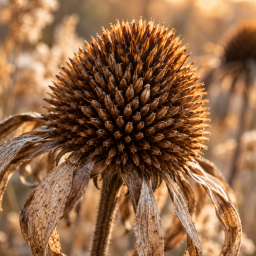
A Small Storehouse in the Garden
For wildlife, those fading plants can also remain useful long after their petals disappear.
That means the brown seed head you might once have clipped away may still be participating in the garden.
A goldfinch can balance on a narrow stem and pick seeds from it.
Wind can shake loose another handful.
Snow can settle around the remaining structure while some seeds stay tucked inside.
The garden has not stopped working simply because flowering has stopped.
Look Again Before You Cut
This is where seed heads begin to change the way we see an autumn garden.
The question becomes less:
Is this plant finished?
And more:
What is happening here now?
You may notice that one seed head disappears almost immediately while another persists for months. One may become a favorite feeding place for birds. Another may release its seeds on the first windy afternoon. A sturdy stem may remain standing through snow while a neighboring plant quietly collapses into the leaves below.
Noticing those differences can teach us something that a plant label rarely does.
It reveals how the plant behaves after bloom.
Sometimes the most interesting part of a flower begins after most people have stopped looking at it.
Every Seed Head Has a Story to Tell
Once you begin looking closely at seed heads, it becomes difficult to see them as simply “spent flowers.”
They are too different from one another.
Some are tight and architectural. Others are loose and feathery. Some hold their seeds deep inside a pod or capsule, while others seem to offer them openly to the wind.
And each form hints at a different strategy.
Some Seeds Are Built for the Wind
A milkweed pod is perhaps one of the easiest examples to recognize.
As the pod matures and opens, rows of brown seeds appear, each attached to a soft tuft of silky fibers. On a dry, breezy day, those fibers catch the air and lift the seed away from the parent plant.
It can feel almost magical when you watch it happen.
But the structure has a purpose.
The seed does not need to fall directly beneath the plant that produced it. Wind gives it a chance to travel farther before eventually settling somewhere new.
Other plants use different versions of the same idea.
Some seeds are light enough to drift. Others have fine hairs or bristles that help them catch moving air. What looks delicate or decorative to us can be part of the plant’s dispersal strategy.
That is one of the reasons a dry seed head can be worth studying before it is cut away.
You may be looking at the beginning of the plant’s next journey.
Others Hold On
Not every plant releases its seeds quickly.
Some seed heads remain standing well into fall or winter, gradually loosening their contents over time.
Wind may shake a few free.
Rain may soften the structure.
Snow and ice may bend the stem.
A bird may land and pull seeds directly from the head.
This slower release can make an aging perennial surprisingly active long after flowering has ended.
That is also why leaving some seed heads standing can matter.
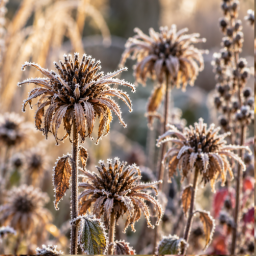
What Does a Mature Seed Head Look Like?
This is where observation becomes especially useful.
A seed head that looks brown is not automatically ready.
Seed maturity varies by species.
Instead of relying on one date, look for changes.
A mature seed head may become:
- noticeably drier
- firmer or more brittle
- darker in color
- easier to open
- more willing to release seeds when touched or shaken
Some pods begin to split naturally.
Some seeds separate easily from the head.
Others remain tightly held until later in the season.
The most useful habit is not memorizing one rule.
It is learning what the plant looks like as it moves from flower, to developing seed, to maturity.
Seasonal timing can also vary across Michigan, so “mid-September” in one part of the state may not look the same farther north or near the Great Lakes shoreline. Flexible observation is often more useful than a calendar date.
A Seed Head Is Not Always Asking to Be Collected
Once gardeners begin noticing seeds, the next instinct is often to gather them.
Sometimes that makes sense.
But Nature Notes invites a different question first:
What happens if I leave this one alone?
Perhaps the seeds will disappear into the garden.
Perhaps birds will find them.
Perhaps the plant will self-seed nearby.
Perhaps very little will happen at all.
Each possibility tells you something.
Leaving even a few seed heads standing gives you the opportunity to watch those relationships unfold instead of stepping in immediately.
That is especially valuable in a native garden, where part of the beauty lies in allowing natural processes to remain visible.
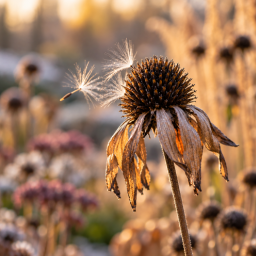
Choose One and Follow It
You do not need to study every plant in the garden.
Choose one seed head.
Look at it today.
Then look again in a few days.
Notice whether its color changes.
Touch it gently and see whether it feels dry or flexible.
Watch for birds.
Look for seeds on the ground nearby.
See whether the head remains standing after a windy day.
Over time, something that once looked ordinary begins to feel more like a small seasonal story.
And once you learn to see that story in one plant, you begin recognizing it everywhere.
What Remains Is Still Part of the Garden
By late fall, the garden can look very different from the one we admired in July.
The bright flowers are mostly gone. Stems have darkened. Seed heads stand above fading foliage. Some plants lean into one another. Others hold their shape surprisingly well.
To an eye trained to look for bloom, this can seem like a garden that has finished.
But it has not.
The garden is simply expressing itself differently.
Winter Beauty Is Built From What We Leave Behind
Seed heads bring something to the winter garden that flowers cannot.
Structure.
Their silhouettes catch low light. Frost outlines their edges. Snow settles into their shapes. A dried coneflower or grass seed head can become more noticeable against a quiet winter background than it ever was among the abundance of summer.
This does not mean every stem must stay standing or that a garden should never be edited.
It means we have another option besides removing everything simply because flowering has stopped.
A few strong seed heads left in the right places can give a garden presence long after the growing season has slowed.
And once you begin seeing them this way, brown is no longer merely the color of something finished.
It becomes part of the season.
The Garden Is Still Being Used
Those standing plants may also continue to have value beyond what we see.
Seeds can remain available to birds. Hollow or pithy stems may contribute to overwintering habitat for insects. Fallen material becomes part of the layer of life closer to the soil.
The important lesson is not that every dried plant must remain untouched.
It is that fall cleanup does not need to happen automatically.
Sometimes the most thoughtful thing we can do is notice first.
Which seed heads are holding their shape?
Which ones are being visited?
Which plants collapse naturally?
Which ones become more beautiful once frost arrives?
Those answers can help determine what stays and what eventually goes.
Let the Garden Finish Its Own Sentence
Perhaps that is the real secret life of a seed head.
It reminds us that the garden’s story does not stop where we usually place the ending.
A flower fades, but the plant continues.
Seeds mature.
Birds arrive.
Wind moves through dry stems.
Snow changes their shapes.
And eventually, some of those seeds may become the beginning of another season.
There is something reassuring about that rhythm.
What looks like an ending from one point of view may simply be a transition we have not learned to recognize yet.
Barbara’s Observation
I think seed heads are one of the garden’s best reminders that beauty is not always asking to be noticed.
Flowers announce themselves.
Seed heads do something quieter.
They ask us to come closer.
The more time I spend in my garden, the more I appreciate those quieter stages, the moments when nothing dramatic seems to be happening, yet the garden is still changing, feeding, releasing, sheltering, and preparing for what comes next.
Sometimes the most interesting garden is the one we almost cleaned away.
COMPLIMENTARY FIRST MONTH
The Michigan Native Garden Journal
This is a perfect time of year to choose one plant and follow its seed head through the season.
Record when the flower fades. Notice when the seed head dries. Watch for birds, wind, snow, or seeds beginning to fall. Then return to your notes next year and see what you notice differently.
The Journal works especially well for seasonal observations like these because it gives you a place to notice the small changes that are easy to forget once another season begins.
GET YOUR COPY ↓
Observe • Discover • Wonder • Grow
Keep Exploring
If this article has you looking at the fading garden differently, continue exploring Michigan Garden Design articles about:
- How to Save Native Flower Seeds for Next Year
- How to Let Your Native Garden Fill in Naturally
- The Best Native Plants that Feed Goldfinches
- How to Create Spaces Where Wildlife Feels Safe
Each one builds on the same idea: a garden is doing far more than we can see at a glance.
What’s Next
Choose one seed head in your garden and leave it standing.
Do not collect it yet.
Do not cut it down.
Just watch it.
Return to it after wind, rain, frost, or snow and notice what has changed.
You may discover that the most interesting part of the plant’s season begins after the flower is gone.
Coming Next
Next in Nature Notes, we’ll turn our attention from what remains standing to what has fallen beneath our feet.
Those autumn leaves may look like something waiting to be cleaned up, but they are part of another seasonal story happening quietly in the garden.
In our next Nature Notes article, we’ll explore what fallen leaves become, who may be using them, and why leaving at least some of them in place can change the way we think about fall garden care.