
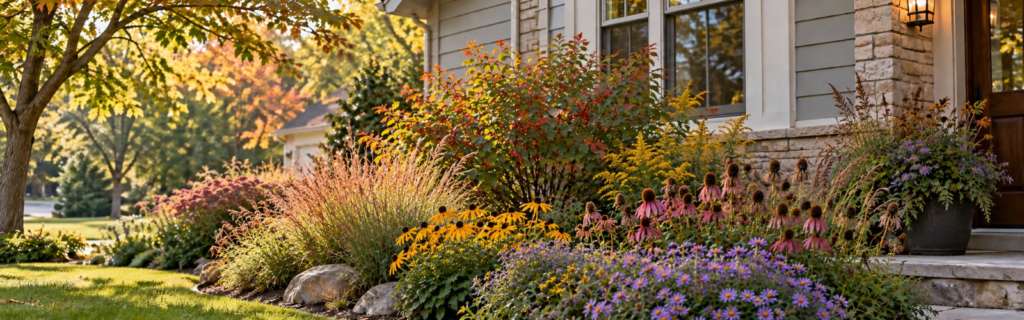
How to Add Native Shrubs to an Existing Landscape
Adding native plants to an established landscape does not always mean creating another flower bed.
Sometimes the most useful addition is a shrub.
A native shrub can quietly solve several garden challenges at once. It can give height to a planting that feels too flat, soften the corner of a house, create privacy without building a wall, connect taller trees with lower-growing perennials, or give birds and other wildlife another layer of shelter and food.
And perhaps most importantly, you do not have to redesign your entire landscape to make room for one.
For gardeners who already have foundation plantings, mature trees, perennial beds, lawn, or a mixture of native and traditional landscape plants, shrubs can be one of the easiest ways to begin adding more structure and ecological value to what is already there.
Think in Layers, Not Replacements
It is easy to look at an existing landscape and think in terms of what needs to come out.
But before removing anything, it can be more helpful to ask a different question:
What layer is missing?
A garden made almost entirely of perennials may have plenty of flowers but very little permanent structure. When those plants die back in late fall, the landscape can suddenly feel bare.
A garden dominated by mature trees may have the opposite problem. There is a beautiful upper canopy, but nothing visually connects those tall trunks to the plants growing near the ground.
Shrubs occupy that valuable middle layer.
They can help make a garden feel more complete while also creating the kind of layered planting we discussed in How to Create Garden Rooms with Native Plants. Instead of seeing the garden as a collection of individual plants, you begin to see how different heights, forms, and spaces work together.
That is an important shift.
You are not necessarily adding more garden.
You may simply be adding the layer the existing garden has been missing.
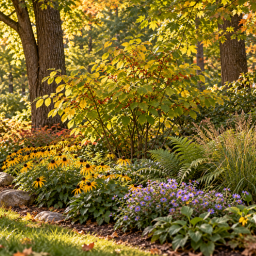
Let the Landscape Tell You Where a Shrub Belongs
Before choosing a shrub, look at the space where you hope to place it.
How much sun actually reaches that area?
Does the soil stay moist after a rain, or dry quickly?
How much room is available once the shrub reaches its mature size?
What plants are already nearby?
And what do you want the shrub to accomplish?
A plant intended to screen a view may need a very different growth habit from one tucked near a walkway. A shrub beneath mature trees needs to tolerate different conditions than one planted against a sunny west-facing wall.
Michigan gardens can vary tremendously in soil, moisture, exposure, and winter conditions, so there is rarely one shrub that belongs everywhere. Observing the site first gives you a much better chance of choosing a plant that can settle naturally into the landscape rather than constantly needing to be managed.
It is the same principle behind Learning How to Trust Your Native Garden: instead of immediately correcting what we see, we begin by paying attention to it.
Native Shrubs Can Do More Than Fill Space
A well-placed native shrub can become part of the framework of the garden for many years.
Depending on the species and location, shrubs may provide spring flowers, summer foliage, berries or other fruit, fall color, winter stems, nesting cover, or food for wildlife.
But their value is not only ecological.
Shrubs are also powerful design plants.
They can repeat a shape from one part of the landscape to another. They can create a backdrop that allows native flowers to stand out. They can soften transitions between garden and lawn. And they can make a newly planted native area feel connected to an older, more established landscape.
That makes them especially useful for gardeners who are transitioning gradually toward more native planting.
You do not have to replace everything at once.
Just as we explored in How to Let Your Native Garden Fill in Naturally, a landscape can evolve in stages. One thoughtfully chosen shrub may change the character of an entire corner of the yard.
The key is choosing it for the garden you actually have, not the garden you imagine on a plant tag.
Start With the Job the Shrub Needs to Do
Once you have identified a place where a shrub might help the landscape, resist the temptation to begin with a plant name.
Begin with the job.
Do you need height behind a perennial bed?
Would a shrub soften a bare corner of the house?
Are you trying to create more privacy, add winter structure, fill the middle layer beneath trees, or bring more wildlife value into an established planting?
That question immediately narrows your choices.
It also helps prevent one of the most common landscape problems: choosing a plant you love first and trying to find somewhere to squeeze it in later.
A shrub that eventually grows six or eight feet wide needs that room whether it looks small in the nursery pot or not. Before planting, look beyond the empty space you see today and imagine the mature plant occupying it.
Consider nearby windows, walkways, utilities, neighboring plants, and the distance from the house.
The goal is not to spend the next ten years pruning a shrub to keep it in a space that was never large enough for it.
Match the Shrub to the Conditions You Already Have
Native does not mean adaptable to every garden condition.
Some Michigan native shrubs naturally occur in moist or wet habitats. Others tolerate considerably drier conditions. Some are comfortable with shade; others perform better with more sun.
MSU Extension recommends understanding the site before choosing the plant. The light, soil, moisture, drainage, and available growing space all matter.
That means the damp area where water collects after rain may not be a problem to “fix.” It may simply be telling you which plants belong there.
The same is true beneath mature trees, along a sunnier property edge, or in an open bed where afternoon sun can be intense.
Instead of changing the site to accommodate the shrub, whenever possible choose a shrub that already suits the site.
A Few Michigan Native Shrubs Worth Considering
You do not need dozens of choices. A handful of well-matched shrubs can solve very different landscape problems.
Common Ninebark (Physocarpus opulifolius)
If you need a substantial shrub that can bring structure to a sunny or partly shaded area, common ninebark is worth considering.
Common ninebark is a medium-sized shrub, typically reaching roughly six to nine feet, with white to pinkish flowers followed by fruit and exfoliating bark that adds winter interest. It is also adaptable to a range of soil conditions.
That makes ninebark useful where you have enough room for a shrub to develop naturally rather than continually shearing it into a smaller shape.
Buttonbush (Cephalanthus occidentalis)
Have a low spot or consistently moist area?
Buttonbush may be a much better answer than repeatedly trying to make that location behave like a dry garden bed.
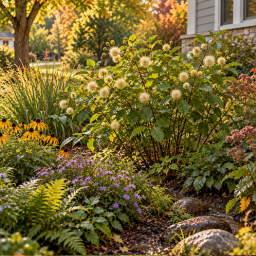
It naturally occurs in wet Michigan habitats, thrives in wet soil and does poorly in dry conditions. Its distinctive rounded summer flower clusters also add a very different texture to the garden.
This is a good example of allowing the conditions to choose the plant.
Spicebush (Lindera benzoin)
Where mature trees create filtered light or moderate shade, spicebush can help fill that often-missing shrub layer.
Spicebush is best suited to moderately shaded conditions. Its small yellow flowers appear early in spring, before the leaves fully emerge.
Rather than forcing a sun-loving shrub beneath established trees, spicebush gives you an option that fits the character of that setting.
Winterberry (Ilex verticillata)
For gardeners interested in extending interest beyond the growing season, winterberry can bring bright fruit to the landscape after the leaves have fallen.
Winterberry grows naturally in several Michigan wetland and shrub communities, so it is especially worth considering where soil retains moisture.
One important planning detail: winterberry plants are male or female, and fruit production on female plants requires a compatible male plant nearby.
That is exactly the kind of detail worth knowing before you shop rather than after planting.
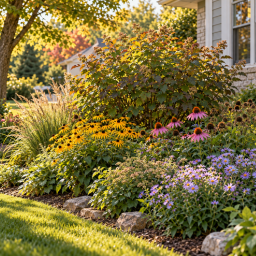
Add One Shrub Where It Will Make a Difference
You do not need to plant an entire hedge or replace every existing foundation shrub.
Look for one place where adding a native shrub would improve both the structure and function of the landscape.
Perhaps it is the empty space beneath a mature tree.
Maybe it is a sunny corner where the garden needs more height.
Or perhaps it is the damp spot where other plants have struggled year after year.
When the shrub fits both the site and the purpose, even one addition can make the surrounding garden feel more intentional.
Help the New Shrub Become Part of the Garden
Once you have chosen the right shrub for the right location, the final goal is simple: give it a good beginning without unnecessarily disturbing the landscape already growing around it.
In an established garden, that often means working more carefully than you would in a brand-new bed.
Before digging, notice what is already beneath and around the planting area. Mature trees, nearby shrubs, and established perennials may have roots extending much farther than their branches suggest. If you encounter large roots, it is usually better to shift the planting location slightly than to cut through them simply to make the original spot work.
The same principle applies above ground.
Give the new shrub enough room to reach its mature form. A young shrub surrounded by open space can look undersized at first, but filling that space immediately with additional plants often creates crowding later.
This is another place where patience serves the garden well.
You can always add smaller plants around the shrub as you learn how the area develops.
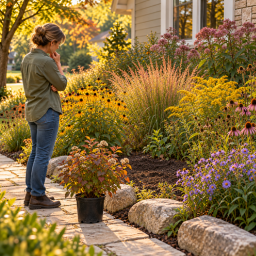
Give It a Strong Beginning
After planting, consistent moisture is especially important while the shrub begins establishing roots.
Rather than watering lightly and frequently, give the root zone a thorough watering when needed and pay attention to the soil itself. Rainfall, temperature, soil type, and exposure can all influence how quickly the planting area dries.
A layer of mulch can help conserve moisture and reduce competition from weeds, but keep mulch away from direct contact with the shrub’s stems rather than piling it against the base.
And resist the urge to immediately fertilize simply because the plant is new. Native shrubs do not all require the same soil conditions, and more nutrients are not automatically better. The goal is to help the plant adapt to the site you selected for it.
Then give it time.
The first season may be much more about root development than dramatic growth above ground.
Let the Shrub Connect the Landscape
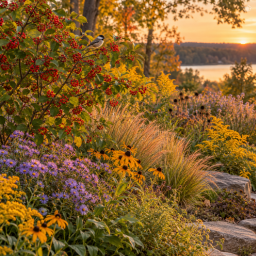
One of the most satisfying things about adding a shrub to an existing garden is watching it gradually stop looking “new.”
Perennials begin growing around it.
Its branches create shade where there was none before.
Birds may begin using it for cover or perching.
Its shape starts connecting one portion of the landscape to another.
What began as a single plant eventually becomes part of the larger garden.
That is often the best kind of landscape change, not one that announces itself all at once, but one that gradually makes the entire space feel more complete.
Barbara’s Observation
I think one of the easiest mistakes we make in an established landscape is assuming that improving it means changing a lot.
Sometimes the most meaningful change is much smaller.
One shrub in the right place can soften a view, create another layer, give wildlife somewhere to pause, and make nearby plants suddenly seem more connected.
The longer I garden, the more I appreciate changes that work with what is already there.
A garden does not always need to be remade.
Sometimes it simply needs one thoughtful addition.
Continue the Observation in Your Garden Journal
If you add a native shrub this season, consider taking a photograph of the area before planting it.
Record what you planted, where you placed it, the light and moisture conditions, and what you hope the shrub will eventually contribute to the landscape.
Then photograph the same view again next season.
Those simple records can help you see changes that are surprisingly easy to miss when you look at the garden every day.
COMPLIMENTARY FIRST MONTH
The Michigan Native Garden Journal
↓ GET YOUR COPY ↓
Observe • Discover • Wonder • Grow
Keep Exploring
If you are continuing to shape an established landscape with native plants, these Michigan Garden articles can help:
How to Create Garden Rooms with Native Plants
Explore how shrubs, perennials, paths, and taller plants can help create structure and distinct spaces within the landscape.
How to Let Your Native Garden Fill in Naturally
Learn why leaving room for plants to mature and interact can create a more natural, settled garden over time.
Learning How to Trust Your Native Garden
A closer look at why observation and patience can sometimes be more useful than immediately trying to correct what appears unfinished.
What’s Next
Choose one area of your landscape and look at it from farther away than you normally would.
Instead of asking, “What plant should I put here?” ask:
What is this space missing?
Height?
Structure?
Screening?
Winter interest?
A connection between taller and shorter plants?
You may discover that you do not need an entirely new garden bed.
You may simply need one well-chosen shrub.
Coming Next
Before making another change in the garden, we’re going to spend a little more time simply looking.
The next Michigan Garden article will explore the clues already present in your landscape—light, moisture, plant behavior, empty spaces, and even the places where plants struggle—and how paying attention to them can help you decide what truly needs changing and what may be better left alone.
Until then,
Happy Gardening!
Barbara
Michigan Garden Design