
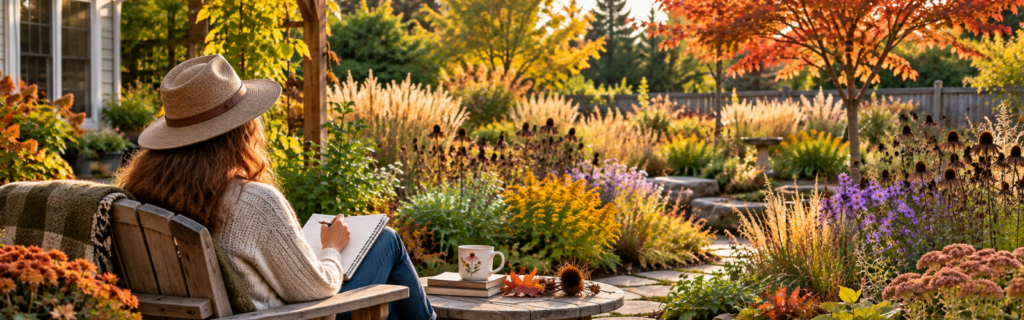
How to Plan Next Year’s Native Garden This Fall
By the time fall arrives, it can feel as though the gardening year is winding down.
The flowers are fading. Seed heads are replacing blooms. Some perennials are beginning to lean, brown, or disappear altogether. Our attention naturally turns toward leaves, cleanup, and getting the garden ready for winter.
But fall offers something else that is easy to overlook:
It may be one of the best times to begin planning next year’s native garden.
Not because you need to redesign everything before the snow arrives. Quite the opposite.
Fall gives you an opportunity to see your garden more clearly.
Your Garden Is Showing You What Worked
During summer, it is easy to be distracted by flowers.
A beautiful patch of purple coneflower can draw your eye away from an awkward empty space nearby. A burst of late-season color can temporarily disguise the fact that one part of the garden lacks structure. Lush foliage can make a planting feel fuller than it really is.
Fall begins to strip some of that away.
Suddenly, you can see where plants have filled in beautifully, and where they have not.
You may notice that one section feels crowded while another still seems disconnected. Perhaps the plants you expected to anchor a bed are smaller than anticipated. Maybe a path has become too narrow, or a tall perennial is blocking something you would rather see.
These are not necessarily problems.
They are information.
This is one of the reasons I encourage gardeners to Learn How to Trust Your Native Garden rather than immediately correcting every space that looks imperfect. Native gardens develop over time, and what you see at the end of one growing season can help you make much better decisions about the next.
Look at the Garden Before You Look at Plants
This is where planning next year’s garden can take an unexpected turn.
Instead of beginning with:
What plants should I buy next year?
Try beginning with:
What is my garden telling me it needs?
Walk through your landscape while this year’s growth is still visible.
Where did the garden feel especially successful?
Where did you enjoy spending time?
Which views caught your attention from the house, patio, driveway, or sidewalk?
Then notice the places that feel less resolved.
Perhaps there is plenty of summer color but very little happening in spring. Maybe one area needs more height, another needs a lower layer along the edge, or a large planting would benefit from the structure of native shrubs.
You might also discover that you do not need more plants at all.
Sometimes the answer is allowing existing plants another season to spread and mature, the same patience we explored in How to Let Your Native Garden Fill in Naturally.
That distinction can save both money and unnecessary work.
Pay Attention to Conditions, Too
Fall planning is not only about appearance.
Think back over what happened in the garden this year.
Was one area consistently drier than you expected? Did water linger somewhere after heavy rain? Did a supposedly sunny bed receive more shade once nearby trees leafed out? Did certain plants struggle while others seemed perfectly at home?
Michigan gardens can vary tremendously in soil, moisture, exposure, and micro-climate, sometimes even within the same yard. What matters most is not what a plant tag says an “average” garden should be like. It is what actually happened in yours.
Those observations become clues.
A struggling plant may not mean that you are bad at growing it. It may simply be telling you that its location is not a good match.
And a plant that flourished with very little attention may be showing you something equally valuable about where similar plants could succeed.
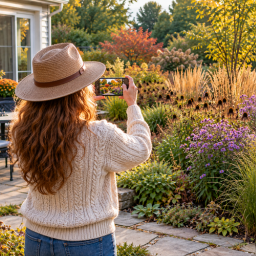
Photograph What You See Now
Before the garden changes completely, take a few photographs.
Not just beautiful close-ups.
Stand back.
Photograph the entire bed. Take a picture from the kitchen window. Capture the view from the patio or the place where you pull into the driveway.
These wider photographs can become surprisingly useful during winter.
When January arrives and the garden exists mostly in memory, you will have something much more reliable to work from. You can look at those images and begin asking:
Where could I repeat a plant to create more rhythm?
Where would a shrub add structure?
Does this bed need another layer—or simply more time?
Could several scattered plants become a stronger grouping?
And perhaps most importantly:
What do I want this garden to feel like next year?
That question moves garden planning beyond simply collecting more plants.
It begins turning individual plantings into a landscape.
And that is where thoughtful native garden design really starts.
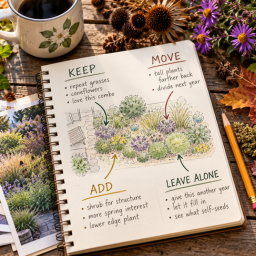
Turn What You Notice Into Next Year’s Garden Plan
Once you have spent some time observing your garden, the next step is not to create a long shopping list.
Instead, take one garden area at a time and ask four questions:
What should I keep?
What should I move?
What should I add?
What should I leave alone?
That simple framework can turn a collection of fall observations into a much clearer plan for spring.
1. Keep What Is Already Working
Start with the successes.
Which plants seemed well matched to their location? Which combinations looked especially good together? Where did the garden feel full, balanced, or alive with activity?
Those areas can become clues for the rest of your landscape.
Perhaps a grouping of native grasses gave one bed structure long after nearby flowers faded. Maybe repeating the same grass elsewhere could create more continuity.
Or perhaps a particular combination of heights worked beautifully—lower plants along the edge, medium-height flowers behind them, and taller plants creating a backdrop.
You do not necessarily need to duplicate the exact plants. Instead, identify why the combination worked.
This is how a garden begins to develop its own design language.
2. Identify What Might Be Better Somewhere Else
Fall can also reveal plants that are not quite working where they are.
Maybe one perennial has grown tall enough to hide shorter plants behind it. Perhaps a vigorous plant is beginning to overwhelm a smaller neighbor. Or something planted near the front of a bed has become larger than expected.
Before deciding that a plant has failed, ask whether it simply needs a better location.
You may already have explored some of these decisions in How to Divide and Move Native Perennials in Fall. Moving or dividing an established plant can sometimes solve a design problem without adding anything new.
Make a note now—even if you decide to wait until spring to act.
A simple garden sketch is enough. Mark plants with arrows, circles, or short notes:
- move farther back
- divide next year
- repeat on opposite side
- give more room
You are creating a working plan, not an architectural drawing.
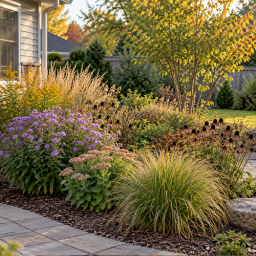
3. Add Only Where the Garden Has a Clear Need
Now look at the spaces that genuinely need something.
Instead of asking which plants you want, identify the job the new plant needs to do.
Does the area need:
- more spring or fall interest?
- a lower plant along the edge?
- more height?
- stronger winter structure?
- something appropriate for a dry or moist area?
- a larger anchor such as a native shrub?
- repetition to connect two parts of the planting?
This changes plant shopping completely.
Rather than arriving at a nursery thinking, I need more native plants, you arrive knowing, I need a lower-growing plant for this sunny, dry edge.
That is a much easier, and much more useful, decision to make.
If your garden needs stronger permanent structure, this may also be the time to consider How to Add Native Shrubs to an Existing Landscape rather than filling every opening with another perennial.
4. Leave Some Things Alone
This may be the hardest category.
A young native garden can make us impatient.
There may be spaces between plants. Some groupings may still look small. A newly planted section may not yet resemble the full garden you imagined.
But not every open space needs to be filled.
Before adding something, consider how long the existing plants have been there and how much room they may need as they mature.
A plant that occupies a modest footprint today may be considerably fuller next year. Some plants may self-seed or gradually form larger groups. Others may simply need another growing season before their role in the design becomes clear.
Sometimes the best note you can write on your plan is:
Wait one more year.
Create a Short Priority List
Once you have worked through the four categories, resist the temptation to turn every observation into a project.
Choose perhaps three priorities for next year.
For example:
- Add structure to the back corner.
- Move two tall perennials away from the front edge.
- Repeat one successful plant grouping on the opposite side.
Everything else can remain on your longer-term list.
Native gardens develop over years. They do not have to reach their final form next spring—and in reality, they probably never will.
That is part of what makes planning them so interesting.
Each year gives you more information.
You observe.
You make a few thoughtful changes.
Then you watch what happens.
Give Yourself Something to Work With This Winter
Before the garden disappears beneath winter weather, gather your notes, photographs, and rough sketch in one place.
You do not need to choose every plant yet.
Winter can be the time to research possibilities, compare mature sizes and growing requirements, think about plant combinations, and refine your ideas without the pressure of standing in front of a nursery bench filled with tempting plants.
By spring, you will not simply have a wish list.
You will have a plan based on what your own garden showed you.
Plan for the Garden, Not Just the Plants
By this point, you may have a handful of ideas for next year.
Perhaps there are plants you want to move, an area that needs more structure, a planting you would like to repeat, or one space you have deliberately decided to leave alone.
Before you put the garden to bed for winter, there is one more question worth asking:
Will these changes make the garden feel more connected?
It is surprisingly easy to improve individual areas while unintentionally making the whole garden feel more scattered.
A beautiful plant here. Another interesting plant there. A new bed in one corner. A shrub somewhere else.
Each choice may be perfectly good on its own, but good plants do not automatically create a cohesive garden.
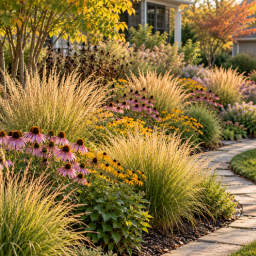
Look for What You Can Repeat
One of the simplest ways to connect different parts of a garden is repetition.
Look at your photographs from this year and identify something that already works.
It might be a plant that appears in several places, a native grass that provides structure, a flower color that moves your eye through the landscape, or a particular grouping that feels especially successful.
Instead of introducing something entirely different next year, consider repeating what is already working.
Repetition does not mean making every garden bed look alike.
It simply gives the eye something familiar to recognize.
Think Beyond Bloom Time
When planning for next year, flowers will naturally get much of your attention.
But imagine the garden in April.
Then July.
Then October.
Then January.
Where will the structure come from when fewer plants are blooming?
Native shrubs, grasses, persistent stems and seed heads can all contribute to the shape of a garden beyond its peak flowering season.
You do not need every corner to look spectacular every month. Instead, think about whether different parts of the garden take turns providing interest.
A garden that changes through the seasons can still feel connected throughout the year.
Leave Room for What You Cannot Predict
Even the most thoughtful garden plan needs a little flexibility.
Plants grow differently from one site to another. Some will spread more quickly than expected. Others may take several seasons to establish. Seedlings may appear in places you never planned for them.
That does not mean the plan failed.
Your plan is a starting point.
Leave yourself permission to observe again next year and respond to what actually happens.
That may mean moving something.
It may mean repeating a combination that surprised you.
And sometimes it will mean doing absolutely nothing.
The goal is not to create a garden that never changes.
It is to become better at recognizing which changes will help and which ones can wait.
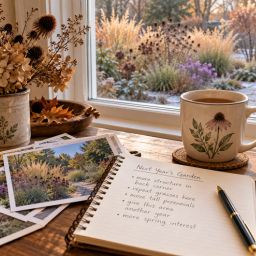
Barbara’s Observation
Fall has a way of making a garden easier for me to read.
When there are fewer flowers competing for attention, I begin noticing the spaces between them—the shape of a planting, the way one area connects to another, and the places where something still feels unfinished.
But I have also learned that “unfinished” does not always mean something is missing.
Sometimes it means the garden is still becoming.
That is why I like the idea of planning in fall. I can notice what I might change next year without feeling that I have to change it today.
Winter gives those ideas time to settle.
And often, by spring, the garden has helped me decide which ones are worth keeping.
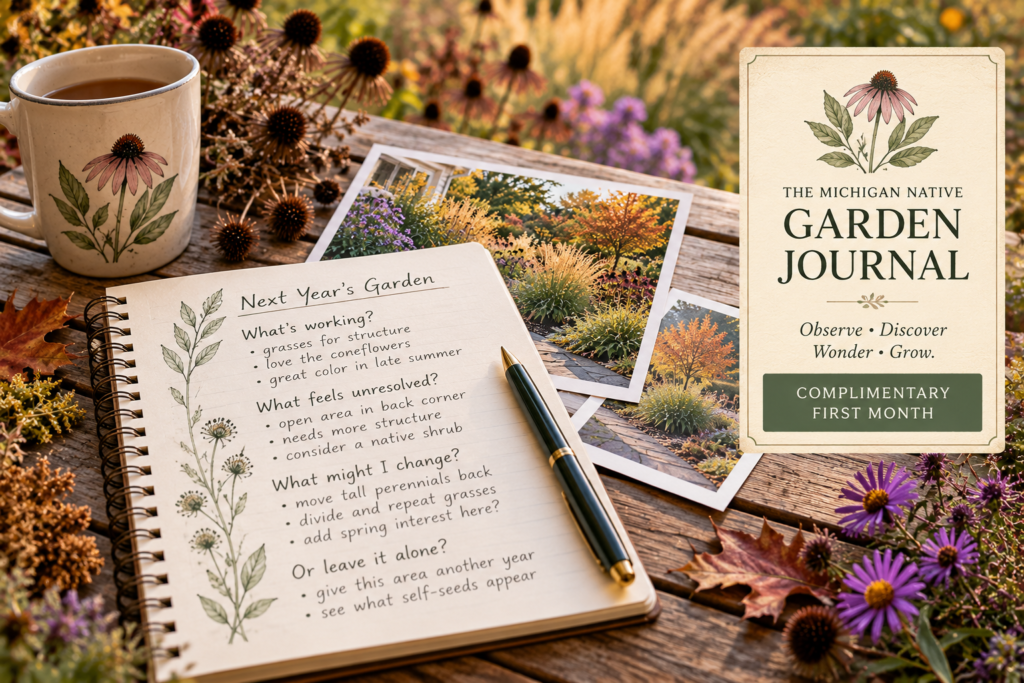
Take Your Fall Observations Into the Garden Journal
Before this year’s garden disappears from view, record what you noticed.
Which areas worked particularly well? Where would you like more structure, repetition, seasonal interest, or room for plants to mature? Add a few wide photographs so you can revisit those same spaces during winter.
Then, next year, compare what you planned with what actually happened.
That kind of year-to-year observation is exactly what The Michigan Native Garden Journal was created to encourage.
COMPLIMENTARY FIRST MONTH
The Michigan Native Garden Journal
GET YOUR COPY ↓
Observe • Discover • Wonder • Grow
Keep Exploring
If you are thinking ahead to next year’s garden, these Michigan Garden Design articles can help you continue planning:
How to Read Your Garden Before You Change It
Start by understanding the conditions, patterns, and clues already present in your landscape.
How to Let Your Native Garden Fill in Naturally
Learn when an apparent gap may simply need another season rather than another plant.
How to Divide and Move Native Perennials in Fall
Consider whether plants you already have could solve some of next year’s design needs.
How to Add Native Shrubs to an Existing Landscape
Explore how shrubs can bring longer-lasting structure to an established garden.
What’s Next
Before winter, choose one garden area you would like to improve next year.
Take a wide photograph of it and write down three things:
What is working?
What feels unresolved?
What might I change, or intentionally leave alone?
You do not need to solve it yet.
Give yourself the winter to think about it.
Coming Next
Once you know what your garden needs, the next question is how to make those changes feel deliberate rather than scattered.
In How to Design a Native Garden That Looks Intentional, we’ll explore how plant repetition, grouping, structure, edges, and other simple design choices can help a naturalistic native garden feel purposeful, without taking away the life and movement that make it beautiful.