
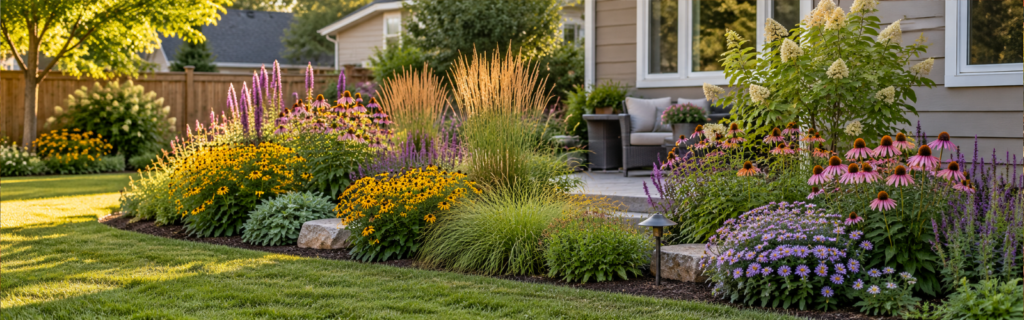
How to Design a Native Garden That Looks Intentional
There is a particular moment that can make a new native gardener question everything.
You have chosen plants thoughtfully. You know they belong in Michigan. You have imagined bees moving among the flowers, birds visiting the seed heads, and a garden that feels more alive than the landscape you started with.
And yet, when you step back and look at it, you wonder:
Why doesn’t this look like the garden I pictured?
Sometimes the plants are still young. Sometimes there are awkward gaps. Sometimes one species is thriving while another seems to have disappeared. And sometimes everything is growing perfectly well, but the garden still feels a little scattered.
The answer may not be more plants.
It may be more visual intention.
A Native Garden Can Be Natural Without Looking Accidental
One of the persistent misconceptions about native gardening is that we have to choose between two extremes.
On one side is the traditional landscape: clipped shrubs, evenly spaced plants, tidy edges, and clearly defined beds.
On the other is the imagined native garden: plants growing wherever they please, stems leaning into one another, seed heads standing through winter, and very little visible order.
But there is an enormous amount of room between those two pictures.
A native garden can have movement, change, self-seeding, insects, seed heads, grasses, and the wonderful unpredictability of living plants, and still look unmistakably designed.
The goal is not to make native plants behave like annual bedding plants.
The goal is to give all that natural abundance a framework the eye can understand.
That framework becomes especially important in a residential landscape. A prairie or woodland does not need to announce that it belongs where it is. A garden beside a driveway, sidewalk, patio, or front porch is different. It exists in relationship with the house, neighboring properties, pathways, lawn, and the people who move through it.
Small design decisions can help connect those worlds.

The Eye Looks for Patterns
When we look at a garden, we instinctively search for relationships.
Where does the garden begin and end?
Does one plant appear again somewhere else?
Are the tallest plants helping create a background, or are they randomly interrupting the view?
Is there somewhere for the eye to rest?
Does the planting relate to the walkway, fence, porch, or other structure nearby?
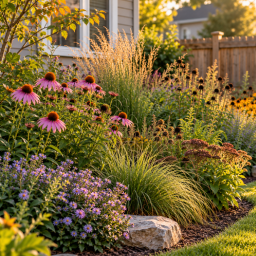
This is why repetition can be so powerful in a native garden. A single purple coneflower appearing unexpectedly may look accidental. A grouping of coneflowers, repeated farther along the bed, begins to create rhythm.
The same principle applies to grasses, shrubs, colors, shapes, and even open space.
And as we explored in How to Create Garden Rooms with Native Plants, structure does not have to come only from hardscape. Plants themselves can define space, guide movement, frame views, and create recognizable patterns.
Intentional Does Not Mean Finished
This may be the most important distinction of all.
A native garden is never going to remain exactly as you designed it.
Plants mature. Some spread. Others seed into nearby openings. Grasses become fuller. Young shrubs eventually occupy the space you once worried looked empty. Plants respond differently to sunlight, moisture, competition, and the particular conditions of your garden.
That is not a design failure.
In fact, Learning How to Trust Your Native Garden means allowing some of that change to happen before deciding that every unexpected development needs correcting.
Good native garden design creates enough structure to accommodate change.
Instead of trying to control every stem, you establish recognizable patterns. Instead of insisting that every plant remain precisely where it began, you decide where movement is welcome and where clearer boundaries matter. Instead of filling every open inch immediately, you allow plants time to mature.
The result can feel cared for without feeling controlled.
That distinction matters because the goal has never been to make nature behave.
It is to create gardens where nature and human intention can comfortably meet.
And sometimes, just a few thoughtful design choices are enough to make that intention visible.
The Design Moves That Make a Native Garden Feel Intentional
A native garden does not need perfect symmetry or rigid spacing to look designed.
What it does need is enough repetition, structure, and visual connection that the eye can understand what is happening.
The good news is that you do not need to redesign the entire landscape to create that feeling. Often, a few deliberate choices make the biggest difference.
1. Repeat Plants Instead of Using One of Everything
One of the easiest ways for a native garden to feel scattered is to plant a single specimen of many different species.
That approach can be exciting when you are collecting plants, but visually, it may leave the garden without a clear rhythm.
Repeating the same plant in several places creates connection.
A group of three or five plants can read as one visual mass. Repeating that same species farther along the bed begins to tie the garden together.
This does not mean every planting has to be identical.
Think of repetition as a thread running through the garden rather than a pattern that has to be followed perfectly.
2. Plant in Groups the Eye Can Read
Native plants often look more intentional when they are planted in noticeable groups rather than evenly scattered throughout a bed.
The size of those groups can vary with the scale of the landscape.
A smaller front-yard bed may only need a few plants of the same species grouped together. A larger planting can support broader drifts.
Grouping also helps individual plants make a stronger visual statement.
One blazing star tucked among ten unrelated plants may disappear visually. Several planted together are easier to notice, and easier for the eye to understand as a deliberate choice.
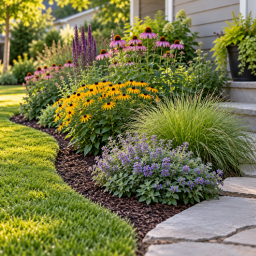
3. Give the Garden a Clear Edge
Sometimes the plants are not the problem at all.
The edge is.
A clean transition between the native planting and the surrounding lawn, walkway, driveway, or patio can immediately make the garden appear more cared for.
That edge might be created with:
- a crisp cut lawn edge
- stone
- brick
- a narrow path
- another clearly defined boundary
The goal is not to make the garden formal.
The goal is simply to show where the garden begins.
A strong edge can give gardeners considerably more freedom within the planting itself.
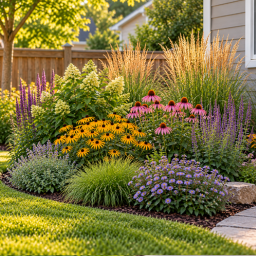
4. Build in Layers
Layers help a native garden feel composed rather than flat.
In a typical residential bed, you might think in terms of:
Lower layer: shorter perennials, sedges, groundcovers, and plants near pathways or bed edges
Middle layer: the main flowering perennials and grasses
Upper layer: taller perennials, larger grasses, shrubs, or small trees
Those layers do not need to form perfect rows.
In fact, they usually look more natural when they overlap.
The important part is that plants relate to one another in height and scale instead of competing randomly for attention.
This is one reason mature plant size matters so much in design. A plant that looks small in a nursery pot may eventually become one of the strongest structural elements in the entire bed.
5. Include Plants That Provide Structure
Flowers naturally draw our attention, but they are only one part of the design.
Shrubs, grasses, sedges, and plants with strong upright or rounded forms can give a garden a visual backbone.
This becomes especially noticeable outside peak bloom.
When some flowers fade, the garden can still feel organized because the larger forms remain.
Structure is particularly useful in Michigan gardens because our landscapes change dramatically through the seasons. A garden designed only around summer flowers may lose much of its visual clarity once those blooms disappear.
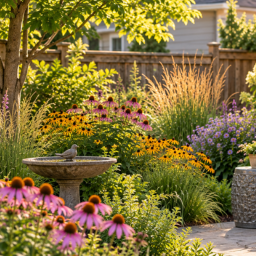
6. Leave Some Open Space
There is a temptation, especially in a young native garden, to fill every visible gap.
But open space can be part of the design.
A little breathing room around a pathway, specimen plant, bench, birdbath, or other focal point can make the entire garden easier to read.
Open space also allows room for plants to mature.
The key is distinguishing between an intentional opening and an area that simply feels unfinished.
Defined edges, repetition, and grouping help make that difference clear.
7. Connect the Garden to Something Else
One of the strongest ways to make a native garden feel intentional is to connect it visually to an existing feature.
That might be:
- the curve of a walkway
- the corner of a porch
- a fence line
- a seating area
- an existing tree
- a stone path
- the architecture of the house
When planting appears to respond to its surroundings, it feels purposeful.
Even a naturalistic garden benefits from having a reason for being where it is.
The Goal Is Cohesion, Not Control
None of these techniques require a garden to stay frozen in place.
Plants can still spread.
Seedlings can still appear.
Grasses can move in the wind.
Seed heads can remain through winter.
Pollinators can still find the flowers, and birds can still investigate what the garden provides.
The design simply gives all of that life a framework.
And that is really what intentional native gardening is about.
Not controlling every plant.
Not making nature look tidy enough to pass inspection.
But creating enough visual order that the natural character of the garden feels welcomed rather than accidental.
Keep the Intention, Let the Garden Change
Once a native garden begins to mature, the design work changes.
At first, you are deciding what to plant and where to place it. Later, you are deciding what to encourage, what to move, what to edit, and what to leave alone.
That is where intentional design becomes less about arranging plants and more about guiding the garden as it develops.
Edit What Distracts From the Design
Not every volunteer seedling needs to stay.
Not every plant that spreads needs to be removed.
The useful question is:
Does this new growth strengthen the pattern of the garden, or does it make the design harder to read?
A seedling appearing within an existing group may make that planting feel fuller and more natural.
The same seedling emerging in the middle of a pathway or directly in front of a smaller focal plant may need to be moved.
Editing does not mean eliminating spontaneity.
It means deciding where spontaneity works.
Watch for One Plant Taking Over the Visual Story
Some native plants spread more readily than others.
That can be useful when you want to cover ground, fill a larger area, or establish a strong drift. But over time, a vigorous plant can begin to erase the contrast that made the planting interesting in the first place.
If one species begins dominating, consider thinning or relocating part of the colony rather than treating the plant as a problem.
The goal is balance.
You still want repetition, but you also want enough variation in height, form, texture, and season to keep the garden visually engaging.
Maintain the Framework
A naturalistic planting can tolerate quite a bit of movement when the underlying structure remains visible.
That may mean occasionally refreshing an edge, keeping a pathway open, pruning a shrub that is obscuring an entrance, or making sure a key grouping is still recognizable.
These small maintenance decisions often have more visual impact than adding another plant.
In fact, before buying something new, it can be useful to stand back and ask:
Does this garden need another plant, or does it need one existing idea to become clearer?
Sometimes the answer is as simple as repeating a plant already present, widening a grouping, or restoring a clean boundary.
Give the Garden Time Before You Redesign It
Native gardens can look very different from one year to the next.
A young planting may seem sparse before plants mature. A section that feels unbalanced one season may settle naturally as neighboring plants fill in.
This is why patience is part of design.
Photographing the same garden area through the seasons, and from year to year, can make patterns easier to see.
You may discover that the garden needs less intervention than you thought.
And when a change truly is needed, you can respond with more confidence because you are reacting to what the garden has actually done rather than what you feared it might do.
Intentional native gardening is not about keeping everything exactly where it began.
It is about creating a garden with enough structure that change can happen without the design disappearing.
Barbara’s Observation
One of the things I find most interesting about a maturing garden is how often the plants begin participating in the design.
A seedling appears in exactly the right place. A group becomes fuller than I could have planned. A grass leans into a neighboring flower and suddenly the combination feels complete.
Those moments remind me that intentional design does not always mean making every decision ourselves.
Sometimes it means creating a strong beginning, paying attention, and knowing when the garden has made a good decision for us.
Complimentary Garden Journal
An intentional garden becomes easier to understand when you can look back at how it has changed.
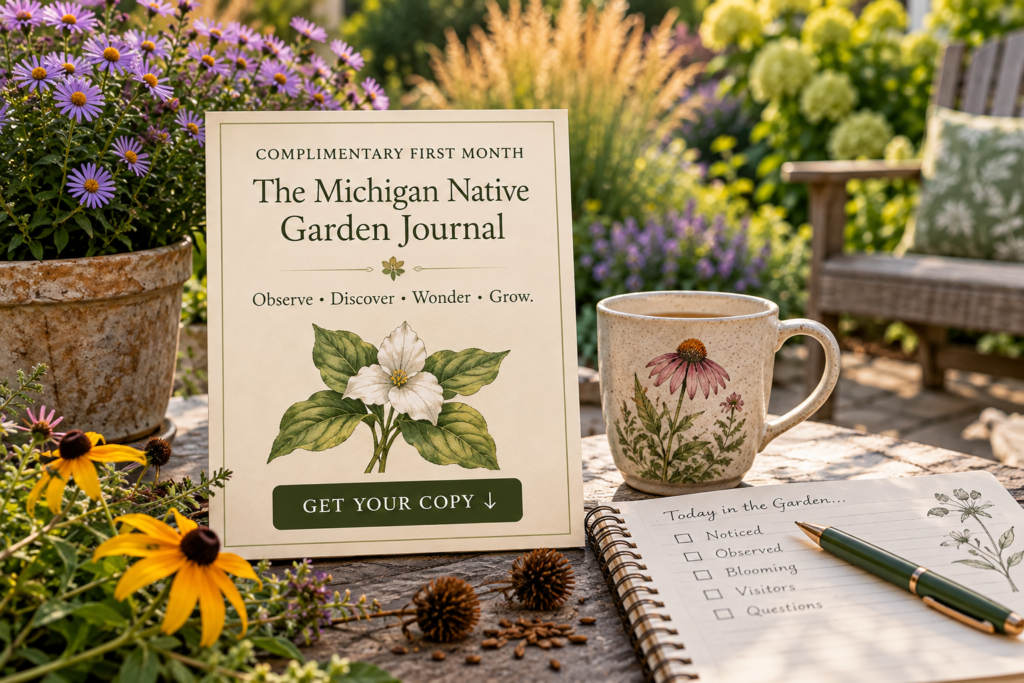
Use The Michigan Native Garden Journal to photograph one area of your garden, note which plants are spreading or filling in, and record the places that still feel visually unsettled.
A few months, or another growing season, can reveal whether a space truly needs redesigning or simply needed time.
COMPLIMENTARY FIRST MONTH
The Michigan Native Garden Journal
↓ GET YOUR COPY ↓
Observe • Discover • Wonder • Grow
Keep Exploring
If you would like to keep building on this idea, these Michigan Garden Design articles are natural next steps:
- How to Create Garden Rooms with Native Plants — for using plants to define space and create structure
- How to Let Your Native Garden Fill in Naturally — for learning when spreading and self-seeding can strengthen the garden
- Learning How to Trust Your Native Garden — for deciding when to intervene and when to give the garden more time
- How to Read Your Garden Before You Change It — for observing what is already working before making new decisions
What’s Next
Choose one area of your garden and look at it from farther away than you normally do.
Do not begin by asking what plant you should add.
Instead, look for three things:
repetition, structure, and edges.
You may discover that the garden already has what it needs, and that one small adjustment could make the whole space feel more intentional.
Coming Next
You do not always need a redesign to bring more native plants into your landscape.
In the next Michigan Garden article, How to Add Native Plants Without Redesigning, we’ll look at simple ways to work native plants into the garden you already have, without tearing everything out or starting over.