
How to Create Garden Rooms with Native Plants
Your Garden Doesn’t Have to Be Seen All at Once
One of the most interesting gardens I know is not a garden you can understand from the driveway.
You have to walk into it.
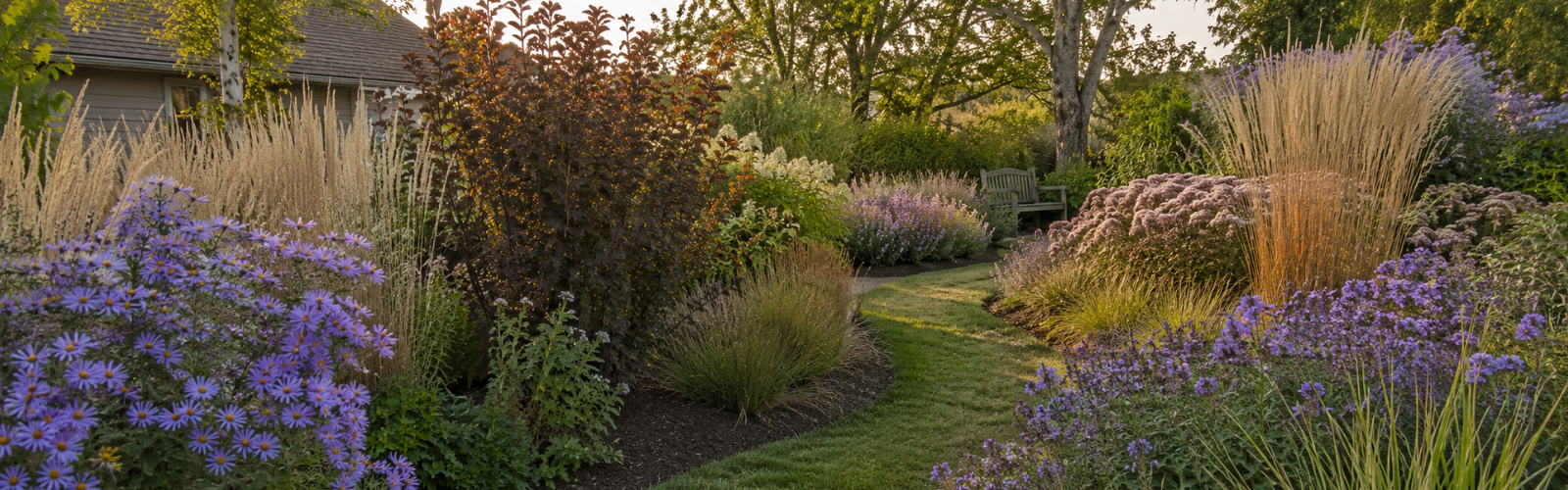
A planting partially hides a bench. A path curves beyond a group of shrubs. Tall grasses soften the view into another part of the yard. Around the corner, the garden suddenly feels different, not because you have entered another property, but because the space has changed around you.
These are garden rooms, and they are one of the most effective ways to make an ordinary residential landscape feel deeper, more inviting, and far more interesting.
The idea is borrowed from the way rooms work inside our homes. A house is rarely one large open area where everything can be seen from the front door. Walls, openings, furniture, and changes in purpose divide the space into places for gathering, eating, working, or resting.
A garden can do much the same thing.
But instead of drywall and doors, we can use native shrubs, grasses, flowering perennials, small trees, pathways, and changes in planting height to create the boundaries.
And unlike a constructed wall, a living garden wall changes.
It flowers. Birds move through it. Seed heads catch winter light. Grasses shift in the wind. Openings appear and disappear as plants grow through the seasons.
That makes native plants particularly well suited to this kind of garden design.
A Small Yard Can Still Have More Than One Room
Garden rooms are sometimes associated with large estates or elaborate landscapes, but the principle works surprisingly well in modest Michigan yards.
You may already have the beginnings of several rooms without realizing it.
The patio beside your house may be one.
A small sitting area beneath a tree may be another.
The sunny garden along the back fence might feel completely different from the quieter, shaded area near the side of the house.
The design opportunity is not necessarily to create more spaces. It is to define the spaces you already have.
This is where planting becomes more than decoration.
A group of native shrubs can partially separate a patio from the rest of the yard. A sweep of taller native grasses can create a soft boundary without making the garden feel enclosed. A planting that narrows the view beside a path can make the area beyond it feel like a destination.
Sometimes the most powerful change is simply allowing part of the garden to remain unseen.
When everything is visible at once, there is little reason to explore.
When something disappears around a corner, the garden quietly asks you to keep walking.
Think in Layers, Not Walls
Creating a garden room does not mean surrounding every space with tall plants.
In fact, completely enclosing a small yard can make it feel smaller.
The better approach is often to think in layers and partial views.
A low planting might suggest an edge.
Medium-height perennials can make one section feel distinct from another.
A shrub or ornamental native grass may interrupt a sightline just enough that you cannot see everything beyond it.
This is closely related to the layered planting approach we explored in How to Let Your Native Garden Fill in Naturally. As plants mature and begin occupying different heights and spaces, the garden develops structure that was not obvious when everything was newly planted.
It is also one reason a native garden often becomes more interesting with age. In Why Your Native Garden Gets Better Every Year, we looked at how increasing plant maturity creates depth, movement, and stronger relationships throughout the garden.
Garden rooms intentionally use those same qualities.
Instead of asking only, “What should I plant here?”, begin asking:
“How do I want this part of the garden to feel?”
Perhaps one area should feel open and sunny.
Another might feel sheltered.
One space may be where you watch butterflies.
Another may simply hold a chair where you can sit quietly at the end of the day.
Once each area has a purpose or feeling, plant choices become much easier.
You are no longer filling empty spaces.
You are shaping an experience.
And that is where native plant garden design becomes especially interesting: the boundaries themselves can become habitat.
Six Ways to Build a Garden Room
Once you begin seeing your yard as a collection of spaces rather than one continuous landscape, the next question becomes practical:
How do you actually create the rooms?
You do not need walls, fences, or major construction. In many gardens, a few carefully placed plants and a change in the way you move through the space can be enough.
1. Use Shrubs to Create the Strongest Boundaries
Native shrubs are one of the easiest ways to establish the “walls” of a garden room.
They work especially well where you want to soften a property line, screen part of a patio, or separate an active area from a quieter one.
The goal does not have to be complete privacy.
A shrub such as nannyberry (Viburnum lentago) or ninebark (Physocarpus opulifolius) can create enough visual mass to define an edge while still feeling like part of the garden.
Often, one well-placed group is more effective than planting a continuous hedge.
Think about what you want to partially hide rather than what you want to completely block.
2. Let Native Grasses Form Softer Walls
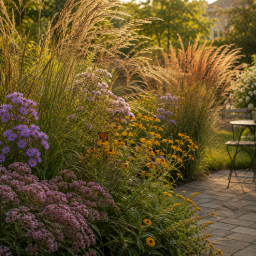
Where shrubs might feel too permanent or heavy, grasses can create beautiful semi-transparent boundaries.
Switchgrass (Panicum virgatum) is one example of a Michigan native grass that can provide height and movement without creating the feeling of a solid barrier.
Place taller grasses near a seating area, along part of a path, or where one garden space transitions into another.
You may still glimpse what is beyond them, and that is often exactly what makes the design inviting.
A garden room usually becomes more interesting when its edges suggest rather than completely conceal.
3. Create an Entrance
Rooms become easier to recognize when there is a sense of entering them.
Your garden entrance might be as simple as:
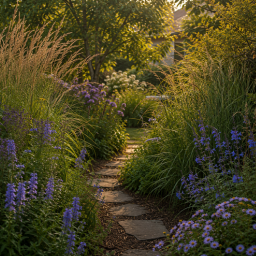
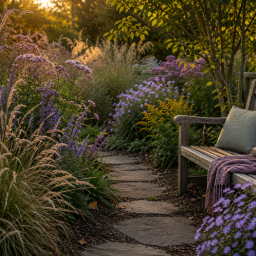
- a path narrowing between two plantings
- taller plants framing either side of a walkway
- stepping stones changing direction
- a gap between shrubs
- an arbor or another simple garden structure
The entrance does not need to be dramatic.
What matters is creating a moment when the gardener senses, “I am moving into another space.”
4. Change What Happens Inside the Room
Plant boundaries alone will not make two spaces feel different if everything inside them looks the same.
Give each room its own purpose.
One might contain a small table and chairs surrounded by pollinator plants.
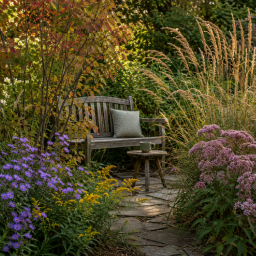
Another might be quieter, a bench positioned near native grasses where you can watch birds move through the garden.
A sunny area could emphasize flowering perennials, while a partially shaded room beneath an existing tree might feel more woodland-inspired.
This is where your site conditions should lead the design.
Rather than choosing a theme first and forcing plants into it, notice the sunlight, moisture, existing trees, views, and ways you already use the yard.
Then allow the room to grow naturally from those conditions.
5. Control the View
One of the most effective garden-design tools costs nothing:
deciding what the visitor can see.
Stand at the entrance to your yard, on your patio, or wherever you normally enter the garden.
Can you see everything?
If so, look for one place where a planting could interrupt that long view.
Perhaps a small native tree or shrub could obscure one corner. Maybe tall grasses could partially hide a bench. A curved planting bed might make a straight path disappear from sight.
You are not trying to make the garden confusing.
You are creating anticipation.
The possibility that something interesting exists beyond the planting is often enough to make a garden feel larger.
6. Give Each Room a Destination
Finally, give people a reason to enter.
A destination could be remarkably simple:
a chair,
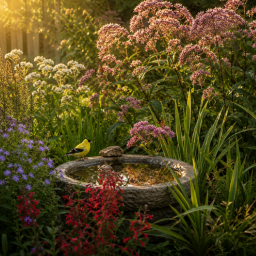
a birdbath,
a favorite flowering plant,
a small water feature,
or even a particularly beautiful view back toward the house.
The destination becomes the quiet reward at the end of the path.
This is one reason the principles from How to Create Small Water Features for Wildlife can fit so naturally into garden-room design. A small source of water can become both a visual focal point and a place where the gardener pauses to observe what arrives.
The best garden rooms do not feel artificially divided.
They feel discovered.
Native plants simply help us shape the boundaries in a way that remains alive, changing through bloom, seed, foliage, movement, and season.
Ready to Make Separate Rooms Feel Like One Garden?
Creating garden rooms is not really about dividing the yard.
It is about giving different parts of the garden their own identity while allowing them to remain connected.
That connection usually comes from repetition.
A native grass used near one sitting area might appear again farther down the path. A flowering plant from the sunny garden room might be repeated near another opening. Similar materials in pathways, edging, containers, or garden furniture can also quietly remind us that we are still moving through the same landscape.
You do not need every room to contain the same plants.
In fact, they probably should not.
But repeating a few colors, plant forms, or materials helps the garden feel intentional rather than fragmented.
Pay Attention to Proportion
The size of each room should make sense for the yard around it.
A small residential garden may need only two or three distinct spaces.
Trying to create too many rooms can make the landscape feel crowded, while oversized plantings may overwhelm places intended for sitting or walking.
Give plants enough room to mature, especially shrubs and taller grasses that are being used as boundaries.
Remember that the garden room you design today will change considerably as those plants fill in.
That changing structure is part of the design.
Let Paths Connect the Experience
Paths are what turn separate spaces into a journey.
They do not have to be elaborate.
A mown path through a naturalized planting, stepping stones through a garden bed, or a simple mulched walkway may be enough.
What matters is that the path gives you somewhere to go.
A slight curve can slow the eye.
A narrowing can create a transition.
A planting that partially obscures the destination can encourage you to continue walking.
These small design decisions influence how we experience a garden just as much as the plants themselves.
Avoid Making Every Room Too Complete
One temptation when creating garden rooms is to make every space feel perfectly finished.
Native gardens rarely work that way.
Plants spread. Seedlings appear. Wildlife changes how the garden is used. A view that feels open one year may become more enclosed as shrubs mature.
Leave a little room for that evolution.
The goal is not to control every inch of the garden.
It is to create enough structure that the garden has direction, and enough flexibility that nature can still participate.
Barbara’s Observation
Some of the gardens I remember most clearly are not the ones where everything was visible at once.
They are the gardens where I wondered what was around the corner.
A path disappeared.
A chair was partly hidden.
A few plants interrupted the view just enough to make me keep walking.
There is something wonderful about allowing a garden to reveal itself slowly.
When we create rooms with native plants, we are not simply organizing space.
We are creating places to pause, notice, and experience the garden differently.
Continue the Observation in Your Garden Journal
If you are considering garden rooms in your own yard, begin by observing before changing anything.
Stand in several places and record:
- what you can see
- which areas already feel separate
- where you naturally pause
- which views you would like to soften
- where a path or destination might draw you farther into the garden
Photographing the same view from several locations can be especially helpful. What looks like one open yard from the house may already contain the beginnings of several distinct spaces.
COMPLIMENTARY FIRST MONTH
The Michigan Native Garden Journal
↓ GET YOUR COPY ↓
Observe • Discover • Wonder • Grow
Keep Exploring
If you would like to continue developing the structure and experience of your native garden, these Michigan Garden Design articles pair naturally with this one:
- How to Let Your Native Garden Fill in Naturally
- Why Your Native Garden Gets Better Every Year
- How to Create Small Water Features for Wildlife
- How to Plan for Your Fall Native Plantings
Each explores another way that observation, plant placement, and time can shape the garden.
What’s Next
Choose one place in your yard and look at it from the perspective of a visitor.
Ask yourself:
What do I see immediately, and what might be more interesting if I could not see it quite yet?
You may discover that creating your first garden room requires only one planting, one path, or one thoughtfully placed destination.
Coming Next
Learning How to Trust Your Native Garden
Native gardens are always changing.
Plants move. Some become more abundant. Others disappear for a season and return later. Empty spaces fill. Unexpected combinations emerge.
Knowing when to intervene, and when to simply watch, is one of the most important skills a native gardener can develop.
Coming next, we’ll explore what it means to trust your native garden, how to recognize when natural change is working in your favor, and when the garden may actually be asking for your help.