
How To Create an Amazing Habitat with Native Trees
When people think about creating wildlife habitat, they often picture colorful flowers filled with butterflies and bees.
Those plants are certainly important.
But if you ask nature where habitat begins, the answer is surprisingly simple:
It starts with trees.
A single native tree can provide food, shelter, nesting sites, shade, and protection for hundreds of different species throughout the year.
Birds raise their young among its branches.
Butterflies lay eggs on its leaves.
Native bees gather pollen from its flowers.
Squirrels, chipmunks, and countless other animals rely on its seeds, nuts, or fruit.
Even after a tree reaches the end of its life, it continues supporting insects, fungi, birds, and other wildlife as it slowly returns nutrients to the soil.
Few additions to a landscape create a greater impact than planting a native tree.
More Than Just Shade
Trees do far more than cool our homes during the summer.
They become the framework around which entire ecosystems develop.
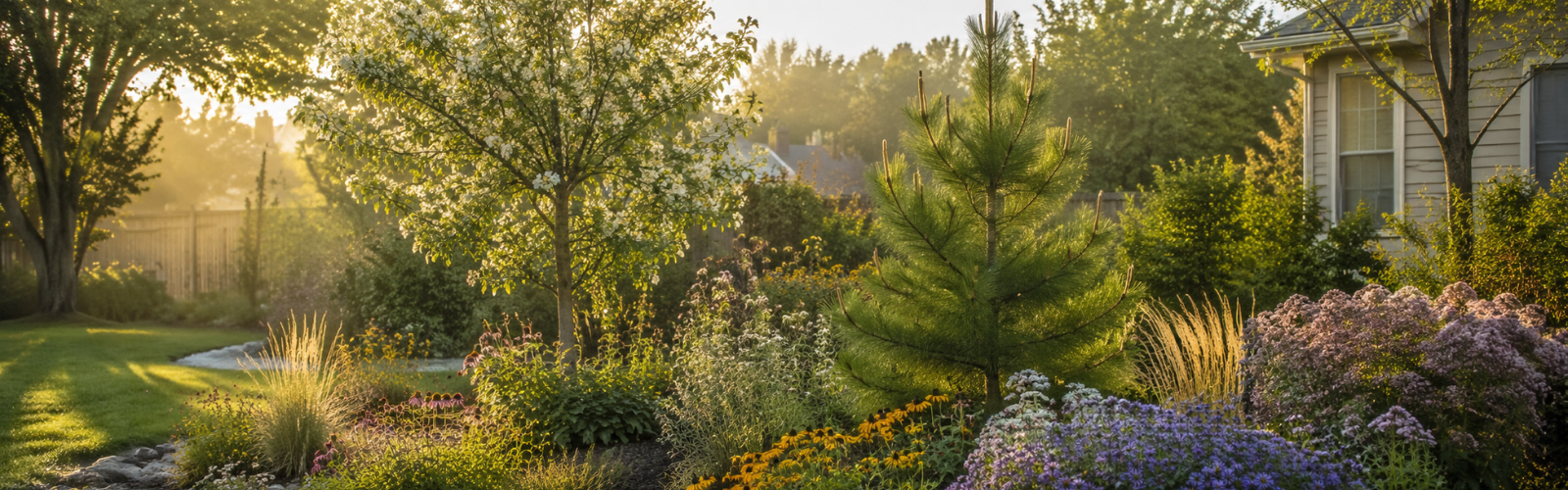
A Serviceberry welcomes spring with delicate white blossoms that provide an early nectar source for pollinators. By early summer, its berries feed dozens of bird species before the tree bursts into brilliant shades of orange and red in autumn.
An Oak quietly supports hundreds of species of caterpillars—an essential food source for nesting birds during spring.
A River Birch offers peeling bark for year-round interest while providing shelter and food for wildlife.
Every tree tells a different story.
Choosing native species simply means that story has been unfolding in Michigan for thousands of years.
To explore native Michigan trees in greater detail, the Michigan State University Extension offers research-based guidance on selecting trees that thrive in Michigan landscapes and support local ecosystems.
Think About Layers Again
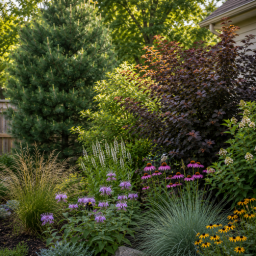
If our recent article, How To Design a Four-Season Michigan Garden, introduced the idea of designing in layers, native trees become the highest layer of that living landscape.
Beneath their branches, shrubs provide berries and cover.
Below the shrubs, flowering perennials attract pollinators.
Groundcovers protect the soil.
Native grasses soften the edges.
Each layer supports the next.
Rather than competing with one another, they work together to create a thriving community of life.
That’s exactly how Michigan’s natural woodlands and savannas have always functioned.
You Don’t Need a Forest
One of the biggest misconceptions about wildlife habitat is that you need a large property.
You don’t.
One thoughtfully chosen native tree can become the centerpiece of an ordinary suburban landscape.
Imagine stepping into your backyard on a summer morning.
A young Serviceberry is beginning to mature.
Goldfinches perch among nearby seedheads.
Native bees move between flowering perennials beneath the tree.
A chickadee pauses briefly on one of its branches before flying off again.
This isn’t a nature preserve.
It’s your backyard.
Habitat begins one tree at a time.
Choose the Right Tree for the Right Place
Before selecting a tree, spend a little time getting to know your landscape.
Notice where the sun falls throughout the day.
Pay attention to how wet or dry the soil remains after a rainfall.
Think about how large the tree will become, not just in height, but in width as well.
The right tree in the right location will reward you for decades.
It will require less maintenance, remain healthier, and better support the wildlife that naturally depends on it.
The goal isn’t to plant the biggest tree.
It’s to plant the tree that’s happiest growing exactly where you place it.
Five Native Trees Every Michigan Habitat Should Consider
Michigan is home to many beautiful native trees, but you don’t need dozens of species to create meaningful habitat.
A single thoughtfully chosen tree can become the heart of your landscape for generations.
Here are five outstanding choices for many Michigan homeowners.
Serviceberry (Amelanchier species)
If there were one native tree I would recommend to almost every homeowner, Serviceberry would be near the top of the list.
Its delicate white flowers appear in early spring, providing one of the season’s first important nectar sources for native pollinators.
By early summer, its berries become a favorite food for robins, cedar waxwings, and many other birds—if you’re lucky enough to harvest a few before they do.
In autumn, the leaves glow with brilliant shades of orange and red before revealing an elegant branching structure that adds beauty throughout the winter months.
For smaller residential landscapes, it’s hard to imagine a better all-around native tree.
If you’d like to extend seasonal beauty beyond your trees, our article How To Design a Four-Season Michigan Garden explores how trees, shrubs, grasses, and perennials work together to create year-round interest.
White Oak (Quercus alba)
The mighty oak is often called one of nature’s greatest wildlife trees, and for good reason.
Hundreds of species of native caterpillars rely on oaks during their life cycles. Those caterpillars, in turn, become essential food for nesting birds raising hungry young each spring.
Acorns feed squirrels, chipmunks, wild turkeys, deer, and many other animals.
Large oaks also provide nesting sites, shelter, and cooling shade that benefit wildlife throughout every season.
If you have room for an oak, you’re making one of the greatest long-term investments you can make for your landscape.
The National Audubon Society offers excellent information about the remarkable relationship between native oaks, caterpillars, and the birds that depend on them.
River Birch (Betula nigra)
River Birch adds beauty in every season.
Its peeling bark becomes increasingly striking as the tree matures, especially during winter when the landscape is quieter.
The tree grows quickly, tolerates a variety of soil conditions, and supports numerous insects that become food for birds.
Its graceful form also provides welcome shade during Michigan’s warm summer months.
Eastern Redbud (Cercis canadensis)
Each spring, Eastern Redbud seems almost to glow.
Brilliant pink blossoms appear along its branches before the leaves emerge, creating one of the most memorable displays of the season.
Those flowers provide an important early food source for pollinators, while the tree’s modest size makes it well suited to many suburban yards.
It’s proof that creating habitat doesn’t require planting enormous trees.
Sometimes smaller trees fit both the landscape and the homeowner’s lifestyle beautifully.
Eastern White Pine (Pinus strobus)
No tree is more closely associated with Michigan’s forests than the Eastern White Pine.
As Michigan’s state tree, it has long been a symbol of the state’s natural heritage. But beyond its history, Eastern White Pine plays an important role in creating year-round wildlife habitat.
Its evergreen branches provide shelter from harsh winter weather, nesting sites for birds, and protective cover throughout every season. Chickadees, nuthatches, woodpeckers, and many other birds regularly use mature white pines for roosting, nesting, and foraging.
Unlike deciduous trees that lose their leaves each autumn, an evergreen continues contributing structure, color, and life to the landscape even in the middle of winter. After a fresh snowfall, its soft green needles remind us that the garden never truly goes dormant.
While Eastern White Pine eventually becomes a large tree and isn’t the best choice for every suburban yard, homeowners with enough space will be rewarded with one of Michigan’s most iconic and ecologically valuable native trees.
Plant for Tomorrow
One of the wonderful things about planting trees is knowing you’re creating something that will outlast today’s garden.
A newly planted Serviceberry may seem small.
A young oak may only cast a little shade.
But every year brings new growth.
More blossoms.
More birds.
More opportunities for wildlife to find food and shelter.
You’re not simply planting for this summer.
You’re planting for the next twenty, thirty, or even one hundred years.
Few gardening decisions leave a more lasting legacy.
Habitat Is Built One Decision at a Time
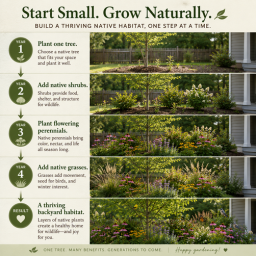
Creating wildlife habitat doesn’t happen all at once.
It begins with one thoughtful decision.
One tree.
One shrub.
One planting bed.
One season after another.
As each piece is added, your landscape becomes more than a collection of plants.
It becomes a place where nature feels at home.
And before long, you’ll find yourself looking out the window —
Not just to admire your garden, but to see who’s visiting today.
Your Tree Will Become Someone’s Home
When you plant a native tree, you’re doing much more than adding another feature to your landscape.
You’re creating a place where life can flourish.
Long before its branches reach their full height, birds may begin stopping to rest.
Native bees may visit its blossoms.
Butterflies may lay eggs on its leaves.
Over time, that single tree becomes woven into the daily rhythm of your garden.
And perhaps without even realizing it, you’ll begin looking at it differently.
Not simply as something you’ve planted—
But as something you’ve helped grow.
Every Season Brings a New Story
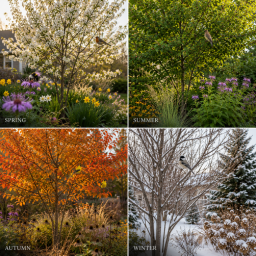
One of the greatest joys of native trees is that they never stop changing.
In spring, blossoms announce the return of another growing season.
Summer brings welcome shade and busy wildlife.
Autumn transforms leaves into brilliant displays of color.
Winter reveals graceful branching, textured bark, evergreen needles, and birds seeking shelter from the cold.
No two months look exactly alike.
That’s one of the reasons native trees remain so rewarding year after year.
They’re always giving you something new to notice.
If you’re interested in learning more about the ecological importance of native trees and forests, the Arbor Day Foundation provides helpful resources on selecting, planting, and caring for trees that benefit both people and wildlife.
Start Where You Are
You don’t need to redesign your entire landscape this season.
You don’t need a large property.
You don’t need to plant a forest.
Perhaps your next step is simply choosing one native tree that fits your yard and planting it well.
That single decision may inspire the next one.
A few years from now, you might add a native shrub beneath it.
Then a drift of wildflowers.
Later, perhaps a small patch of native grasses.
Before long, your landscape becomes something much larger than the sum of its parts.
It becomes a place where people and wildlife feel equally at home.
Choosing the right companion plants is just as important as choosing the right tree. Our article Best Native Shrubs for Privacy and Wildlife explores shrubs that provide berries, nesting cover, and year-round interest beneath the tree canopy.
Happy Gardening!
The best time to plant a tree is often said to have been years ago.
The second-best time is today.
A native tree won’t transform your landscape overnight.
But with each passing season, it will grow stronger, more beautiful, and more valuable to the wildlife that depends upon it.
One day you’ll step outside, hear birds singing from its branches, watch butterflies drifting beneath its canopy, and realize that what began as a small sapling has become the heart of your garden.
That’s the quiet gift of planting native trees.
They ask us to think beyond today.
And they reward us for generations.
Happy gardening,
Barbara Fleury 🌿
Michigan Garden Design
🌿 Continue Growing
Coming Next:
The Best Native Plants That Thrive in Sandy Soil
Not every Michigan garden is blessed with rich, moisture-retaining soil. In our next article, we’ll explore beautiful native plants that flourish in sandy conditions and discover how to work with your soil instead of constantly trying to change it.
Continue Exploring
If you enjoyed this article, you may also like: