
The Best Michigan Native Vines for Pollinators
When we think about adding more native plants to a garden, we usually look down.
Where is there room for another coneflower?
Could we tuck in another grass?
Is there space for one more shrub?
But sometimes the most useful growing space in the garden is not beside us.
It is above us.
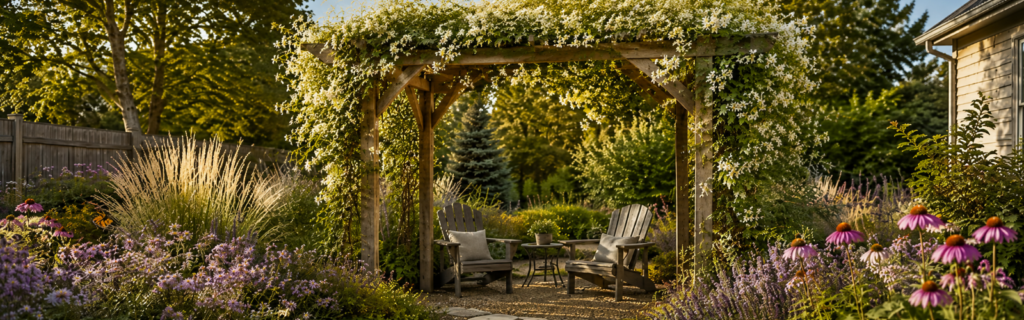
Native vines allow us to take a pollinator-friendly garden vertical, adding flowers, foliage, shelter, and wildlife value without requiring another large planting bed.
A fence, arbor, trellis, porch post, or carefully chosen garden structure can suddenly become part of the habitat.
And for gardeners working with smaller Michigan landscapes, that can open up possibilities we may never have considered.
Why Vines Matter to Pollinators
A native vine is more than a plant that climbs.
Depending on the species, vines can provide nectar and pollen for bees, butterflies, moths, and other insects.
Their foliage can offer shelter.
Some become host plants for caterpillars.
Others produce fruits or seeds that feed birds later in the season.
Dense growth can even create protected places where small creatures rest or move through the landscape.
That is one of the things I love most about native plants.
They rarely have only one job.
A vine may begin the season as fresh foliage, become a flowering pollinator resource, and later provide fruit or cover for wildlife.
It is another example of the layered habitat we discussed in How to Create a Pollinator Habitat in Michigan: It’s More Than Just Flowers.
The garden becomes much more useful when we stop thinking only about blooms.
Vertical Space Can Change a Small Garden
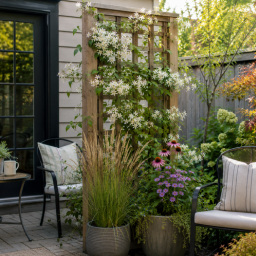
Native vines are especially interesting for gardeners who do not have room to keep expanding outward.
Perhaps you have:
- a small patio
- a narrow side yard
- a fence along the property line
- an arbor over a garden entrance
- a trellis beside a garage
- a porch or deck that could use a softer edge
Those spaces may already have all the soil area they can reasonably accommodate.
But vertical space is often still available.
A vine can provide substantial foliage and flowers while occupying a relatively small footprint at ground level.
You do not necessarily need another garden bed.
Sometimes you need to look at the structures you already have differently.
Not Every Vine Belongs Everywhere
This is where choosing carefully becomes important.
Vines grow in very different ways.
Some twine around supports.
Some use tendrils.
Others attach themselves directly to surfaces.
Their mature size can vary dramatically too.
A vine that works beautifully on a sturdy fence may overwhelm a delicate trellis.
A species that is wonderful along a woodland edge may be far too vigorous beside a small patio.
Before selecting any vine, consider:
How does it climb?
How large will it eventually become?
What will support it?
Can I reach it if it needs occasional pruning or guidance?
Those questions matter just as much as flower color.
Good garden design is not simply choosing a plant we like.
It is choosing a plant whose natural behavior fits the place where we want it to grow.
Native Matters Here, Too
Vines are also one of those plant categories where familiar landscape plants are not always the best ecological choices.
Several nonnative vines commonly found in gardens can spread aggressively or provide far less habitat value than native alternatives.
Some can even escape into natural areas and compete with Michigan vegetation.
That does not mean every vigorous vine is a problem.
It means identification matters.
When we choose a Michigan native vine, we have an opportunity to add vertical beauty while strengthening the relationships between plants and the insects, birds, and other wildlife that evolved alongside them.
It is the same principle behind choosing native flowers, grasses, shrubs, and trees.
The form of the plant changes.
The ecological relationship does not.
Think Beyond the Trellis
A vine does not automatically need to climb a decorative garden trellis.
Imagine one growing:
along a simple fence,
over a sturdy arbor,
through an appropriately sized garden structure,
or in a larger naturalized area where it can interact with surrounding vegetation.
The support should match the personality of the plant.
And just as importantly, the vine should feel connected to the rest of the garden.
Native flowers at its base can continue the pollinator habitat.
Grasses can add contrast and movement.
Nearby shrubs may provide additional shelter and structure.
If you are already using the layering principles from How to Use Native Grasses in Your Michigan Garden, a vine simply adds one more dimension.
Look Up
The next time you walk through your garden, pay attention to the spaces above the flowers.
Look at the fence.
The arbor.
The side of the shed.
The empty trellis.
The narrow corner where another shrub would never fit.
There may be an entire layer of the garden you have not planted yet.
And with the right native vine, that unused vertical space can become another place where flowers bloom, pollinators feed, and the garden becomes a little more alive.
The Best Native Vines for Michigan Home Gardens
If you have been waiting for a long list of native flowering vines, there is something important to know.
Michigan simply does not have the same abundance of garden-friendly native vines that we have in native flowers, grasses, shrubs, and trees.
And I think that makes choosing carefully even more important.
Rather than filling a trellis with a vine simply because it is commonly sold as “native,” let’s look at the plants that truly belong to Michigan, and where they make the most sense in a residential landscape.
Virgin’s Bower
Clematis virginiana
If I were choosing one Michigan native vine specifically for a pollinator-friendly home garden, Virgin’s Bower would be at the top of the list.
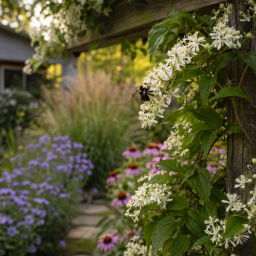
In late summer, it produces airy clusters of small white flowers that can attract bees and other pollinating insects.
The flowers have a completely different character from the large ornamental clematis many gardeners know. Rather than creating one dramatic focal bloom, Virgin’s Bower creates a soft cloud of flowers that feels naturally at home among native perennials and grasses.
After flowering, feathery seed heads extend the season of interest.
Where it works best
Virgin’s Bower can be a beautiful choice for:
- an arbor
- open fencing
- a sturdy trellis
- a garden entrance
- the back of a perennial border
It climbs by wrapping its leaf stalks around supports, so it needs something relatively narrow that it can grab.
Give it room.
This is not necessarily a tiny, perfectly restrained patio vine. In favorable conditions, it can grow enthusiastically, so occasional guidance or pruning may be needed.
For a larger trellis or garden structure, however, that vigor can be an asset.
Virginia Creeper
Parthenocissus quinquefolia
Virginia Creeper offers a very different kind of value.
Its flowers are small and easy for us to overlook, but native gardening is not always about choosing the plant with the showiest bloom.
The flowers contribute to insect activity, while the berries that follow can provide food for birds.
Then fall arrives.
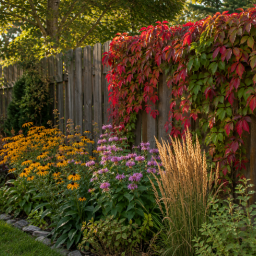
Virginia Creeper can turn brilliant shades of red, creating one of the most dramatic seasonal displays among our native vines.
MSU identifies Virginia Creeper as native to Michigan.
Where it works best
Think bigger with this one.
Virginia Creeper can work beautifully on:
- substantial fences
- large arbors
- pergolas
- outbuildings
- larger naturalized areas
It climbs with tendrils ending in adhesive pads, which allows it to attach directly to surfaces.
That also means it deserves thoughtful placement.
I would not choose it for a small decorative trellis beside a patio where you want a vine to remain neatly confined.
Give Virginia Creeper the space and structure its mature size deserves.
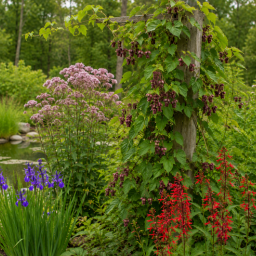
American Groundnut
Apios americana
American Groundnut is one of our more unusual native vines.
Its clusters of reddish-brown to burgundy flowers look almost tropical compared with many familiar Michigan natives.
It is a twining vine naturally associated with moist environments, and its flowers can be visited by pollinating insects.
But this is where we begin moving away from the typical suburban trellis.
Where it works best
American Groundnut makes the most sense in:
- moist garden areas
- rain-garden edges
- pond or water-feature plantings
- larger naturalized landscapes
- sturdy informal supports
If you have a conventional dry foundation bed or small patio garden, this probably would not be my first recommendation.
But for the gardener with the right conditions, it can be a fascinating addition.
Wild Cucumber
Echinocystis lobata
Wild Cucumber is another Michigan native worth knowing, even if it will not belong in every designed garden.
Unlike the perennial vines above, it is an annual vine.
It emerges, grows rapidly, flowers, produces seed, and completes its life cycle within one season.
Its small white flowers can attract insects, and later it develops distinctive prickly-looking fruits.
Where it works best
Wild Cucumber is particularly appropriate for:
- woodland edges
- moist fence lines
- informal wildlife gardens
- larger naturalized areas
Its character is loose and exuberant.
That may be exactly what you want along a woodland edge.
It may be less appropriate beside a manicured patio.
And that distinction matters.
What About Trumpet Honeysuckle?
This is a plant Michigan gardeners are likely to encounter when researching “native vines for pollinators.”
Trumpet Honeysuckle (Lonicera sempervirens) has beautiful tubular flowers and excellent wildlife appeal.
But there is an important distinction:
It is native to parts of eastern North America, but it is not considered native to Michigan.
MSU landscape references specifically list trumpet honeysuckle as not native to Michigan.
That does not automatically make it a bad garden plant.
It simply means I would not include it in an article promising Michigan native vines.
This is exactly why checking regional native status matters. A plant can be native to North America, or even the Midwest broadly, without being native to Michigan.
What About Trumpet Vine?
The same caution applies to Trumpet Vine (Campsis radicans).
Its orange-red tubular flowers make it an obvious hummingbird and pollinator plant, and it is frequently marketed as a native vine.
But MSU also lists Trumpet Vine as not native to Michigan.
For Michigan Garden Design, I think that distinction is worth maintaining.
A Short List Can Be a Good List
It might feel surprising that our strongest residential choices are not a list of ten or fifteen vines.
But I actually see that as useful information.
If your goal is a Michigan-native, pollinator-friendly residential landscape, you do not need to force vines into every available structure.
Use them where they truly fit.
Virgin’s Bower may be wonderful on a sunny or partly shaded arbor.
Virginia Creeper may transform a large fence while providing wildlife value and spectacular fall color.
American Groundnut may thrive beside a moist garden.
And elsewhere, the better answer may simply be another native shrub, grass, or flowering perennial.
Native gardening is not about filling every plant category.
It is about choosing plants that belong to the place.
Build Pollinator Habitat Around the Vine
Whatever vine you choose, think of it as one layer of the planting rather than the entire habitat.
At its base, you might add:
- Purple Coneflower for summer bloom
- Asters for late-season nectar
- Wild Bergamot for bees and butterflies
- Prairie Dropseed or Little Bluestem for texture and structure
MSU emphasizes that landscapes with native plants can provide food and habitat for local wildlife, and that overlapping flowering periods help sustain pollinators throughout the growing season.
The vine gives you height.
The plants underneath give you succession.
Together, they create a much more complete vertical garden.
Using Native Vines Successfully in the Garden
Native vines can add an entirely new layer to a garden, but they work best when the support, location, and mature size of the plant are considered from the beginning.
The goal is not simply to make something climb.
It is to create vertical habitat that feels intentional.
Match the Vine to the Structure
A delicate trellis and a vigorous vine are not a good match.
Before planting, look carefully at what the vine will be climbing.
Ask:
- Is the support strong enough for the mature plant?
- Can the vine wrap around it easily?
- Will I still be able to reach the plant if it needs pruning?
- Could the vine eventually interfere with siding, gutters, or nearby shrubs?
Virgin’s Bower works well with open structures it can twine around.
Virginia Creeper needs considerably more room and a more substantial surface.
American Groundnut is happiest where moisture is available and the support can handle enthusiastic growth.
When the structure and the plant fit one another, maintenance becomes much easier.
Think About Scale
A vine that looks beautiful in a large landscape may feel overwhelming in a small patio garden.
For compact spaces, keep the vertical feature narrow and intentional.
In a modest backyard, a fence or arbor gives you more freedom.
In a larger front yard or naturalized edge, a vigorous vine may become part of the larger framework of the garden.
This is the same principle we use throughout garden design:
Let the size of the space guide the size of the plant.
Give the Vine a Garden at Its Feet
A vine should not feel like it is growing out of an empty patch of soil.
Plant around it.
Native flowers and grasses at the base help connect the vertical structure to the rest of the landscape.
For example:
- Virgin’s Bower with asters and Prairie Dropseed
- Virginia Creeper near native shrubs and Little Bluestem
- American Groundnut beside moisture-loving native flowers
The vine provides height.
The plants below provide continuity.
Together, the planting feels layered rather than isolated.
Guide Growth Early
Most vines are easier to manage when you pay attention during the first few seasons.
Guide new stems toward the structure you want them to use.
Remove growth heading into places where it does not belong.
Check supports occasionally.
And learn how the plant naturally grows before deciding that every wandering stem needs to be cut.
A little early guidance can prevent much larger corrections later.
Barbara’s Observation
Vines change the way we think about garden space.
Most of the time, we look across the landscape.
We notice empty beds, bare corners, and places where another plant might fit.
But a vine asks us to look up.
Suddenly a fence becomes habitat.
An arbor becomes a flowering structure.
A narrow space that seemed too small for another garden begins supporting pollinators above the plants already growing there.
That shift in perspective is what I find most interesting.
Sometimes the garden does not need to become wider.
It simply needs another layer.
Your Garden Has a Story. Start Recording It.
Vertical growth can be especially interesting to observe over time.
When does your vine begin climbing?
Which pollinators visit the flowers?
How quickly does it fill the structure?
What happens around it as the surrounding plants mature?
The complimentary first month of The Michigan Native Garden Journal gives you a place to record those changes and begin noticing the relationships developing throughout your garden.
COMPLIMENTARY FIRST MONTH
The Michigan Native Garden Journal
↓ GET YOUR COPY ↓

Observe • Discover • Wonder • Grow.
Keep Exploring
Continue building a layered, wildlife-friendly Michigan garden:
- How to Create a Pollinator Habitat in Michigan: It’s More Than Just Flowers
- How to Use Native Grasses in Your Michigan Garden
- The Best Native Plants That Feed Goldfinches
- How To Create Small Water Features for Wildlife
For additional information about Michigan native plants and pollinator habitat, explore trusted resources from Michigan State University Extension, Wildflower Association of Michigan, and Michigan Pollinator Initiative.
What’s Next
If you have never considered using a native vine before, begin by looking at the structures already in your landscape.
Is there a fence that feels bare?
An arbor with nothing growing over it?
A narrow space where another shrub would never fit?
Then choose the vine for the place, not the other way around.
One thoughtfully placed vine can add flowers, shelter, movement, and wildlife value without requiring another large garden bed.
And sometimes, that unused vertical space is exactly where the next layer of your garden belongs.
Coming Next
A native garden often looks a little sparse in its first year, but that does not mean something is wrong.
In the next Michigan Garden article, How to Let Your Native Garden Fill in Naturally, we’ll look at how native plants spread, reseed, and knit together over time, along with how to recognize the difference between healthy natural growth and a garden that truly needs intervention.
Sometimes the best thing we can do is give the garden a little more time.