
How to Read Your Garden Before You Change It
There is something about fall that makes gardeners want to make plans.
The flowers are fading. Plants that once filled every corner are beginning to lean, dry, and disappear. Spaces we barely noticed in July suddenly seem obvious. Maybe a planting feels too crowded. Maybe another area looks strangely empty. Maybe you have already started imagining what you could move, divide, remove, or add next spring.
But before you change anything, there is one step worth taking first:
Read the garden you already have.
A garden is constantly giving us information. The challenge is that we often move too quickly to notice it.
We see a bare spot and think, I need another plant.
We see a perennial leaning and think, That plant doesn’t belong there.
We notice fewer flowers and assume something has gone wrong.
Sometimes those conclusions are right. But sometimes the garden is telling us something entirely different.
The bare spot may receive less sunlight than it did when you first planted it. The leaning perennial may simply be reaching toward better light. An area that struggles every summer may be much drier than the rest of the bed. And a space that appears empty in October may have been beautifully filled by spring ephemerals only a few months earlier.
Before we redesign a garden, it helps to understand the story behind what we see.
Your Garden Is a Collection of Conditions
One of the easiest mistakes in garden planning is to think of a bed as having one set of growing conditions.
“This is my sunny garden.”
“This is the wet area.”
“This bed has sandy soil.”
In reality, even a modest residential garden can contain several small environments.
The south side of a house may stay warm and dry while a nearby corner remains shaded and moist. Water may collect at the bottom of a slight slope but drain quickly only a few feet away. A tree that was small when the garden was planted may now cast hours of additional shade.
Michigan gardens can contain sand, clay, loam, fill, altered subdivision soil, and combinations of those conditions, which is one reason it is better to evaluate your own site than to make assumptions about what “Michigan soil” should be.
And those conditions do not remain completely static.
Trees grow.
Roots spread.
Drainage patterns become noticeable.
Plants expand into colonies.
Some species thrive while others slowly decline.
Over time, the garden becomes a record of what works there.
Look at the Plants That Are Already Answering the Question
Sometimes the most useful information does not come from the plant that failed.
It comes from the one beside it that flourished.
If one section of your native garden consistently produces sturdy growth while another struggles, pause before replacing the struggling plants. What is different between those two places?
Look at sunlight.
Look at moisture.
Look at competition from nearby plants or tree roots.
Look at how large the plants have actually become compared with what you expected.
Notice where seedlings are appearing naturally and where plants are beginning to form colonies.
This is closely connected to what we explored in How to Let Your Native Garden Fill in Naturally. A garden is not a collection of plants frozen in the positions where we first placed them. It changes as plants mature, spread, reseed, and respond to one another.
Those changes are information.
Fall Makes Some Things Easier to See
By late summer and fall, much of the garden’s growing season is behind us. That makes this an especially useful time to look back.
Where did you wish you had more summer shade?
Which plants disappeared behind taller neighbors?
Where did rainwater linger?
Which area dried out first?
Where did plants crowd a walkway?
Which part of the garden always seemed to have something happening, and which part went quiet for weeks?
You do not have to solve any of those things yet.
For now, simply notice them.
That distinction matters because observation and correction are not the same step.
The impulse to improve a garden can make us rush directly toward solutions. But the better question often comes first:
What is my garden showing me?
Once you begin looking at the garden that way, empty spaces, crowded plants, unexpected seedlings, changing shade, and even unsuccessful plantings become useful clues rather than problems that need an immediate fix.
And those clues can make the next decisions much easier.
You do not need to conduct a formal landscape assessment to learn a great deal about your garden.
Choose one bed, border, or section of your yard and spend a little time looking at it differently. Instead of asking, What should I plant here? begin with a simpler question:
What is already happening here?
A few observations can tell you far more than a shopping list ever could.
1. Start With the Light
We often remember how much sun a garden received when we planted it rather than how much it receives now.
Stand in the garden and look up.
Have nearby trees grown larger? Has a shrub begun shading plants beside it? Does your house block afternoon sun during part of the year?
Notice the plants, too. Are some leaning strongly toward the light? Are formerly vigorous sun-loving plants becoming thinner or flowering less?
You do not necessarily need to change anything immediately. You are gathering clues.
If you are planning significant changes next year, consider observing the area at several times of day and recording approximately when direct sun reaches and leaves it.

2. Follow the Water
Water can vary surprisingly within a single garden bed.
Look for the places that remain damp after rain and those that dry quickly. Notice low spots where water collects, areas beneath rooflines that receive less rainfall, slopes where water moves away quickly, and places where nearby tree roots may compete for moisture.
Then look at your plants.
Which ones consistently thrive there?
Which ones struggle during dry stretches?
The plants already growing in that location can help you understand the conditions beneath your feet.
Rather than immediately trying to change the site to suit a plant, sometimes the better solution is eventually choosing plants that suit the site.
3. Look Beyond the Surface of the Soil
You do not have to identify your soil by sight alone.
Instead, pay attention to what it does.
After a soaking rain, does water disappear quickly or remain for a long time? When you dig, is the soil loose and easy to work or dense and compacted? Does one section behave differently from another?
If you need more precise information before making major changes, soil testing can provide a much clearer picture than guessing or routinely adding amendments.
The goal is not to create some imaginary version of “perfect garden soil.”
It is to understand the soil you actually have.
4. Let Your Plants Give You a Performance Review
Now look at the garden plant by plant, but resist judging everything by whether it looks beautiful in fall.
Instead, think back over the growing season.
Which plants were sturdy and healthy?
Which flowered well?
Which flopped or needed support?
Which became larger than expected?
Which disappeared behind their neighbors?
Which spread into places where you were happy to see them, and which began taking more territory than you wanted?
This is where mature gardens become particularly valuable teachers.
A plant tag can tell you what a species typically does. Your own garden shows you what that plant is doing in your conditions.
5. Notice the Spaces Between the Plants
Not every gap needs filling.
Look at an open area and ask what occupied it earlier in the year.
Was it truly empty all season?
Did an early-blooming plant grow there and then go dormant?
Will neighboring plants expand into the space next year?
Could that opening be providing visual breathing room between larger masses of plants?
This is another reason to be cautious about making major decisions from a single autumn snapshot.
On the other hand, you may discover a genuine seasonal gap, a place where the garden repeatedly loses color, structure, or interest for several weeks. That is useful information to carry into next year’s planning.
6. Watch Where the Garden Is Moving on Its Own
Finally, look for change.
Perhaps a native perennial is forming a larger colony. Maybe seedlings have appeared several feet from the parent plant. One species may be gradually weaving between another.
Before deciding that those plants are “out of place,” consider whether their movement is improving the planting.
Some of the most natural-looking native gardens develop when we allow plants a little room to show us where they are comfortable.
That does not mean giving up design or allowing every plant to grow wherever it chooses. It means recognizing that a living garden will never remain exactly where we placed it.
The question becomes:
Which changes should I guide, and which ones should I allow?
Make a Record Before You Make a Plan
You do not need pages of notes.
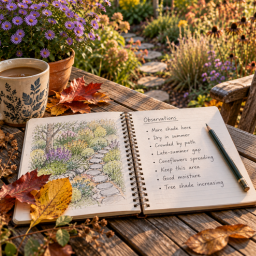
Take a few photographs. Make a simple sketch. Write down three or four things you noticed.
More shade here.
Dry in midsummer.
Too crowded along the path.
Nothing flowering here in August.
Coneflowers spreading beautifully into this space.
Those small observations become remarkably valuable several months later, when the garden looks completely different and you are trying to remember what happened.
For now, you still do not need to fix anything.
You are creating something more useful first:
a record of the garden you actually have, not the garden you remember having.
Decide What Really Needs to Change
After you have spent some time reading your garden, you may discover something unexpected:
There may be less to fix than you thought.
A plant leaning into another may simply need more room. A bare spot may be temporary. A native perennial spreading beyond its original footprint may be doing exactly what you hoped it would do, just not within the tidy boundaries you first imagined.
And sometimes, of course, the garden really is telling you that something should change.
The difference is that now you have a reason for making that change.
Separate the Problem From the Preference
Before moving, removing, or adding anything, ask yourself:
Is something actually not working, or would I simply like it to be different?
Both are valid reasons to make a change, but they are not the same.
A plant repeatedly struggling because the site has become too shady is a performance issue.
A plant growing beautifully but blocking your view from the kitchen window is a design issue.
A native perennial spreading into its neighbors may be perfectly healthy but more vigorous than you want in that particular location.
And a garden bed that feels untidy to you may simply need stronger edges, repetition, or structure rather than an entirely new collection of plants.
Understanding why you want something to change makes the eventual solution much clearer.
Know When to Give the Garden Another Season
Gardens develop slowly, and young native plantings can be particularly deceptive.
A space that looks sparse today may look entirely different as plants mature. Recently moved or divided plants may need time to settle. A young shrub that seems undersized for its location may eventually provide exactly the structure you hoped for.
Before filling every opening or relocating something that seems disappointing, ask:
What happens if I wait?
Take a photograph. Make a note. Look again next spring or summer.
Waiting is not the same as ignoring a problem.
Sometimes waiting is how we discover whether there was a problem in the first place.
Change the Garden With a Reason
When you do decide to make a change, let your observations guide it.
Instead of:
I need something new here.
You may now know:
I need a plant that can handle increasing afternoon shade.
Instead of:
This area looks empty.
You may realize:
This area needs something that carries interest into late summer.
Instead of:
These plants aren’t working.
You might discover:
They are healthy, but their mature size is wrong for this narrow space.
Those are much more useful starting points.
They also make plant selection easier because you are no longer asking a new plant to solve a problem you have not yet identified.
The goal is not to stop changing the garden.
It is to make each change more intentional.
Barbara’s Observation
The longer I spend around gardens, the more I appreciate the difference between looking at one and truly noticing it.
It is easy to walk outside and immediately see what we want to change. The harder, and often more rewarding, practice is to stay there long enough to notice what is already working.
A plant choosing its own little corner. A patch of soil that stays damp longer than we realized. An opening that looked empty in October but was filled with flowers in May.
Gardens leave clues everywhere.
Sometimes the most important thing we can do before reaching for the shovel is simply learn to see them.
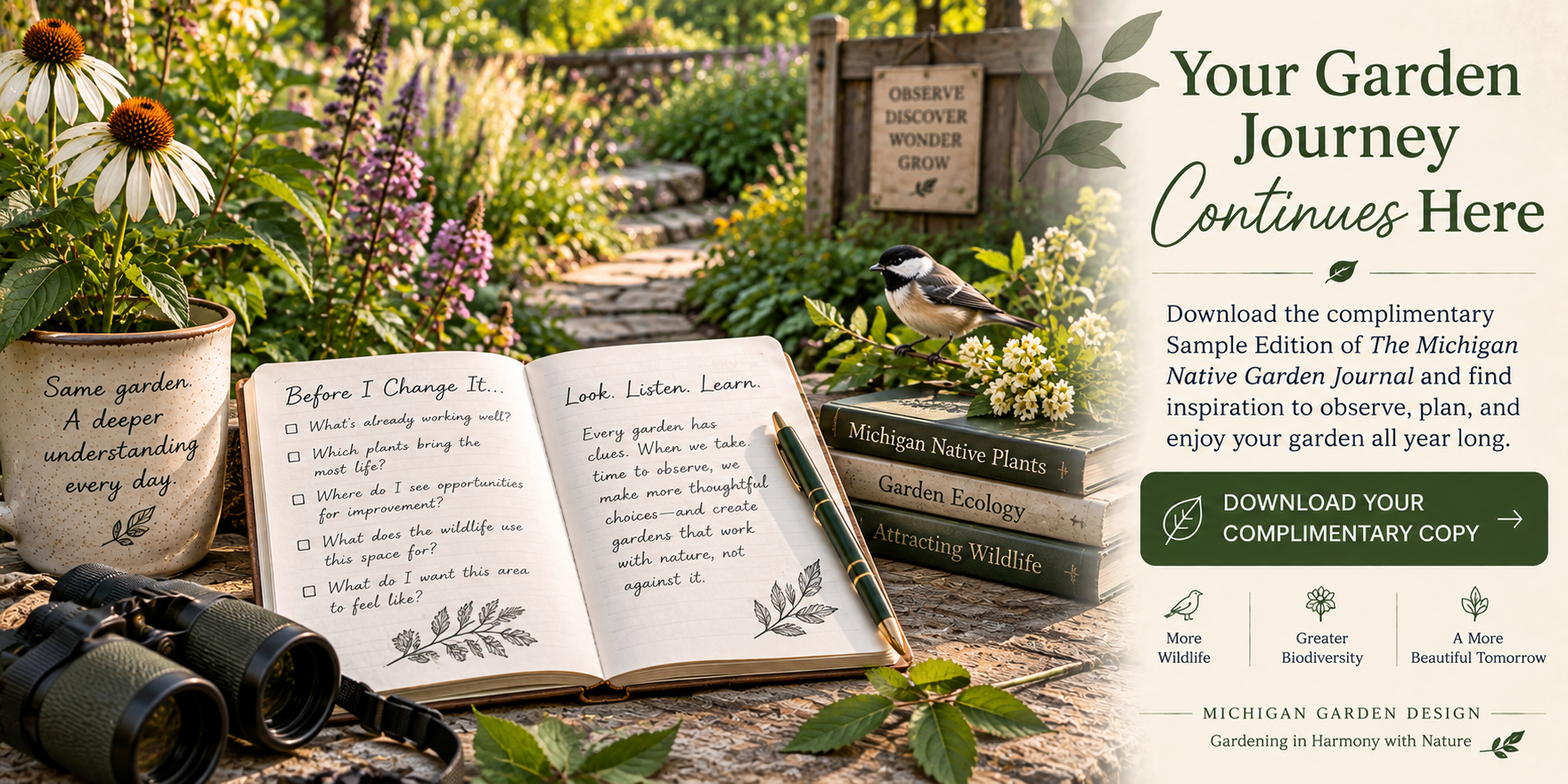
Take Your Observations Into the Michigan Native Garden Journal
This is exactly the kind of garden learning the Michigan Native Garden Journal was created to encourage.
Before changing a garden area, photograph it and record what you notice: sunlight, moisture, plant performance, crowding, seasonal gaps, or places where plants are beginning to move naturally.
Then return to those observations next season.
Over time, those simple records can help you recognize patterns that are almost impossible to remember from season to season.
COMPLIMENTARY FIRST MONTH
The Michigan Native Garden Journal
↓ GET YOUR COPY ↓
Observe • Discover • Wonder • Grow
Keep Exploring
If you are learning to make decisions by watching how your garden develops, continue with:
How to Let Your Native Garden Fill in Naturally
See how native plants can spread, mingle, and gradually occupy space without every gap needing to be replanted.
Learning How to Trust Your Native Garden
Explore the difference between neglecting a garden and giving natural processes enough time to unfold.
How to Divide and Move Native Perennials in Fall
When observation tells you that a plant truly would perform better somewhere else, learn how to approach the move thoughtfully.
How to Add Native Shrubs to an Existing Landscape
Discover how shrubs can add structure and another layer without requiring you to redesign the entire garden.
What’s Next
Choose one area of your garden this week and resist the urge to change it.
Take a photograph and write down five things you notice.
Where does the light fall?
Where does the soil seem wetter or more dry?
Which plants are thriving?
Where are plants moving on their own?
What changed during the growing season that you had forgotten about?
You do not need to decide what to do yet.
For now, your only job is to read the garden.
Coming Next
Once you understand what your garden is showing you, planning becomes much easier.
Next in our Michigan Garden articles, we’ll take those observations and begin turning them into thoughtful choices in:
How to Plan Next Year’s Native Garden This Fall 🍁
We’ll look at how this year’s successes, struggles, seasonal gaps, and unexpected changes can become the starting point for next year’s garden, before winter makes those details much harder to remember.