
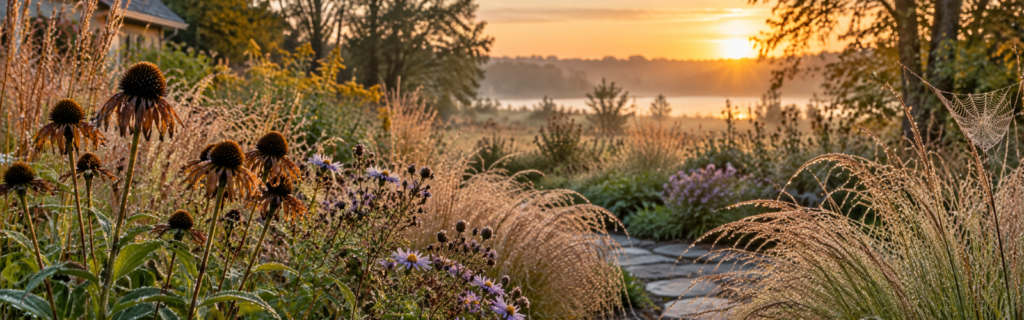
Why Morning Dew Is One of the Garden’s Greatest Gifts
Nature Notes | No. 7 | Published Sep 10, 2026
There is a moment in the garden that belongs almost entirely to morning.
Before the sun climbs high enough to warm the leaves, before bees begin moving steadily from flower to flower, and before the garden settles into the activity of the day, tiny beads of water often rest along the edges of grasses, leaves, petals, and seed heads.
Morning dew can make an ordinary garden look newly made.
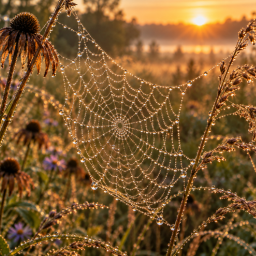
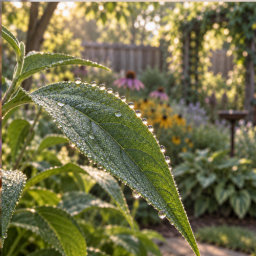
A spiderweb that went unnoticed the evening before suddenly becomes a silver net stretched between two stems. The fine hairs along a leaf catch dozens of tiny droplets. A fading flower glows for a few minutes as though it has been decorated overnight.
And then, almost as quickly as it appeared, the dew is gone.
Perhaps that is part of what makes it so easy to overlook.
Dew Is More Than a Pretty Morning Detail
Dew forms when surfaces in the garden cool enough overnight for water vapor in the surrounding air to condense into droplets. It is not the same thing as rain falling from the sky. Instead, moisture already present in the air gathers on cooler surfaces near the ground.
Leaves, blades of grass, seed heads, garden furniture, stones, and even spider silk can become places where that moisture collects.
The amount of dew we see can vary considerably from one morning to another. Clear nights, calm conditions, humidity, temperature, and the characteristics of the surface itself all influence how much condensation forms.
That means the garden does not wake up wearing the same amount of dew every day.
And that variability is worth noticing.
One morning, the lawn may sparkle while taller plants remain almost dry. Another morning, every stem seems outlined in water. On some late-summer and early-fall mornings in Michigan, heavy dew can make the entire garden appear as though it has received a very light rain.
It is one of those seasonal details that reminds us how much is happening in a garden before we ever step outside.
Dew Makes the Invisible Easier to See
One of dew’s greatest gifts may have very little to do with the water itself.
Dew reveals structure.
It shows us the architecture of a spiderweb suspended between plants.
It traces the fine edges of native grasses.
It settles onto the textures of leaves we normally notice only for their color.
And as flowers move toward seed, dew can make the forms of seed heads unexpectedly beautiful.
That is one reason leaving portions of a garden standing into fall can become such a rewarding change in perspective. Plants that might once have looked “finished” suddenly begin offering entirely different details.
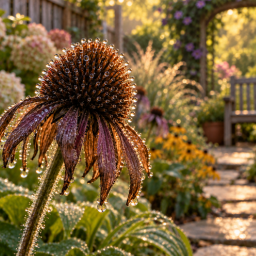
A coneflower seed head covered with dew does not look like a flower that has disappeared.
It looks like something new.
That same shift in perspective is part of what we explored in How to Save Native Flower Seeds for Next Year. Once we begin watching what happens after bloom, the garden becomes much larger than its flowers.
Morning dew simply makes some of those later stages easier to notice.
A Garden Changes When We Begin Looking Earlier
Many of us become familiar with our gardens at the times we are most often outside.
Perhaps that is late afternoon after work. Maybe it is midday while watering, weeding, or walking through the yard.
But visiting the garden early in the morning can introduce an entirely different landscape.
Colors appear softer.
Bird activity may be different.
Flowers that seemed tired in yesterday’s heat may appear refreshed.
And surfaces that usually seem ordinary suddenly reflect light.
The garden has not necessarily changed overnight.
Our opportunity to see it has.
This is one of the quiet lessons behind much of Nature Notes. Sometimes discovering more about a garden does not require adding anything at all.
It simply requires arriving at a different moment.
What Morning Dew Reveals
Morning dew is easy to admire from a distance.
But the real surprise begins when you move closer.
A garden covered in dew becomes a temporary collection of details—textures, patterns, tracks, webs, edges, and shapes that may be almost invisible later in the day.
The best way to experience it is not to hurry through.
It is to look.
Start With the Leaves
Different leaves hold dew differently.
Broad leaves may collect larger droplets across their surfaces. Narrow leaves can hold beads of water along their margins. Fine hairs on stems and foliage can catch moisture so delicately that the entire plant seems outlined in light.
Try comparing several plants in the same garden.
Which leaves appear almost dry?
Which seem covered?
Where do droplets gather—along the edges, near the veins, at the tips?
You do not need to identify every reason for the difference. The value is in beginning to notice that plants interact with the same morning conditions in very different ways.
That observation alone can make familiar foliage suddenly interesting again.
Look Closely at Grasses
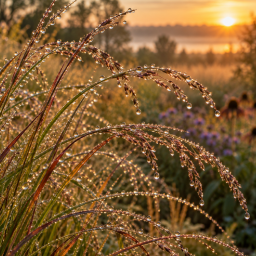
Native grasses can be especially beautiful on a dewy morning.
Their long blades catch droplets along narrow edges, while seed heads can hold tiny points of moisture that shimmer when the light reaches them.
From across the yard, you may notice the entire planting glowing.
Up close, the effect is even more striking.
This is also one of those moments when the structure of grasses becomes as important as their color. Their upright stems, arching blades, and delicate seed heads create places for water and light to collect.
It is a reminder that garden beauty is not limited to bloom.
Find the Spiderwebs
Few things demonstrate the revealing power of dew better than a spiderweb.
A web that is nearly invisible on a dry afternoon may become unmistakable in the morning, every strand traced with droplets.
Suddenly you can see where it was built.
Between two flower stems.
Across the open center of a shrub.
Near a porch railing.
Low among grasses.
Seeing those webs can also remind us that a garden is occupied even when we are not watching.
Many of its inhabitants are using stems, leaves, seed heads, and small open spaces as part of their everyday world.
Dew simply gives us a brief glimpse of that hidden activity.

Notice Flowers Differently
A dew-covered flower often looks entirely different from the same flower at midday.
Droplets can cling to petals, settle into the center of a bloom, or gather along unopened buds.
But do not look only at the flowers that are at their peak.
Look at the ones beginning to fade.
Late-season gardens are especially good places to notice this transition. Petals may be disappearing while seed structures become more prominent. Dew highlights those changing shapes and can make the shift from flower to seed easier to appreciate.
The garden is not becoming empty.
It is changing form.
Pay Attention to Seed Heads
Seed heads may be one of the most rewarding places to look.
Coneflowers, asters, grasses, and many other plants develop distinctive structures after flowering. On a dry day, those structures may blend quietly into the background.
Add dew, and suddenly every edge becomes visible.
You begin to see the geometry of the seed head.
Its texture.
Its layers.
The way it holds itself above the rest of the plant.
That close observation becomes especially meaningful as the season advances, because these structures are preparing to carry the garden forward in ways that flowers no longer can.
And once you begin looking at seed heads closely, it becomes difficult to see them as simply the remains of summer.
Give Yourself Five Quiet Minutes
You do not need a formal garden walk or a long morning outdoors.
Five minutes can be enough.
Step outside before the sun has dried the garden.
Choose one small area.
Look at the leaves.
Look beneath them.
Notice where the dew is heavy and where it is absent.
Find one spiderweb.
Study one seed head.
Watch how the light changes as you move.
You may be surprised by how much becomes visible when the purpose of the walk is not to weed, prune, water, or decide what needs fixing.
For a few minutes, the only job is to notice.
What Dew Teaches Us to Notice
Morning dew does not last long.
Once the sun rises higher and the air warms, droplets begin to disappear. Spiderwebs fade back into near invisibility. Seed heads lose their sparkle. Leaves return to the familiar surfaces we see throughout the rest of the day.
That briefness is part of the gift.
Dew reminds us that some of the garden’s most beautiful moments are temporary.
They cannot be scheduled for later.
They have to be noticed while they are here.
The Garden Is Always Offering More Than Flowers
It is easy to measure a garden by what is blooming.
Flowers are obvious. They announce themselves.
But dew draws attention to quieter things.
A leaf edge.
A blade of grass.
A web.
A spent flower.
A seed head.
A stem catching the first light of morning.
These are not secondary details. They are part of the garden too.
When we begin noticing them, the season feels less like a series of blooms that appear and disappear and more like one continuous unfolding.
That shift becomes especially meaningful as summer moves toward fall.
The garden may be changing, but it is not becoming less interesting.
Its stories are simply becoming quieter.
Let Morning Change the Way You See the Garden
You do not need to become an early riser every day to appreciate this.
Just choose a morning now and then when the conditions seem right.
Walk outside before the sun has dried everything.
Leave the pruning shears behind.
Leave the list of chores inside.
Look for one detail you have never noticed before.
It might be the pattern of water along a grass blade.
It might be a spiderweb suspended between two stems.
It might be the shape of a seed head you had previously considered finished.
The more often we practice this kind of looking, the more the garden begins to reveal.
And sometimes the greatest change is not in the garden at all.
It is in what we have learned to see.
Barbara’s Observation
Some of the moments I remember most clearly in a garden are not the dramatic ones.
They are the quiet mornings when I step outside and something familiar looks completely different.
Dew has a way of doing that.
It takes plants I have walked past countless times and asks me to look again.
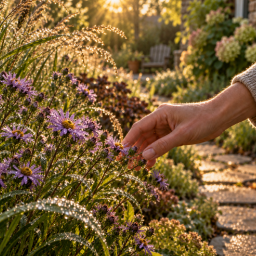
A grass catches the light differently. A spiderweb suddenly appears where I did not know one existed. A seed head becomes intricate and beautiful instead of simply looking like a flower that has finished blooming.
Those mornings remind me that a garden never really runs out of things to show us.
Sometimes we simply need to arrive at the right moment.
Take This Observation Into Your Garden Journal
A dewy morning is a perfect opportunity to record one of the garden’s temporary moments.
You might photograph the same plant early in the morning and again later in the day.
Notice where dew collects most heavily.
Record what surprised you.
Or choose one leaf, web, grass, or seed head and describe what you saw before the droplets disappeared.
Over time, those small observations begin to tell a much larger story about the changing seasons in your own garden.
COMPLIMENTARY FIRST MONTH
The Michigan Native Garden Journal
↓ GET YOUR COPY ↓
Observe • Discover • Wonder • Grow.

Keep Exploring
If this morning walk has you noticing the quieter details of the garden, you may also enjoy:
How to Save Native Flower Seeds for Next Year
Look beyond the bloom and discover what happens as flowers begin preparing for another generation.
Why Your Native Garden Gets Better Every Year
Explore how time, patience, and natural development help a native garden become richer and more connected.
Learning How to Trust Your Native Garden
A closer look at what happens when we stop reacting to every change and begin observing what the garden is doing.
What’s Next
On the next dewy morning, step outside before the garden dries.
Do not try to study the whole yard.
Find one thing.
One leaf.
One web.
One blade of grass.
One seed head.
Look closely enough to notice something you would have missed later in the day.
That is enough.
Coming Next
Morning dew has already begun introducing us to one of the garden’s most overlooked structures: the seed head.
But there is far more happening there than meets the eye.
Next in Nature Notes, we’ll explore How To Unravel the Secret Life of a Seed Head and look more closely at what happens after a flower fades, how seeds are held and released, and why these quiet structures deserve far more attention than they usually receive.