
How to Prepare Michigan Native Plants for Winter
When the Garden Begins to Wind Down
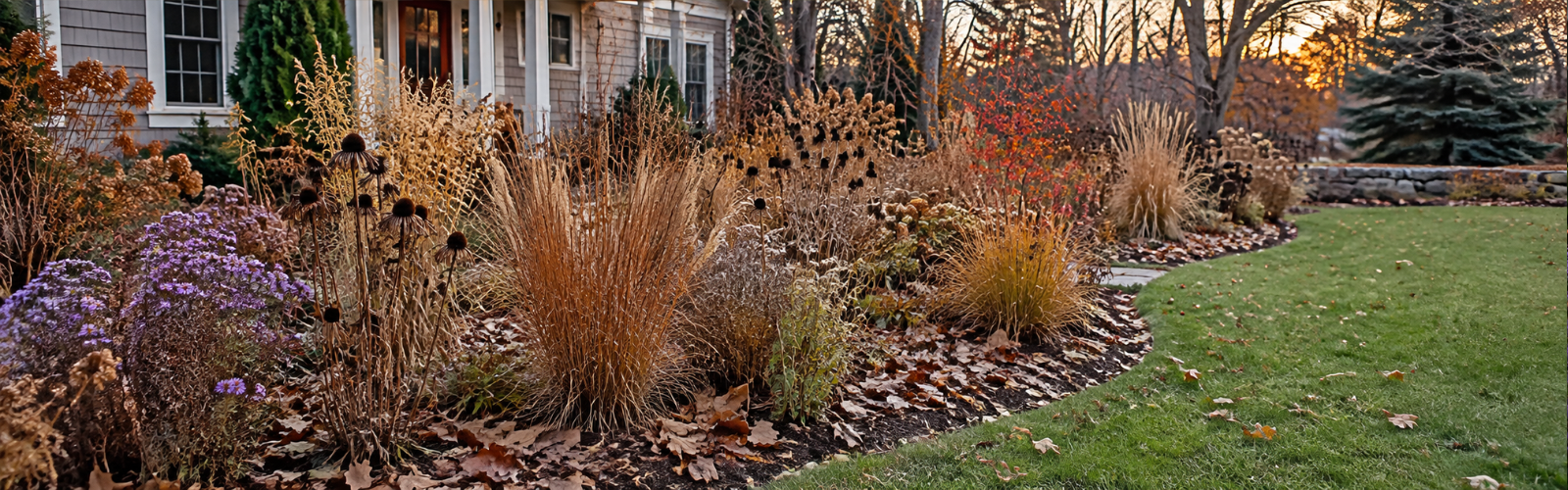
There comes a point in every Michigan garden when summer begins to loosen its grip.
Purple Coneflowers lose their bright pink petals.
Black-eyed Susans fade from brilliant yellow to brown.
Blazing Star turns from purple flower spikes to slender stems topped with seed.
Native grasses begin trading summer green for shades of gold, bronze, and copper.
For many gardeners, this is the moment when the garden starts looking like it needs to be cleaned up.
We’ve been taught to deadhead spent flowers, cut back brown stems, rake away fallen leaves, and leave the landscape looking tidy before winter arrives.
But when you’re gardening with Michigan native plants, preparing the garden for winter can look surprisingly different.
In many cases, the best thing you can do is less.
Native Plants Are Already Preparing for Winter
Long before we begin thinking about frost, native plants are responding to changes in daylight and temperature.
Their growth slows.
Energy shifts away from producing flowers and new leaves.
Seeds mature.
Aboveground foliage begins to fade while perennial plants prepare to rely on the roots and crowns that will carry them through winter.
This seasonal transition isn’t a sign that the garden is failing or becoming neglected.
It’s exactly what these plants are supposed to do.
Michigan native plants have evolved alongside our cold winters, freeze-and-thaw cycles, snow, and changing seasons. Once established in appropriate growing conditions, most don’t need to be wrapped, dug up, heavily fertilized, or otherwise persuaded to survive winter.
What they need most from us is to understand when to help, and when to leave their natural processes alone.
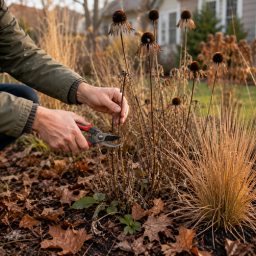
Start by Putting Down the Pruners
One of the biggest changes you can make to your fall garden routine is also one of the easiest:
Don’t automatically cut everything down.
A flower doesn’t stop being useful when its petals fall.
Purple Coneflower develops the familiar dark, bristly cone that can hold seeds.
Black-eyed Susan leaves behind rounded dark centers.
Milkweed produces distinctive pods that eventually open and release silky seeds into the wind.
Native grasses develop seed heads that catch the light, move in the breeze, and remain part of the landscape long after summer flowers disappear.
These aren’t simply remnants waiting to be removed.
They are part of the plant’s natural life cycle, and they can continue serving the garden well into fall and winter.
Why Seed Heads Matter
One of the easiest ways to understand the value of leaving at least some plants standing is to watch what happens after the flowers are gone.
You may see an American Goldfinch balancing on a coneflower stem and pulling seeds from its center.
Other seed-eating birds may investigate standing plants for food.
Some seeds will fall naturally into the garden.
Others may be carried elsewhere.
And native grasses can continue providing both seeds and valuable winter structure.
Suddenly, plants you might once have considered “finished” are doing something entirely new.
This is one reason our approach in How to Prepare Your Garden for Fall Pollinators doesn’t end when the last major flush of flowers disappears. A garden allowed to move naturally through its seasons can continue providing resources long after peak summer color has passed.
Leaving Plants Standing Doesn’t Mean Leaving Everything
This is an important distinction.
Preparing a native garden for winter isn’t about abandoning it until spring.
There are still good reasons to intervene.
Diseased plant material may need to be removed.
Plants blocking sidewalks, driveways, entrances, or other frequently used spaces can be trimmed.
Aggressive reseeders can be deadheaded when you don’t want additional plants.
Newly planted natives may need attention if autumn has been unusually dry.
And fallen leaves can be managed thoughtfully rather than automatically removed from every corner of the landscape.
The goal isn’t:
Leave everything.
It’s:
Understand what you’re changing before you change it.
That small shift turns fall cleanup into something much more intentional.
Don’t Rush to Fertilize
Fall also brings another familiar gardening instinct: giving plants one final feeding before winter.
For an established native garden, that’s generally unnecessary.
Native plants growing in conditions suited to their needs typically don’t require the kind of routine fertilization often associated with traditional ornamental landscapes.
In fact, excessive fertility can sometimes encourage lush growth at the expense of the sturdy, naturally adapted growth we’re trying to encourage.
Rather than automatically reaching for fertilizer, let the plants begin their natural transition toward dormancy.
Their slowing growth isn’t something we need to correct.
Your Winter Garden Begins in Fall
The decisions you make now determine much of what you’ll see outside your window several months from now.
Leave a coneflower standing, and you may eventually see its dark seed head outlined in frost.
Leave Little Bluestem, and its warm copper tones can rise above the snow.
Allow Prairie Dropseed and other native grasses to remain, and suddenly the winter garden has movement, texture, and shape.
Leave some healthy stems and plant material, and you’re allowing the garden to retain more of the structure nature created.
This is where preparing a native garden for winter begins to look very different from simply “putting the garden to bed.”
We’re not closing the garden for the season.
We’re helping it move into the next one.
And once you begin seeing fall that way, the brown stems, seed heads, changing grasses, and fallen leaves start looking less like something to clean up, and more like part of a garden that is still very much at work.
What Your Native Garden Actually Needs Before Winter
Once you stop thinking of fall as the season when everything must be cut down and cleared away, winter preparation becomes much simpler.
Instead of asking:
How do I clean up this garden?
Try asking:
What actually needs my attention before winter?
For an established Michigan native garden, the answer may be surprisingly little.
But there are a few things worth checking before consistently cold weather settles in.
Pay Special Attention to Newly Planted Natives
Established native plants may be remarkably resilient, but plants that went into the ground this year are still developing the root systems that will eventually make them so dependable.
That means first-year plants deserve a little extra attention heading into winter.
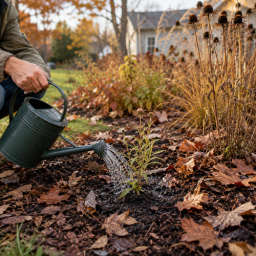
If autumn has been dry, continue watering them as needed while the soil remains workable. The goal isn’t to keep the plants actively growing, it is to avoid sending newly established roots into winter in excessively dry soil.
Plants installed later in summer or fall may need even closer observation because they’ve had less time to establish.
Once the ground freezes, watering is no longer useful. Until then, however, don’t assume cooler weather automatically means your new plants have enough moisture.
A few minutes spent checking the soil can tell you much more than the calendar.
Let Fallen Leaves Work for You
Autumn leaves are another place where native gardening can challenge our traditional ideas about cleanup.
Leaves don’t necessarily need to disappear from the landscape.
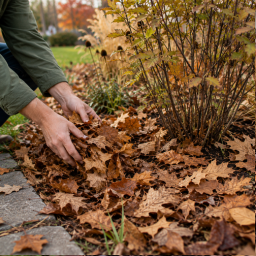
A light layer beneath trees, shrubs, and within appropriate garden beds can help protect soil, conserve moisture, return organic matter as it decomposes, and provide habitat for countless small organisms.
That doesn’t mean every leaf needs to remain exactly where it falls.
Leaves accumulating heavily over a lawn can be moved.
Walkways and driveways can certainly be cleared.
And thick, matted layers shouldn’t be allowed to smother small plants.
The opportunity is simply to move leaves with purpose rather than automatically sending all of them away.
A leaf removed from the patio may be much more useful tucked beneath a shrub or incorporated into an appropriate garden area.
Sometimes winter preparation is less about removing material and more about deciding where it belongs.
Remove Problems, Not the Entire Garden
There is an important exception to our “leave more standing” approach:
disease.
If a plant has experienced a significant disease problem during the growing season, leaving affected material in place may not be the best choice.
Remove clearly diseased foliage or stems when appropriate and dispose of that material in a way that won’t simply return the problem to the garden.
The same principle applies to unwanted weeds and invasive plants.
Winter habitat doesn’t require allowing problems to remain.
This is where observation matters.
Healthy brown foliage is not the same thing as diseased foliage.
A spent flower is not automatically unhealthy.
A dormant plant isn’t dying.
Learning to recognize those differences allows you to remove what genuinely needs attention while leaving the rest of the garden intact.
What Should You Cut Back?
There isn’t one rule that works for every plant in every garden.
Instead, consider why you’re cutting something.
Is it diseased?
Is it blocking a walkway?
Has it collapsed in a way that creates a problem?
Do you need to prevent excessive reseeding?
If there’s a good reason, cut it back.
But if the only reason is “It’s brown now,” consider waiting.
Many sturdy flowering natives and grasses can remain through winter.
Purple Coneflower, Black-eyed Susan, asters, Blazing Star, and native grasses can provide texture and structure after flowering. Their seed heads may also continue offering food to birds.
A grouping of coneflowers left standing can become a natural feeding station.
Native grasses can catch snow and move beautifully in winter wind.
And plants that seemed ordinary in October can look entirely different outlined with frost in January.
Allow Some Seeds to Stay Where Nature Put Them
If you’d like your garden to become more self-sustaining over time, fall is also an opportunity to allow at least some native plants to complete their reproductive cycle.
Not every seed will become a plant.
Some will feed wildlife.
Some will land where they can’t germinate.
Some require particular environmental conditions before they’ll sprout.
But occasionally, one succeeds.
A young Black-eyed Susan appears between established plants.
A coneflower shows up near its parent.
A native plant finds an open space you hadn’t planned to fill.
You can always decide later whether that seedling belongs there.
Allowing some natural reseeding simply gives the garden the opportunity to participate in its own development.
What About Mulch?
Established native gardens often need less mulch as plants mature and begin filling their spaces.
For newly planted gardens, however, an appropriate layer of mulch can still help moderate soil conditions and reduce competition from weeds.
The key is not to bury the plants.
Keep mulch away from the crowns and stems rather than piling it against them, and avoid creating unnecessarily deep layers.
You may also discover that fallen leaves can provide some of the seasonal protection you once relied on purchased mulch to provide.
Over time, a well-designed native planting increasingly creates its own living ground layer.
Resist the Urge to Make Everything Look Finished
There is something satisfying about looking across a freshly cut garden in fall and thinking:
That’s done.
But a native garden isn’t really done.
The seed heads are still changing.
Birds are still visiting.
Leaves are settling into the landscape.
Plants are entering dormancy.
Roots remain below the soil.
Grasses continue moving above it.
The garden has simply entered another stage.
Preparing it for winter doesn’t mean erasing everything that came before.
It means addressing the things that genuinely need your attention, and allowing the rest of the garden to continue doing what it already knows how to do.
A Winter Garden Can Still Look Intentional
For some gardeners, the hardest part of leaving native plants standing isn’t understanding the ecological benefits.
It’s looking out the window and wondering:
Will my garden look messy all winter?
It doesn’t have to.
A native garden can provide food, shelter, and winter habitat while still looking cared for.
The secret isn’t leaving everything exactly where it falls.
It’s making thoughtful choices about what stays, what goes, and how the garden is framed.
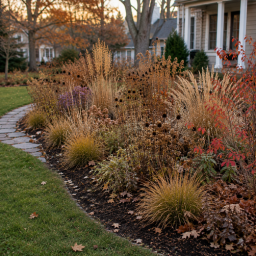
Keep the Edges Neat
One of the simplest ways to make a naturalistic planting look intentional is to maintain clear boundaries.
A defined garden edge beside a lawn, walkway, driveway, or patio tells the eye that the plants inside that space belong there.
Clear leaves and fallen stems from paths.
Trim plants that interfere with entrances or sidewalks.
Remove weeds and invasive plants.
Then allow the healthy stems, seed heads, grasses, and other plant material within the garden to remain where they can continue serving a purpose.
This combination—tidy edges with a more natural interior—can make even a winter native garden feel deliberately designed.
Let Repetition Create Structure
During summer, flowers provide much of the garden’s visual impact.
Once those flowers disappear, other design elements become much more noticeable.
Shape.
Texture.
Height.
Movement.
Repetition.
A single coneflower seed head may not seem particularly significant.
Twenty of them repeated through a planting can create rhythm.
A single stem of Little Bluestem may disappear into the landscape.
A grouping can become a beautiful sweep of copper above the snow.
Prairie Dropseed can soften the edge of a bed.
Larger native grasses can provide strong vertical structure.
Frost, snow, and low winter sunlight reveal shapes that may have been hidden by summer flowers.
This is one reason The Best Native Grasses for Michigan Gardens is such a natural companion to winter garden planning. Native grasses aren’t simply supporting players during the growing season. As flowers disappear, they can become some of the most visually important plants in the landscape.
Don’t Forget the Wildlife You’re Preparing For
We often talk about preparing plants for winter.
But we’re also preparing the garden for everything that may use it during winter.
Seed heads can continue feeding birds.
Plant material and leaf litter can provide shelter.
Standing vegetation creates structure close to the ground and above it.
And the garden remains part of a much larger habitat even when very little appears to be happening.
That connects directly with what we discussed in How to Prepare Your Garden for Fall Pollinators. Supporting wildlife isn’t something that ends when summer flowers disappear.
The resources simply change.
A flower that provided nectar in August may provide seeds later.
A plant that offered foliage during summer may provide standing structure in winter.
The garden keeps changing jobs.
Then Let Winter Do What Winter Does
Once you’ve addressed dry soil around new plants, removed significant disease problems, managed leaves where necessary, and made thoughtful decisions about what to leave standing, there may not be much else to do.
That’s okay.
Native gardening isn’t about constantly intervening.
Michigan winter will bring freezing temperatures.
Snow may flatten some plants.
Wind may break stems.
Freeze-and-thaw cycles will change the landscape.
Some seed heads will slowly empty.
Others may remain recognizable until spring.
You don’t need to keep correcting those changes.
For a garden filled with plants suited to Michigan conditions, winter isn’t an emergency.
It’s part of the cycle.
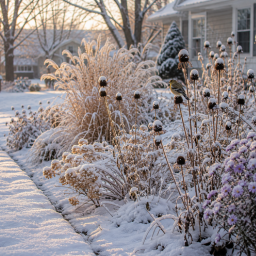
What About Heavy Snow?
When snow begins accumulating on your garden, you may be tempted to brush it from every plant.
Most dormant herbaceous native perennials don’t need that kind of attention.
Let snow settle naturally through the planting.
If heavy, wet snow or ice weighs down branches of shrubs or young trees, avoid aggressively knocking or shaking frozen branches, which can cause additional damage.
Otherwise, the perennial garden can generally be allowed to move through winter on its own.
Some stems will remain upright.
Some will bend.
Some will disappear beneath the snow entirely.
Come spring, the garden will begin again.
Spring Cleanup Doesn’t Have to Happen All at Once
Eventually, Michigan will give us one of those unexpectedly warm days that makes us want to head outside with pruners and start clearing everything away.
There’s no need to rush.
Some beneficial insects may still be sheltering in plant material, and early spring temperatures can swing dramatically from one day to the next.
Instead of thinking of spring cleanup as a single weekend project, approach it gradually.
Watch the weather.
Notice what’s emerging.
Remove material that genuinely needs attention.
And give the garden time to wake up.
As new growth begins appearing, you’ll be able to see much more clearly what needs to be cut back and what nature has already taken care of for you.
Barbara’s Gentle Reminder
Preparing a native garden for winter isn’t really about putting the garden to bed.
It’s about learning to trust it.
These plants have been responding to Michigan’s changing seasons long before they arrived in our yards.
Our job isn’t to protect them from every frost, snowfall, brown leaf, or fading flower.
Our job is to understand what they need, and resist doing things they don’t.
Water the new plant when autumn is dry.
Remove the disease problem.
Move the leaves where they can do some good.
Leave the seed head for the goldfinch.
Let the grasses catch the snow.
Then step back.
Your garden may look different from the one you enjoyed in July.
But different doesn’t mean finished.
Winter is part of the garden, too.
Happy gardening,
Barbara Fleury
Founder, Michigan Garden Design
Your Garden Has a Story.
Start Recording It.
🌱 COMPLIMENTARY FIRST MONTH 🌱
The Michigan Native Garden Journal
↓ GET YOUR COPY ↓
Observe • Discover • Wonder • Grow
🌿 Continue Growing
If you’d like to keep exploring how your Michigan garden changes through the seasons, you may also enjoy:
- How to Prepare Your Garden for Fall Pollinators
- Why Your Native Garden Gets Better Every Year
- The Best Native Grasses for Michigan Gardens
- How to Create a Pollinator Habitat in Michigan: It’s More Than Just Flowers
Coming Next:
How to Use Native Grasses in Your Michigan Garden
Flowers may get most of the attention during summer, but native grasses can completely transform a garden. Next, we’ll explore how Michigan gardeners can use native grasses to add movement, texture, structure, seasonal color, and year-round interest to residential landscapes.
Keep Exploring
For additional information about Michigan native plants, wildlife habitat, and seasonal garden care, trusted resources include: