
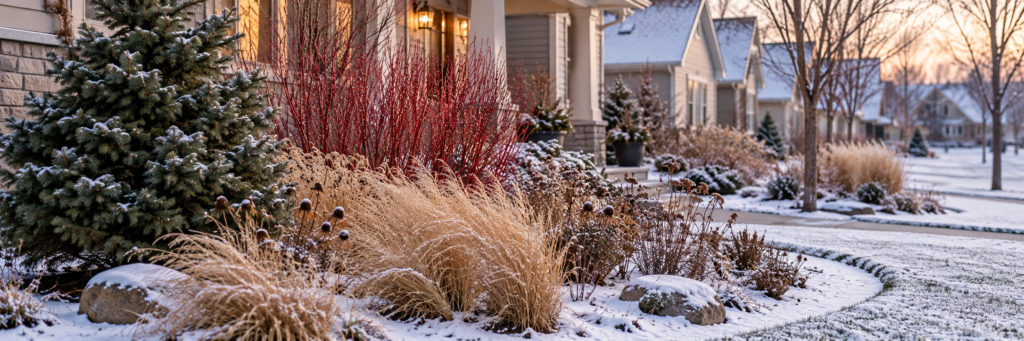
How to Add Winter Structure to Your Native Garden
There is a moment in every Michigan garden when the flowers have faded, the leaves have fallen, and the landscape begins to reveal something we may not have noticed during the growing season.
Its structure.
Without colorful blooms and lush foliage to capture our attention, we begin to see the garden differently. The shapes of its trees, the branching patterns of its shrubs, the movement of its grasses, and the spaces between plantings suddenly become much more noticeable.
For some homeowners, this is when their gardens begin to feel empty. What looked beautiful in July may seem flat and lifeless by December.
But a native garden doesn’t have to lose its beauty when winter arrives.
In fact, winter can reveal some of the most interesting qualities of a thoughtfully designed native landscape.
The secret isn’t necessarily adding more plants. It’s learning how to create a garden with enough structure to remain visually interesting long after the growing season has ended.
And in Michigan, where winter can occupy a substantial portion of our gardening year, that is an important design consideration.
Winter Beauty Begins Long Before Winter Arrives
One of the most common approaches to garden planning is choosing plants primarily for their flowers.
We imagine the purple blooms of summer, the golden colors of autumn, and the butterflies moving from one flower to another.
Those are wonderful reasons to choose native plants. But they represent only part of what a garden can offer.
When designing a garden, it’s equally important to ask:
What will this space look like when nothing is blooming?
A garden designed with winter in mind considers the shapes, heights, textures, and arrangements of plants throughout the entire year.
Think about the difference between a garden filled primarily with low-growing perennials and one that includes a small native evergreen, an interesting deciduous shrub, and several groups of upright native grasses.
Both gardens may be beautiful during summer.
But once winter arrives, the second garden has more opportunities to maintain its visual presence.
The evergreen provides a consistent shape. The shrub reveals its branching structure. The grasses introduce movement and texture.
Together, they give the eye something to follow, even beneath a blanket of snow.
This is one reason the principles explored in How to Create Garden Rooms with Native Plants are valuable beyond the growing season. Plants can define spaces and create a sense of enclosure even when their flowers and leaves are gone.
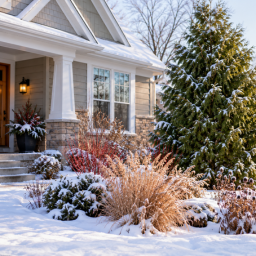
Understanding the Difference Between Winter Interest and Winter Structure
Although these terms are often used together, they aren’t quite the same thing.
Winter interest refers to the details that catch our attention during the colder months.
It might be frost collecting along a dried seed head, the reddish stems of a shrub, or a cluster of berries standing out against fresh snow.
These details bring moments of beauty to the garden.
Winter structure, on the other hand, is what gives the garden its overall form.
It comes from the arrangement of plants, the contrast between different heights, and the presence of shapes that remain recognizable throughout winter.
A mature tree may create an overhead framework. A group of shrubs can define the edge of a planting bed. Upright grasses may provide a transition between taller woody plants and lower-growing perennials.
Even the open spaces between these elements become part of the design.
The distinction matters because a garden can have plenty of winter interest without having strong winter structure.
A few beautiful seed heads may catch our attention, but they cannot always provide the visual balance that a thoughtfully arranged combination of trees, shrubs, and grasses can create.
The most inviting winter gardens often have both.
A Native Garden Doesn’t Need to Be Evergreen to Be Beautiful
When homeowners think about winter landscaping, evergreens are often the first plants that come to mind.
And understandably so.
Their year-round foliage provides dependable color and recognizable form, especially when much of the surrounding landscape has turned brown or gray.
But relying entirely on evergreens can overlook some of the most beautiful qualities of Michigan’s deciduous native plants.
Consider the delicate branching of a small tree against a pale winter sky.
Or the copper-colored blades of little bluestem standing above fresh snow.
Even the dried stems of native wildflowers can contribute texture and contrast, particularly when planted in generous groupings rather than scattered individually.
These plants remind us that winter beauty doesn’t always require the color green.
It can come from golden grasses, dark branches, textured bark, and the subtle shapes that emerge when a garden settles into dormancy.
This connects naturally with the ideas in Learning How to Trust Your Native Garden. A garden doesn’t have to look the same in every season to remain beautiful or purposeful.
Sometimes, allowing plants to complete their natural seasonal cycle reveals qualities we would otherwise miss.
Winter Structure Can Support Wildlife, Too
There is another reason to think carefully about what remains standing in the garden through winter.
The same plants that provide visual structure may also offer valuable resources for wildlife.
Native shrubs and evergreen trees can provide protective cover for birds. Standing perennial stems may offer overwintering habitat for certain insects. Seed-bearing plants can provide food for birds that remain in Michigan through the colder months.
Not every standing stem or seed head serves the same wildlife function, but a garden with varied plant forms can offer more opportunities than one that has been completely cleared.
This doesn’t mean allowing every part of the garden to become overgrown or untidy.
It means designing intentionally so that natural winter features feel like part of the landscape rather than something left behind.
A garden can be both thoughtfully arranged and ecologically welcoming.
And that balance is at the heart of gardening in harmony with nature.
Choosing Native Plants That Give Your Garden Winter Structure
Creating a beautiful winter garden doesn’t mean filling every available space with evergreens or adding an entirely new collection of plants.
Instead, think about building a few dependable layers that remain interesting after Michigan’s growing season ends.
A thoughtfully designed winter garden often includes three important elements: strong permanent shapes, interesting branching patterns, and softer textures that introduce movement.
The goal is to bring these elements together so they complement one another rather than compete for attention.
Here are some Michigan native plants that can help accomplish that.
1. Begin with Evergreens That Anchor the Landscape
Evergreens are often the most recognizable structural elements in a winter landscape.
They maintain their foliage, provide visual weight, and help define garden spaces when surrounding plants have entered dormancy.
Two Michigan native choices worth considering are:
- Eastern White-Cedar (Thuja occidentalis) — An evergreen with dense foliage that can create a year-round backdrop or natural screen. It generally prefers moist, well-drained conditions and can become a substantial tree over time.
- Eastern White Pine (Pinus strobus) — A graceful evergreen with soft needles and an open, layered appearance as it matures. Its considerable eventual size makes it better suited to properties with adequate space.
Both offer wonderful winter structure, but neither should be selected solely for how it looks when young.
An important part of thoughtful native garden design is considering the plant’s mature size and how it will relate to the home, walkways, and neighboring plants.
In smaller residential gardens, one carefully positioned evergreen may provide more balance than several crowded together.
2. Add Shrubs That Reveal Their Beauty After the Leaves Fall
Not all shrubs need leaves to be beautiful.
Some of Michigan’s native deciduous shrubs become especially interesting in winter because their colorful stems or fruit are more visible.
Consider these two examples:
Red-Osier Dogwood (Cornus sericea)
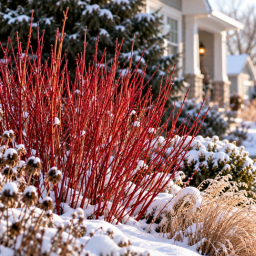
Its reddish stems can create a striking contrast against snow, particularly when several shrubs are planted together. It generally performs best where soil moisture is reasonably consistent and can spread into sizable colonies.
Winterberry (Ilex verticillata)
This deciduous holly can produce brilliant red berries that remain visible after its leaves have fallen. It favors acidic, moist soils. A compatible male plant is needed for pollination and berry production on female plants, and fruit persistence varies with wildlife activity and weather.
The key is positioning these shrubs where their winter features can be appreciated.
A grouping of red-osier dogwood against darker evergreens, for example, creates a lovely contrast.
Winterberry may be especially attractive near a window where its colorful fruit can be enjoyed from indoors.
Both are recognized among Michigan’s native landscape alternatives by the Michigan Department of Natural Resources.
3. Use Native Grasses for Movement and Texture
Trees and shrubs provide the stronger framework, but native grasses soften that structure beautifully.
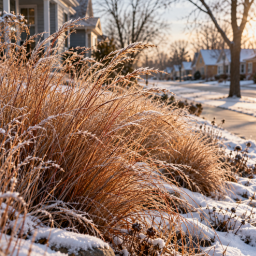
As the growing season ends, many warm-season grasses develop shades of copper, tan, and gold. Their upright stems and seed heads can remain attractive into winter, although heavy snowfall and strong winds may flatten them.
Two excellent examples are:
- Little Bluestem (Schizachyrium scoparium) — A clump-forming grass whose warm autumn and winter coloring makes it especially useful in smaller, sunny gardens with well-drained soil.
- Big Bluestem (Andropogon gerardii) — A much taller prairie grass that creates impressive vertical accents where there is sufficient space. It generally prefers full sun and may spread over time.
For the greatest visual effect, consider planting grasses in groups rather than placing single plants throughout the garden.
A small grouping of little bluestem in front of a dark evergreen can create an attractive combination of color, height, and texture.
It also gives the garden a sense of continuity between autumn and winter.
4. Allow Perennials to Contribute Their Winter Silhouettes
Some of the most interesting winter details come from plants we traditionally cut back in autumn.
The dark seed heads of black-eyed Susan (Rudbeckia hirta) can create small, attractive silhouettes, while the taller dried stems of spotted Joe-Pye weed (Eutrochium maculatum) may contribute height and texture in moist garden areas.
These features won’t provide the same dependable framework as a tree or shrub. Their appearance also changes throughout winter as weather and wildlife gradually alter them.
But that’s part of their charm.
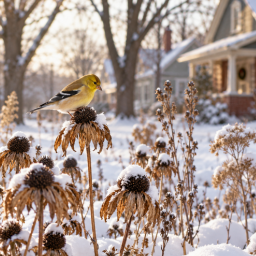
Leaving selected perennials standing can also provide seeds for birds and overwintering habitat for some insects.
The important design consideration is allowing these plants to complement the garden’s stronger structural elements rather than expecting them to carry the entire winter display.
Bringing the Layers Together
Imagine looking out a window at your native garden on a snowy January morning.
Toward the back of the planting, a native evergreen provides a deep green backdrop.
A grouping of red-osier dogwood introduces bright stems just in front of it.
Several clusters of little bluestem occupy the middle of the garden, their copper-colored blades moving gently in the wind.
Closer to the front, dried perennial seed heads add small architectural details above the snow.
Each planting has a purpose, but together they create something much more interesting.
The garden has rhythm, contrast, and balance, even without a single flower in bloom.
And perhaps most importantly, the design doesn’t depend on adding dozens of different plants.
A handful of well-chosen Michigan natives, arranged with consideration for their mature size and seasonal appearance, can make a remarkable difference.
This is where winter structure becomes more than simply choosing plants that look attractive in cold weather.
It becomes a way of designing the garden as a whole.
Creating Winter Beauty Without Redesigning Your Entire Garden
One of the most encouraging things about adding winter structure to a native garden is that you don’t necessarily have to start over.
Often, the foundation is already there.
Perhaps you have a beautiful native shrub that becomes almost invisible against the surrounding landscape in winter. Or a collection of perennials that looks wonderful during summer but leaves the garden feeling empty once their stems have fallen.
The opportunity may be as simple as adding one structural plant, repeating a grouping of grasses, or creating a stronger contrast between existing plantings.
Before making changes, spend some time observing your garden during winter.
Look at it from your front walkway, driveway, or favorite window. Notice where your eye naturally travels and where the landscape seems to lose definition.
Ask yourself whether the garden needs more height, a stronger focal point, or simply a different texture.
You might discover that a single well-placed evergreen would anchor an entire planting bed. Or perhaps a grouping of native grasses would provide just enough movement and winter color to connect the plants already growing there.
The goal isn’t to make every corner of the garden visually busy. It’s to create enough structure that the garden feels intentional, even in its quietest season.
Let Winter Structure and Natural Habitat Work Together
A beautifully designed winter garden doesn’t need to be perfectly groomed.
In fact, some of its most interesting features come from allowing native plants to remain standing through the colder months.
Dried perennial stems, seed heads, and ornamental grasses can contribute to the garden’s appearance while providing food or shelter for wildlife.
The key is thoughtful placement.
Keep walkways accessible, remove damaged branches that present safety concerns, and allow appropriate plantings to remain undisturbed where their natural forms can be appreciated.
A defined garden edge, an attractive shrub grouping, or a strong evergreen backdrop can make standing winter vegetation appear purposeful rather than neglected.
This balance allows us to maintain the welcoming appearance of our homes while honoring the seasonal needs of the natural world.
And perhaps that is one of the most rewarding aspects of native garden design.
We can create spaces that are beautiful to us while remaining useful to the wildlife that shares them.

Barbara’s Observation
I’ve come to appreciate how much a garden reveals about itself after the leaves have fallen.
During summer, flowers can easily become the center of attention. But winter allows us to see the shapes and relationships that were there all along.
Sometimes, what appears to be missing from a garden isn’t another colorful plant. It’s a sense of structure that carries the design from one season into the next.
I think there is something especially beautiful about looking across a snowy Michigan garden and seeing the graceful shapes of native grasses, the branching of a favorite shrub, or an evergreen quietly holding its place in the landscape.
The garden isn’t waiting for spring to become beautiful again.
It’s simply showing us a different kind of beauty.
Begin Your Native Garden Journey with Confidence
Whether you’re adding winter structure to an established landscape or beginning to explore native gardening for the first time, thoughtful choices can make all the difference.
Our complimentary Michigan Native Garden Starter Guide is designed to help you discover the possibilities of gardening with Michigan native plants and begin making decisions that feel right for your space.
You don’t need to transform your entire landscape at once. Sometimes, understanding where to begin is the most valuable first step.
Michigan Native Garden Starter Guide
A complimentary introduction to creating a garden that is beautiful, welcoming, and connected to nature.
GET YOUR COMPLIMENTARY GUIDE ↓
Gardening in Harmony with Nature 🌿
Keep Exploring
Continue discovering ways to create a more beautiful and purposeful Michigan native garden:
- How to Create Garden Rooms with Native Plants — Explore how plant placement and natural boundaries can bring definition to your landscape.
- The Best Native Shrubs for Michigan Gardens — Discover shrubs that offer beauty, structure, and ecological value.
- How to Prepare Michigan Native Plants for Winter — Learn how thoughtful seasonal care helps your native garden move into winter.
- Learning How to Trust Your Native Garden — Consider how allowing natural processes to unfold can change the way you experience your garden.
What’s Next?
On a winter day, choose one place where you regularly enjoy looking at your garden.
Take a photograph of the view.
Notice which plants still provide shape, where the garden feels balanced, and where a little additional structure might make a difference.
You don’t need to make any decisions immediately.
Simply observing your garden without its summer foliage can reveal opportunities that were difficult to see during the growing season.
When spring arrives, you’ll have a clearer picture of what your garden actually needs.
Coming Next: How to Design a Native Garden for Year-Round Wildlife
A garden with beautiful winter structure can offer more than visual interest.
The same thoughtful arrangements that create shelter, texture, and seasonal beauty can also help make our landscapes more welcoming to wildlife throughout the year.
In our next Michigan Garden article, How to Design a Native Garden for Year-Round Wildlife, we’ll explore how to bring together native plants and essential habitat features so birds, pollinators, and other beneficial creatures can find valuable resources as the seasons change.
Because a garden designed with nature in mind can offer something meaningful every month of the year.