
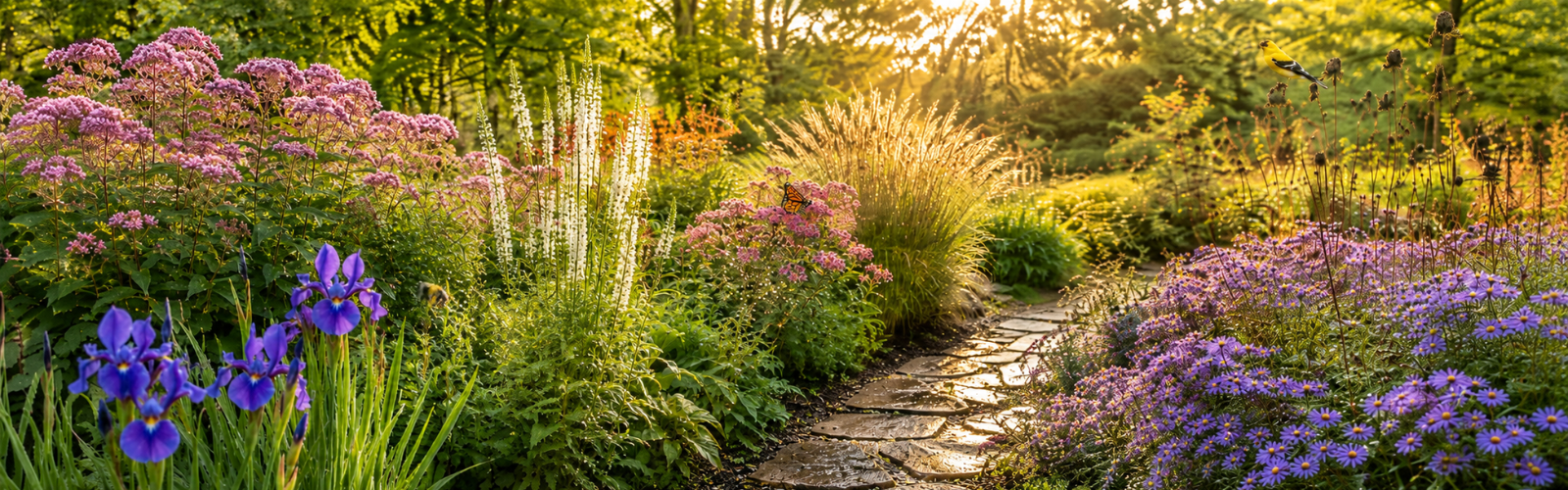
The Best Native Plants That Thrive In Clay Soil
If you’ve ever tried digging a hole in Michigan clay, you know the feeling.
Your shovel hits the ground with a thud. The soil sticks together in heavy clumps after a rain, then hardens like concrete during a dry spell. Water seems to linger in some areas, while roots struggle to spread through the dense earth.
It’s no wonder many homeowners assume they’re fighting a losing battle.
The good news is that clay soil isn’t the problem it’s often made out to be.
In fact, some of Michigan’s most beautiful native plants naturally thrive in clay soils. For thousands of years, they have adapted to our state’s heavy soils, seasonal moisture, freezing winters, and warm summers. Rather than struggling against these conditions, they use them to their advantage.
Instead of spending years trying to change your soil, you can often achieve better results by choosing plants that already love growing there.
In this guide, you’ll discover the best native plants that thrive in clay soil, why they perform so well in Michigan landscapes, and how working with your soil, instead of constantly fighting it, can lead to a healthier, lower-maintenance, and more beautiful garden.
Clay Soil Isn’t the Enemy
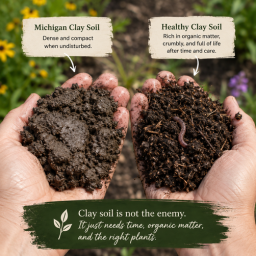
Clay soil has earned an unfair reputation.
While it certainly presents challenges, it also offers several advantages that many gardeners overlook.
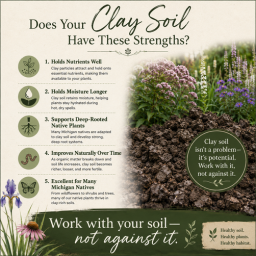
Because clay particles are extremely small, they hold nutrients remarkably well. They also retain moisture longer than sandy soils, helping plants weather periods of summer drought.
Of course, clay isn’t perfect.
Water drains more slowly through dense soils, especially if the ground has become compacted over many years. Newly planted gardens may stay wet after heavy rains, and digging can require a little more patience.
But these characteristics don’t automatically make clay “bad.”
They simply mean you need the right plants.
Many Michigan native species evolved in clay-rich prairies, woodland edges, wetlands, and river corridors where these exact soil conditions have existed for thousands of years.
When you match the plant to the site, gardening becomes significantly easier.
Should You Amend Clay Soil?
One of the most common questions gardeners ask is whether they should replace their clay soil before planting.
In most cases, the answer is no.
While incorporating compost throughout an entire planting bed can gradually improve soil structure, excavating large holes and filling them with loose garden soil often creates more problems than it solves.
Imagine placing a bowl into the ground.
Now fill that bowl with soft, amended soil while leaving the surrounding ground as dense clay.
After a heavy rain, water may collect inside that planting hole because it cannot move quickly into the surrounding soil. Gardeners often refer to this as the “bathtub effect.” Instead of encouraging healthy roots, you’ve unintentionally created a pocket where excess moisture lingers.
A better approach is to loosen the surrounding soil, add organic matter where appropriate, and allow your native plants to gradually establish themselves into the existing soil.
Those deep root systems are exactly what make native plants so resilient over time.
For additional guidance on improving Michigan soils, Michigan State University Extension offers excellent information on soil health, compost, and planting practices.
Why Native Plants Excel in Clay Soil
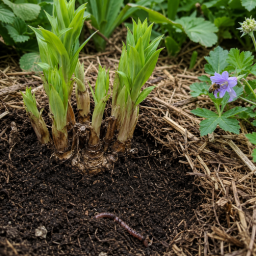
One of the greatest strengths of native plants is that they evolved right here.
Long before neighborhoods, lawns, and landscape beds existed, Michigan’s natural landscapes included heavy clay soils across much of the Lower Peninsula.
Native plants adapted in remarkable ways.
Some developed deep taproots capable of penetrating dense ground.
Others formed extensive fibrous root systems that stabilized heavy soils while improving drainage over time.
Many tolerate both the wet conditions of spring and the drier periods that often arrive later in summer.
That’s one of the reasons established native gardens become increasingly resilient with each passing year.
Rather than constantly needing fertilizer, irrigation, or soil replacement, they simply continue doing what they’ve done for centuries.
If you’ve read our previous article, How to Know If Your Native Plants Are Happy, you already know that one of the clearest signs of success is steady, healthy growth over time. Choosing plants that naturally fit your site’s conditions makes that success much easier to achieve.
The Best Native Perennials That Thrive in Clay Soil
Fortunately, clay soil doesn’t limit your choices.
Some of Michigan’s most spectacular native wildflowers actually perform best in these conditions.
Here are a few outstanding perennials to consider.
Blue Flag Iris (Iris versicolor)
If your clay soil tends to remain consistently moist, Blue Flag Iris is difficult to beat.
Its elegant blue-violet flowers bloom in late spring while its upright, sword-like foliage provides structure throughout the growing season.
Blue Flag Iris is especially well suited to rain gardens, pond edges, low-lying areas, and any location where water occasionally collects.
It’s also an excellent choice for supporting native pollinators while adding early-season color.
Swamp Milkweed (Asclepias incarnata)
Despite its name, Swamp Milkweed performs beautifully in average garden conditions as long as the soil retains moderate moisture.
Its fragrant pink flower clusters attract monarch butterflies, native bees, hummingbirds, and countless other pollinators during midsummer.
Few native plants combine beauty and ecological value as effectively.
Joe-Pye Weed (Eutrochium maculatum)
Looking for height?
Joe-Pye Weed produces impressive stems topped with large, soft pink flower clusters that become magnets for butterflies in late summer.
Growing five to seven feet tall, it creates a dramatic backdrop while thriving in fertile clay soils that hold moisture.
Its towering blooms also provide excellent late-season nectar when many other flowers are beginning to fade.
Culver’s Root (Veronicastrum virginicum)
One of Michigan’s most elegant native perennials, Culver’s Root sends graceful white flower spikes high above rich green foliage during early summer.
Its architectural form adds vertical interest while attracting an impressive variety of native bees and butterflies.
Once established, it’s remarkably dependable in heavier soils.
New England Aster (Symphyotrichum novae-angliae)
As summer gives way to fall, New England Aster bursts into bloom with vibrant purple flowers surrounding bright golden centers.
It thrives in clay soils, provides one of the final major nectar sources of the growing season, and supports migrating monarch butterflies along with numerous late-season pollinators.
Few plants finish the gardening season with more color.
More Native Perennials That Love Clay Soil
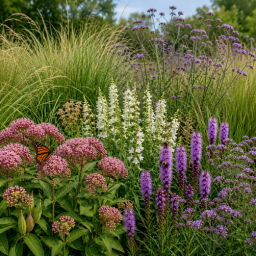
The beauty of native gardening is that you aren’t limited to just a handful of plants. Michigan’s native landscapes offer an incredible variety of flowers that perform beautifully in heavier soils while supporting pollinators from spring through fall.
Here are several more outstanding choices.
Cardinal Flower (Lobelia cardinalis)
Few native plants create a stronger visual impact than Cardinal Flower.
Its brilliant red flower spikes bloom from midsummer into early fall, attracting hummingbirds along with numerous native bee species. Cardinal Flower naturally grows in moist soils and performs especially well in clay soils that retain consistent moisture.
Plant it where the soil doesn’t completely dry out during summer for the best performance.
Boneset (Eupatorium perfoliatum)
Often overlooked, Boneset is one of the hardest-working plants in a pollinator garden.
Its clusters of creamy white flowers bloom in late summer and attract an astonishing diversity of butterflies, bees, beneficial wasps, and other pollinating insects.
Because it naturally grows in moist meadows and low areas, Boneset is perfectly adapted to heavier Michigan soils.
Blue Vervain (Verbena hastata)
With elegant spikes of violet-blue flowers rising above upright stems, Blue Vervain brings graceful height and movement to native gardens.
Its long bloom period makes it an excellent nectar source during midsummer while thriving in moist clay soils.
When planted in groups, Blue Vervain creates a beautiful naturalistic effect that pairs well with native grasses.
Great Blue Lobelia (Lobelia siphilitica)
A close relative of Cardinal Flower, Great Blue Lobelia produces striking blue blossoms that brighten partially shaded gardens.
It tolerates clay soils exceptionally well and provides valuable late-season nectar for native bees and butterflies.
Its cool blue flowers also create a beautiful contrast with golden Black-eyed Susans or the purple blooms of New England Aster.
Fox Sedge (Carex vulpinoidea)
Although technically a sedge rather than a perennial flower, Fox Sedge deserves a place in many clay soil gardens.
Its graceful foliage provides texture throughout the season while helping stabilize soil and filter runoff.
It performs particularly well in rain gardens, swales, and low areas where clay soils tend to remain moist.
Native Grasses That Thrive in Clay Soil
Native grasses are often overlooked, but they’re some of the hardest-working plants in the landscape.
Their extensive root systems improve soil structure, reduce erosion, provide wildlife habitat, and add movement and beauty throughout the year.
Switchgrass (Panicum virgatum)
Switchgrass is one of Michigan’s most adaptable native grasses.
Its upright form, airy seed heads, and beautiful golden fall color make it an outstanding structural plant for clay soils.
Once established, its roots extend several feet into the ground, gradually improving soil health while increasing drought tolerance.
Prairie Cordgrass (Spartina pectinata)
If you have an area that remains consistently wet, Prairie Cordgrass is an excellent solution.
Its bold, arching foliage provides year-round interest while tolerating both standing water and dense clay soils.
It’s especially useful in larger landscapes where erosion control is important.
Little Bluestem (Schizachyrium scoparium)
Although Little Bluestem prefers well-drained locations, it adapts surprisingly well to many clay soils once established, provided drainage is reasonable.
Its blue-green summer foliage transforms into stunning shades of copper, orange, and burgundy during autumn.
The fluffy seed heads also provide winter interest while feeding birds.
Native Shrubs for Clay Soil
Native shrubs add structure, privacy, seasonal interest, and wildlife habitat while handling many clay soil conditions with ease.
Buttonbush (Cephalanthus occidentalis)
If your clay soil tends to remain moist, Buttonbush is one of the finest shrubs you can grow.
Its unique spherical white flowers attract an incredible variety of butterflies and native bees throughout the summer.
The interesting seed heads also provide winter interest while supporting birds and other wildlife.
Red Twig Dogwood (Cornus sericea)
Beautiful in every season, Red Twig Dogwood thrives in clay soils and becomes especially striking during winter when its bright red stems stand out against snow-covered landscapes.
It also provides nesting habitat, berries for birds, and attractive white flowers in spring.
Ninebark (Physocarpus opulifolius)
Ninebark is one of the toughest native shrubs available.
It tolerates clay soils, drought, heat, and cold while producing clusters of white flowers in late spring.
Its exfoliating bark creates year-round interest, especially in winter landscapes.
Designing with Clay Soil in Mind
Rather than scattering individual plants throughout the landscape, consider planting in generous groupings.
Nature rarely arranges plants one at a time.
Drifts of five, seven, or even nine plants create a much stronger visual impact while making it easier for pollinators to locate nectar sources.
Combining flowering perennials with native grasses and shrubs also creates the layered structure found in natural Michigan habitats.
If you’ve already read our article Creating a Beautiful Native Garden with Layers, you’ve seen how these different plant heights work together to create landscapes that feel both beautiful and naturally balanced.
Thoughtful layering becomes even more effective when each plant is growing in soil it naturally prefers.
Creating a Beautiful Clay Soil Garden
The secret to designing with clay soil isn’t simply choosing plants that survive.
It’s combining plants that complement one another throughout the seasons.
Imagine this planting combination:
In spring, Blue Flag Iris and Foxglove Beardtongue begin the show.
Summer brings Mountain Mint, Culver’s Root, Joe-Pye Weed, and Swamp Milkweed into bloom.
Late summer transitions to Marsh Blazing Star, Ironweed, and New England Aster.
Throughout it all, Switchgrass and Little Bluestem provide structure, movement, and beautiful autumn color.
Instead of isolated flowers, you’ve created a living community that offers beauty from spring through winter.
That’s exactly how native landscapes were designed by nature.
A Garden That Improves Every Year
One of my favorite things about native gardens is that they rarely peak in their first season.
Instead, they become more beautiful with time.
Roots grow deeper.
Plants spread naturally.
Pollinators discover new nectar sources.
Birds learn where to find seeds and shelter.
Even the soil itself begins to change as roots, earthworms, and beneficial microorganisms gradually improve its structure.
Every growing season builds upon the last.
That’s one of the greatest rewards of choosing native plants that naturally fit your site.
Rather than constantly replacing struggling plants, you’re investing in a landscape that becomes healthier, more resilient, and easier to care for with each passing year.
Happy Gardening!
Clay soil isn’t something to overcome.
It’s simply one of Michigan’s many natural landscapes.
When you choose plants that have evolved to thrive in these conditions, gardening becomes less about correcting problems and more about enjoying the remarkable process of watching nature do what it has always done best.
Every new bloom.
Every visiting bee.
Every goldfinch gathering seed.
Every season of growth.
They’re all reminders that the best gardens aren’t created by changing the land beneath our feet.
They’re created by understanding it.
Happy gardening,
Barbara
Michigan Garden Design
🌿 Continue Growing
Coming Next:
Designing a Four-Season Michigan Garden
You’ve discovered some of the best native plants for Michigan’s clay soils. But choosing the right plants is only the first step.
The real magic happens when those plants are thoughtfully combined into a landscape that offers beauty, structure, and wildlife habitat throughout the entire year.
In our next article, we’ll explore how to design a native Michigan garden that shines in every season using trees, shrubs, grasses, seedheads, bark, berries, and perennial flowers.
Continue Exploring
If you enjoyed this article, you may also like:
I am a new gardener who is interested in landscaping with natives. This guide was incredibly helpful in understanding my soil and the native plants I should look for!
Jessica, thank you so much for your kind words! Reading your comment absolutely made my day.
I’m especially happy to hear the guide helped you better understand your clay soil and gave you a starting point for choosing native plants. Every experienced gardener was once a beginner, and one of my goals with Michigan Garden Design is to make native gardening feel approachable and enjoyable for everyone.
Wishing you the very best as you begin creating your garden, and I hope you’ll continue to visit as new articles are published. If questions come up along the way, don’t hesitate to ask. I’m always happy to help.
Happy gardening!
Barbara