
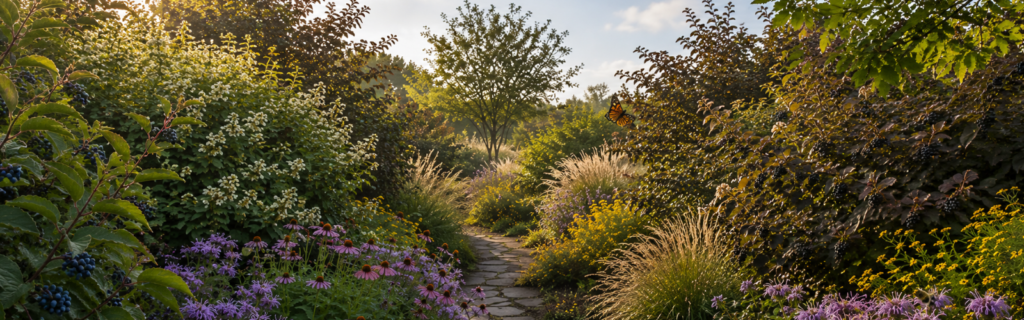
Best Native Shrubs for Privacy and Wildlife
Beautiful Native Shrubs That Create Habitat, Structure, and Year-Round Interest
When most people think about creating privacy in their landscape, they immediately picture a row of evergreen shrubs.
It’s understandable.
Evergreens have long been the traditional solution for screening views and defining property lines.
But what if privacy could do more?
What if the plants creating privacy in your yard also provided food for birds, shelter for pollinators, seasonal beauty, and valuable habitat for wildlife?
That’s where native shrubs shine.
Many of Michigan’s native shrubs offer much more than a visual screen. They provide flowers for pollinators, berries for birds, cover for nesting wildlife, and beautiful seasonal changes throughout the year.
In many ways, shrubs are the unsung heroes of a native landscape.
They help connect trees to perennials.
They provide structure during winter.
And they often become some of the hardest-working plants in the entire garden.
Why Shrubs Matter More Than You Think
In our previous article, Creating a Beautiful Native Garden with Layers, we explored the importance of layering plants to create depth and visual harmony.
Shrubs occupy one of the most important layers in that system.
They form the middle layer between trees and lower-growing perennials.
Without shrubs, gardens can sometimes feel incomplete.
With them, gardens gain structure, texture, and a sense of permanence.
Shrubs also provide something many wildlife species need desperately: cover.
While flowers may feed pollinators and trees may provide nesting sites, shrubs often serve as the safe spaces in between.
Birds seek shelter within their branches.
Pollinators visit their flowers.
Wildlife uses them as travel corridors and protective cover.
The result is a garden that feels more alive.
🌿 Garden Tip
If you’re trying to increase wildlife activity in your yard, adding a few well-placed native shrubs will often have a greater impact than adding several more flowering perennials.
What Makes a Great Privacy Shrub?
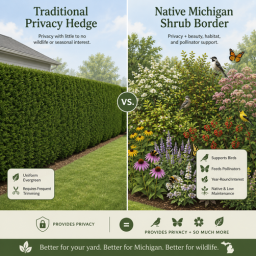
Not every shrub is ideal for privacy.
The best privacy shrubs generally share a few characteristics:
- Dense branching
- Multi-season interest
- Adaptability to local conditions
- Wildlife value
- Attractive natural form
The good news is that many Michigan native shrubs excel in all five areas.
And unlike some traditional landscape shrubs, they support the local ecosystem while they grow.
Black Chokeberry
One of Michigan’s Most Versatile Native Shrubs
If I could recommend only one native shrub to a beginning gardener, Black Chokeberry (Aronia melanocarpa) would be near the top of the list.
This adaptable shrub provides:
- White spring flowers
- Glossy summer foliage
- Brilliant red fall color
- Persistent berries for wildlife
It also tolerates a surprisingly wide range of conditions.
Wet soil.
Average soil.
Periods of drought once established.
Few native shrubs are as flexible.
Its dense growth habit makes it particularly useful in privacy plantings and property borders.
Silky Dogwood
A Wildlife Magnet
One shrub that deserves far more attention in Michigan landscapes is Silky Dogwood (Cornus amomum).
In fact, many gardeners discover that birds find Silky Dogwood long before people do.
The blue berries produced in late summer are highly attractive to numerous bird species.
Its dense branching structure also creates valuable cover throughout the growing season.
For gardeners interested in supporting wildlife, few shrubs offer such a complete package:
- Pollinator-friendly flowers
- Bird-attracting berries
- Excellent shelter value
- Attractive natural form
The Michigan Natural Features Inventory frequently highlights the importance of native shrubs like dogwoods within healthy Michigan ecosystems because of the habitat they provide for wildlife.
St. John’s Wort
Small Shrub, Big Impact
Not every privacy planting requires large shrubs.
Sometimes a smaller shrub can play an important supporting role.
Kalm’s St. John’s Wort (Hypericum kalmianum) is one of my favorite examples.
Its bright yellow summer flowers attract pollinators and add long-lasting color to the landscape.
The compact size makes it particularly useful in:
- Foundation plantings
- Smaller yards
- Mixed shrub borders
- Pollinator gardens
While it won’t create a six-foot privacy screen, it contributes beautifully to layered plantings and helps fill the important middle layer between groundcovers and larger shrubs.
Its tidy growth habit also makes it approachable for gardeners who are just beginning to explore native landscaping.
Privacy Doesn’t Have to Mean Isolation
One of the things I appreciate most about native shrubs is that they create a sense of enclosure without making a space feel closed off.
A thoughtfully placed grouping of shrubs can:
- Define outdoor rooms
- Soften property lines
- Screen undesirable views
- Provide wildlife habitat
- Create seasonal beauty
All at the same time.
And unlike a fence, shrubs continue to evolve and become more beautiful with each passing year.
In many ways, they help transform a yard into a living landscape.
More Native Shrubs Worth Considering
Michigan gardeners are fortunate to have a wide variety of native shrubs available, each offering its own combination of beauty, habitat value, and landscape function.
The best choice often depends on your goals.
Are you hoping to create privacy?
Support pollinators?
Feed birds?
Add four-season interest?
Fortunately, many native shrubs accomplish several of these goals at once.
New Jersey Tea
Small Shrub, Huge Ecological Value
New Jersey Tea (Ceanothus americanus) may be one of Michigan’s most underappreciated native shrubs.
Growing only three to four feet tall, it won’t create a traditional privacy screen on its own.
What it does provide is exceptional ecological value.
Its fragrant white flowers attract a wide variety of native bees, butterflies, and other pollinators throughout the summer.
The plant also serves as a host plant for several butterfly and moth species.
This makes it an excellent choice for sunny locations where other shrubs may struggle.
If you’d like to learn more about New Jersey Tea and the pollinators it supports, the Lady Bird Johnson Wildflower Center Native Plant Database offers an excellent plant profile.
Ninebark
Four Seasons of Interest
If you’re looking for a shrub that remains attractive throughout the year, Ninebark (Physocarpus opulifolius) deserves serious consideration.
This adaptable native shrub offers:
- Attractive exfoliating bark
- Clusters of white spring flowers
- Pollinator value
- Interesting seed heads
- Winter texture
Its arching branches create a natural, informal appearance that works beautifully in wildlife-friendly landscapes.
Ninebark can also provide a substantial visual screen when planted in groups.
For gardeners seeking a balance between privacy and habitat value, it’s one of the strongest options available.
Buttonbush
A Pollinator Favorite
Some shrubs seem to buzz with life.
Buttonbush (Cephalanthus occidentalis) is one of them.
Its unique spherical flowers attract an astonishing variety of pollinators.
Bees.
Butterflies.
Beneficial insects.
Even hummingbirds occasionally visit.
Buttonbush naturally grows in moist conditions and is particularly useful near:
- Rain gardens
- Pond edges
- Wet areas
- Low spots in the landscape
If you’re interested in exploring additional native shrubs that perform well in Michigan landscapes, Michigan State University Extension has an excellent guide featuring many of the species discussed in this article.
In the proper location, it becomes one of the most valuable wildlife shrubs you can grow.
🌿 Garden Tip
When selecting shrubs, don’t focus only on mature height.
Consider flowers, berries, fall color, winter structure, and wildlife value as well.
The most successful shrubs often provide benefits in every season.
Building a Native Privacy Screen
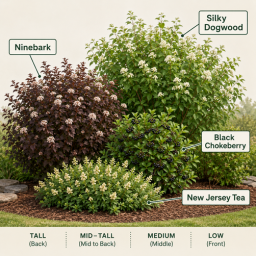
One of the biggest mistakes gardeners make is planting a single shrub species in a straight line.
While this creates uniformity, it often lacks the beauty and ecological value found in natural landscapes.
Instead, consider combining multiple native shrubs.
For example:
Layer One
- Ninebark
- Silky Dogwood
Layer Two
- Black Chokeberry
- St. John’s Wort
Layer Three
- New Jersey Tea
This creates a privacy planting that feels more natural while supporting a wider variety of wildlife.
It also reduces the risk of losing an entire screen to a pest or disease issue affecting a single species.
Nature rarely relies on monocultures.
Our gardens don’t need to either.
Shrubs and Four-Season Beauty
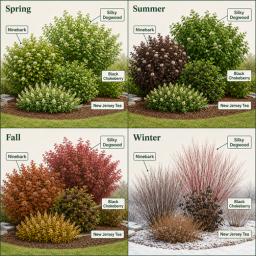
One of the greatest strengths of native shrubs is that they continue contributing long after flowers fade.
Spring may bring blossoms.
Summer brings foliage and wildlife activity.
Fall often delivers colorful berries and vibrant foliage.
Winter reveals branch structure, bark texture, and persistent seed heads.
This is one reason shrubs are so valuable in garden design.
They provide continuity.
They help anchor the landscape throughout the year.
And they remind us that a beautiful garden isn’t defined by a single season.
The best gardens remain interesting month after month.
Thinking Beyond the Property Line
Privacy screens are often designed with a simple goal:
Hide something.
A neighboring house.
A road.
A fence.
But native shrubs allow us to think differently.
Instead of merely blocking a view, they help create habitat.
They soften transitions.
They support wildlife.
And they contribute to a healthier ecosystem.
That’s a very different approach to privacy.
And in my experience, it’s often a far more rewarding one.
Common Native Shrub Mistakes
The good news is that native shrubs are generally forgiving plants.
The challenge isn’t usually keeping them alive.
The challenge is using them effectively.
Here are a few common mistakes worth avoiding.
Planting Too Far Apart
It’s natural to space shrubs based on how they look at planting time.
The problem?
Most newly planted shrubs look small.
Very small.
Gardeners often leave large gaps between shrubs, only to spend years waiting for the planting to fill in.
Instead, plan for the mature size of the shrub and envision how the planting will look in five or ten years rather than five or ten weeks.
Ignoring Mature Height and Width
Every gardener has experienced it.
A shrub is planted in the perfect location.
A few years later, it has outgrown the space.
Before planting, always consider:
- Mature height
- Mature width
- Sun requirements
- Soil conditions
Before selecting a shrub, I also recommend reviewing its mature size and growing requirements using the Missouri Botanical Garden Plant Finder, one of the most respected horticultural databases available.
A little planning now can prevent years of pruning later.
Treating Shrubs Like Decorations
Shrubs are often installed as isolated specimens surrounded by mulch.
While this can work, native shrubs often look best when integrated into a layered planting.
Surrounding shrubs with:
- Native grasses
- Flowering perennials
- Groundcovers
creates a more natural appearance and increases ecological value.
Remember:
A shrub doesn’t need to stand alone to stand out.
🌿 Garden Tip
Think in groups rather than individual plants.
Nature rarely plants one shrub by itself.
Repeating shrubs in drifts or clusters often creates a stronger visual impact.
Where Should Native Shrubs Be Placed?
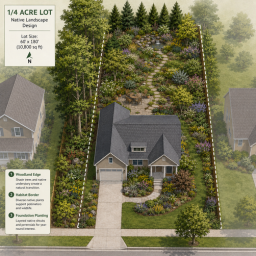
One of the easiest ways to improve a landscape is to think strategically about shrub placement.
Native shrubs work particularly well:
Along Property Lines
Creating soft privacy and habitat corridors.
Near Outdoor Living Spaces
Providing enclosure and a sense of intimacy without creating walls.
Along Woodland Edges
Helping transition between open lawn and wooded areas.
Around Water Features
Supporting birds, pollinators, and amphibians while creating a more natural appearance.
As Part of Layered Garden Beds
Connecting trees, perennials, grasses, and groundcovers.
The goal is not simply to fill space.
The goal is to create relationships between plants.
A Garden Designer’s Perspective
One of the most common questions I hear is:
“What is the best shrub?”
The truth is that there isn’t a single answer.
The best shrub depends on:
- The site
- The purpose
- The surrounding plants
- The wildlife goals
What matters most is choosing shrubs that belong in the larger composition.
A thoughtfully placed Black Chokeberry may provide more value than a dozen randomly selected plants.
A grouping of Silky Dogwoods may transform a habitat area.
A single Serviceberry paired with native shrubs can create structure that lasts for decades.
Good design is rarely about finding the perfect plant.
It’s about helping plants work together.
Why Native Shrubs Are Worth the Investment
Trees often receive the attention.
Flowers often receive the compliments.
But shrubs quietly hold everything together.
They provide:
- Structure
- Habitat
- Privacy
- Seasonal beauty
- Ecological value
And they do so year after year.
As they mature, many become even more beautiful and more valuable to wildlife.
In many ways, native shrubs are one of the smartest long-term investments a gardener can make.
🌿 Coming Next
One of the most common questions I hear during Michigan summers is:
“How much should I water my native plants?”
The answer may surprise you.
In our next Michigan Garden article, What Is the Best Formula for Watering Native Plants, we’ll explore how watering changes during establishment, why overwatering can be just as harmful as underwatering, and how to encourage deeper, healthier root systems.
Understanding how native plants use water is one of the most important steps toward creating a resilient, low-maintenance garden.
🌿 Continue Growing
If you enjoyed this article, you may also enjoy:
• Creating a Beautiful Native Garden with Layers
• The Best Native Grasses for Michigan Gardens
• Do You Really Need Fertilizer? A Michigan Perspective
• How to Create a Pollinator Friendly Garden in Michigan
• Beautiful Ground Covers That Thrive in Michigan
🌿 A Final Thought
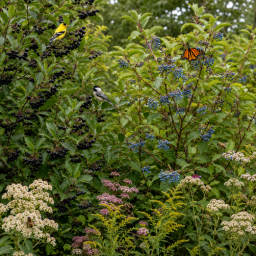
When most people think about wildlife gardening, they think about flowers.
And flowers certainly matter.
But many birds, pollinators, and beneficial insects depend just as much on shrubs.
A flowering shrub provides nectar.
A fruiting shrub provides food.
A dense shrub provides shelter.
And together, they help transform a garden into habitat.
That’s one reason I encourage gardeners to look beyond individual blooms and think about the larger landscape.
Native shrubs may not always be the stars of the show.
But they’re often the plants that make everything else possible.
Happy gardening,
Barbara 🌿
Michigan Garden Design